
India added an estimated 200,000 new pickleball players between 2022 and 2024 – making it one of the fastest-growing racket sports markets in Asia. From Bengaluru tech parks to Mumbai’s newly built multi-sport complexes, courts are filling up fast. Yet for all this enthusiasm, one question trips up players at every level: which pickleball balls should I actually be using? Understanding the right pickleball balls in India isn’t just a technicality – it can be the difference between a fluid rally and a frustrating afternoon on a cracked cement court.
What Makes a Pickleball Ball Different From Other Sports Balls?
At first glance, a pickleball ball looks deceptively simple – a hollow plastic sphere roughly the size of a baseball, punched through with holes. But that description undersells a surprisingly precise piece of sports engineering.
Pickle balls are manufactured from injection-moulded thermoplastic polymers, most commonly a durable form of polyethylene or polypropylene. The ball must conform to standards set by USA Pickleball (the global benchmark), which mandates a diameter between 2.87 and 2.97 inches, a weight between 0.78 and 0.935 ounces, and a bounce height between 30 and 34 inches when dropped from 78 inches onto a granite surface.
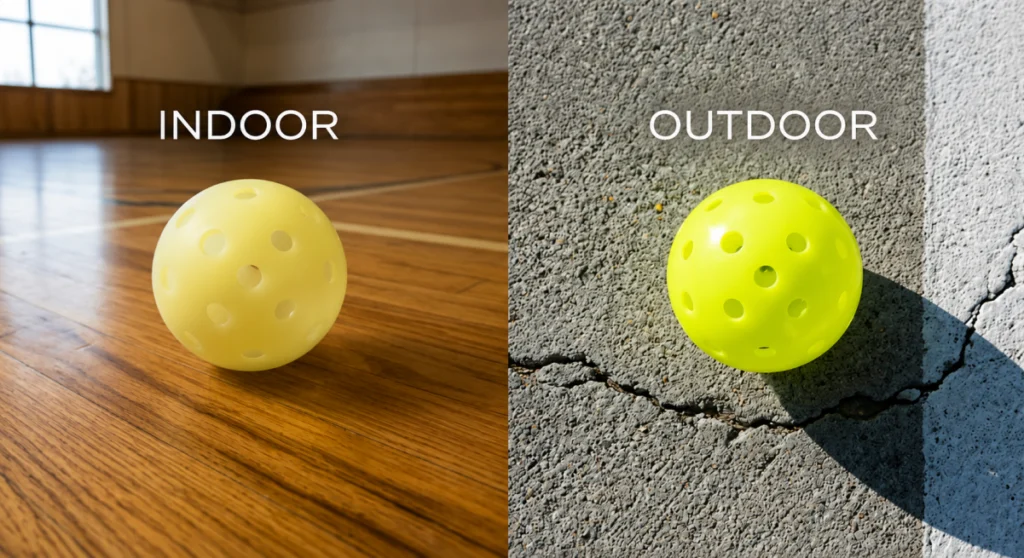
Here is where it gets interesting for the Indian player: the number, size, and arrangement of holes, as well as the hardness of the plastic, vary significantly between balls designed for indoor play and those engineered for outdoor courts. These aren’t cosmetic differences. They fundamentally alter flight dynamics, bounce behaviour, speed, and durability – all of which matter enormously on India’s diverse playing surfaces. If you’re new to the sport, it helps to first understand what pickleball ball is and how it’s played before diving into equipment choices.
Indoor Pickleball Ball – Built for Controlled Environments
Indoor pickleball ball are the softer, lighter, and – in the eyes of many beginners – more forgiving of the two types. They are typically constructed from a softer, more pliable plastic and feature 26 larger holes spread evenly across the surface.
The larger holes reduce aerodynamic drag inside windless, enclosed spaces – which is exactly the environment for which they are designed. The result is a slower, more predictable flight path and a lower, softer bounce. For players learning to develop their dink game or working on third-shot drops, an indoor ball can be genuinely instructive: it gives you a fraction more time to read and react.
In practical terms, indoor balls perform best on smooth wooden gymnasium floors – the kind found in school sports halls, college multipurpose auditoriums, and the growing number of dedicated indoor pickleball facilities opening across Indian metros. Chennai, Pune, Hyderabad, and Delhi-NCR have all seen a marked increase in climate-controlled indoor courts over the past two years, driven partly by the summer heat that makes outdoor play difficult from March through June.
The trade-off is durability. The softer plastic that makes indoor balls so playable indoors also makes them susceptible to cracking on rougher surfaces. Take an indoor ball onto a concrete court even once, and the abrasion can compromise its structural integrity within a single session.
Outdoor Pickleball Ball – Engineered for the Elements
An outdoor pickleball ball is designed to withstand hard court surfaces, wind, and changing weather conditions.
Step outside onto any public park, residential society compound, or sports authority facility in India, and the courts you will find are almost universally concrete or asphalt – hard, unforgiving, and fully exposed to the elements. This is the world outdoor pickleballs are built for.
Outdoor balls use a harder, stiffer plastic and are drilled with 40 smaller holes. The physics are straightforward: fewer, smaller holes mean reduced wind drag, which gives the ball a more stable trajectory even in the breezy conditions common near India’s coastal cities. The harder plastic produces a higher, more energetic bounce off rough surfaces and holds up against the abrasion that would destroy an indoor ball in minutes.
Speed is another key distinction. Outdoor balls travel faster, reward harder drives, and tend to favour players with stronger groundstrokes – a natural fit for the aggressive, power-forward style that many Indian players, coming from badminton and tennis backgrounds, naturally gravitate toward.
The Indian climate, however, presents a particular challenge. Summer temperatures in cities like Nagpur, Ahmedabad, or Delhi regularly cross 42°C, which causes harder plastics to become marginally more brittle – increasing the risk of cracking mid-rally. Monsoon humidity, on the other hand, can cause the ball surface to become slightly tacky, subtly altering grip and spin dynamics. Serious outdoor players in India would do well to store balls away from direct sunlight between sessions and to inspect them regularly for the hairline cracks that signal the end of a ball’s useful life.
Indoor vs Outdoor – Head-to-Head Comparison
Understanding the difference between the two ball types is easier when the key variables are laid out side by side.
Weight: Both types fall within the same regulatory range (0.78-0.935 oz), but outdoor balls tend to sit toward the heavier end due to their denser plastic composition, giving them slightly more momentum through the air.
Hole Count: Indoor balls carry 26 larger holes; outdoor balls carry 40 smaller holes. This single design choice drives most of the performance differences between the two.
Hardness: Indoor balls are noticeably softer to the touch – you can flex them slightly under firm hand pressure. Outdoor balls are rigid and will not flex.
Bounce: Indoor balls produce a lower, softer bounce suited to the smooth wooden floors of sports halls. Outdoor balls deliver a higher, sharper bounce that suits concrete and asphalt.
Ideal Surface: Indoor balls belong on smooth gym floors; outdoor balls are built for hard courts of concrete, asphalt, or textured sport tiles – the dominant surface type across India.
Durability: Outdoor balls, despite their harder construction, are generally more durable on outdoor surfaces. Indoor balls will crack quickly on rough outdoor courts, making surface-matching a non-negotiable.
Which Ball Should Indian Players Use?
The honest answer for the vast majority of Indian players is: start with an outdoor ball.
The reality of the Indian playing landscape is that most available courts – in parks, housing societies, school grounds, and municipal sports complexes – are outdoor hard courts. An outdoor pickleball ball will survive these surfaces, perform consistently across India’s weather extremes, and suit the fast-paced, power-oriented game that most Indian players quickly develop.
Beginner players should not overthink this. Any AIPA-approved outdoor ball will serve well. Focus on court time over equipment nuance. For a full rundown of everything you need to get started, see our essential pickleball equipment guide for India.
Club and intermediate players who have access to both indoor and outdoor facilities should invest in both types and keep them separate. Using the correct ball for each surface dramatically improves play quality and extends equipment life.
Competitive and tournament players should note that most sanctioned events in India currently use outdoor balls – typically the Dura Fast 40 or the Franklin X-40 – regardless of whether the tournament is held indoors or outdoors. If you are preparing for competition, train with a ball that matches tournament specifications. For more detailed guidance on equipping yourself fully for the Indian game, see our guide to the best pickleball paddles available in India.
One final note: if you are buying balls online, ensure the listing specifies outdoor or indoor use and confirms USA Pickleball approval. The Indian market has seen a rise in uncertified balls that may not meet weight or bounce standards – a small but meaningful handicap for developing players.
Buying Guide: What to Look for When You Buy Pickleball Balls in India
If you are ready to buy pickleball balls in India, here is what to check before clicking purchase:
AIPA Pickleball Approval: Look for the “APPROVED” mark. This confirms the ball meets international standards for diameter, weight, bounce, and roundness. Non-approved balls teach your body the wrong physics.
Seam Construction: Quality balls are seamless or have a single, imperceptible seam. A prominent seam line creates a wobble mid-flight and is a sign of lower manufacturing precision.
Colour for Indian Conditions: High-visibility yellow is the global standard and performs best in India’s bright, high-contrast outdoor light. White balls can be harder to track against a pale-sky background during midday play.
Pack Quantity: For outdoor play on rough Indian courts, buying in packs of 6 is more economical than single-ball purchases – you will crack and rotate through balls faster than you expect.
Brand Reputation: The Franklin X-40 and Dura Fast 40 are internationally the most trusted outdoor balls. For the right paddle to pair with your ball choice , matching your equipment to your playing level and surface makes a measurable difference in your development.
Paddle Pairing: Your ball choice should match your paddle specs. Read our guide on how to choose the right pickleball paddle in India, and if you’re weighing material options, our carbon fiber vs fiberglass paddle breakdown covers everything a serious Indian player needs to know.
For a full breakdown of paddle options suited to Indian courts and budgets, see our comprehensive guide to the best pickleball paddles available in India.
Where Do Most Indians Actually Play? (And Why It Matters)
The answer to “which ball should I buy” depends almost entirely on where you play. Here is a realistic snapshot of the Indian pickleball landscape as of 2024.
Outdoor municipal and society courts account for the overwhelming majority of play in India. These are concrete or rough-tile surfaces, typically in open air. Outdoor ball – essential.
School and college gymnasiums are increasingly hosting pickleball as part of PE programmes, particularly following initiatives under the Sports Authority of India’s Khelo India framework . These smooth-floored halls are ideal for indoor balls, and many school coaches now stock both types.
Private sports clubs and academies in metros like Mumbai, Delhi, Bengaluru, and Hyderabad increasingly have dedicated courts – sometimes indoors with wooden or synthetic surfaces, sometimes outdoors with sport tiles. Members at these clubs benefit most from owning both ball types.
Corporate and apartment complex courts – one of the fastest-growing segments – are almost exclusively outdoor concrete, making outdoor balls the default requirement.
The Pickleball India Federation maintains a growing directory of registered courts across the country, which can help players identify the surface type at their nearest facility before purchasing equipment.
Frequently Asked Questions
Can I use an outdoor ball indoors?|
Technically, yes – but it is not recommended. Outdoor balls are harder and faster than indoor courts are designed to handle, and on smooth wooden floors they can bounce unpredictably and higher than the standard game expects. You also risk scuffing or damaging gym floors with the harder plastic. For any serious indoor session, use an indoor-specific ball.
How long does a pickleball ball last?
This varies considerably with playing conditions. Under normal use on outdoor hard courts, a quality pickleball will typically last between 3 and 10 sessions before cracking. Balls played in Indian summer heat or dragged across rough concrete may crack sooner. Inspect your ball before each session: a hairline crack, a noticeable flat spot, or a hollow sound when tapped against a hard surface are all signs to retire it.
Does weather affect pickleball ball in India?
Significantly. High temperatures – common during Indian summers – make plastic marginally more brittle and can cause balls to crack more quickly. Cold air has the opposite effect, making balls harder and reducing bounce height. Monsoon humidity can cause surface tackiness that slightly alters spin and grip. Serious players in India are advised to acclimatise balls to playing temperature before a match and to store them at room temperature, away from direct sunlight.
What ball do professionals use in India?
Most professional and competitive pickleball ball events in India use internationally approved outdoor balls, with the Franklin X-40 and the Dura Fast 40 being the most commonly specified tournament balls as of 2024. The Pickl-Ball Dura Fast 40 in particular has been the ball of choice at several major national-level events. Players competing at the state or national level should train with these specific balls to develop accurate muscle memory for ball speed and bounce behaviour.
👉 Looking to start playing? Explore GLIDERZ Pickleball Paddles – India’s first AIPA-approved manufacturer. Or shop the full GLIDERZ collection of paddles and balls made for Indian players.