
India’s sports landscape is shifting – and pickleball is at the centre of it. What started as a niche recreational pastime in a few metro cities has evolved into one of the most talked-about sporting movements in the country. Pickleball India is no longer a novelty; it is a market in motion.
Player registrations are climbing. Courts are being booked weeks in advance. Coaching enquiries are outpacing available instructors. And clubs that were slow to notice are now scrambling to catch up.
If you run a sports club, manage an academy, oversee a school sports programme, or are looking at sports infrastructure as an investment – India’s pickleball boom is a window you cannot afford to leave closed.
This article breaks down the growth, the opportunity, and the practical roadmap for clubs and academies ready to move.
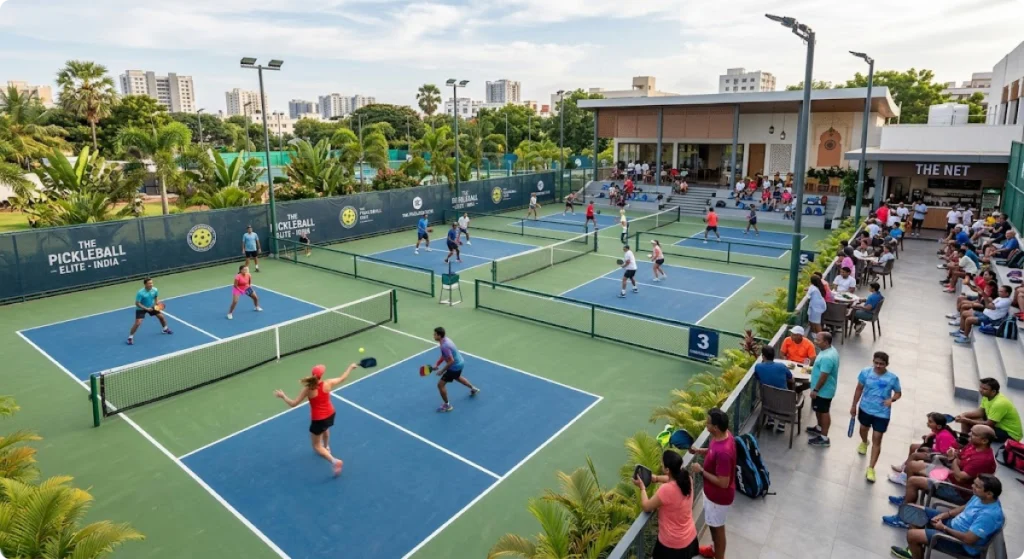
Understanding India’s Pickleball Boom
Pickleball arrived in India quietly. Around 2008–2010, early adopters – primarily Indian-Americans returning from the United States and expats settled in metros – introduced the sport through private clubs and residential communities. For years, it stayed in that lane: small, passionate, and largely invisible to the mainstream.
That changed somewhere around 2019–2020, and the pace has accelerated sharply since. The All India Pickleball Association (AIPA), which governs the sport domestically and interfaces with the International Federation of Pickleball (IFP), has reported a significant rise in registered players and affiliated clubs over the past three years.
What is driving participation? A combination of factors – rising urban health consciousness post-pandemic, growing awareness through social media, and the sport’s natural appeal across age groups. Unlike many competitive sports, pickleball can be played seriously at 25 and socially at 65, often on the same court.
National and state-level tournaments are now a regular feature of the sporting calendar. Cities like Mumbai, Bengaluru, Hyderabad, Delhi, Pune, and Chennai have active pickleball communities with organised leagues, open play sessions, and inter-club rivalries. Pickleball clubs India-wide are multiplying – from dedicated facilities to multi-sport clubs adding courts to their existing footprint.
Pickleball arrived in India quietly. Around 2008–2010, early adopters – primarily Indian-Americans returning from the United States and expats settled in metros – introduced the sport through private clubs and residential communities. For years, it stayed in that lane: small, passionate, and largely invisible to the mainstream.
That changed somewhere around 2019–2020, and the pace has accelerated sharply since. The All India Pickleball Association (AIPA), which governs the sport domestically and interfaces with the International Federation of Pickleball (IFP), has reported a significant rise in registered players and affiliated clubs over the past three years.
What is driving participation? A combination of factors – rising urban health consciousness post-pandemic, growing awareness through social media, and the sport’s natural appeal across age groups. Unlike many competitive sports, pickleball can be played seriously at 25 and socially at 65, often on the same court.
National and state-level tournaments are now a regular feature of the sporting calendar. Cities like Mumbai, Bengaluru, Hyderabad, Delhi, Pune, and Chennai have active pickleball communities with organised leagues, open play sessions, and inter-club rivalries. Pickleball clubs India-wide are multiplying – from dedicated facilities to multi-sport clubs adding courts to their existing footprint.
Why Pickleball Is the Fastest Growing Sport in India
Speed of adoption tells you something about a sport’s appeal. Pickleball’s growth in India is not accidental – it is structurally inevitable, given what the sport offers compared to its closest alternatives.
Accessibility: A beginner can rally within minutes of picking up a paddle. The rules are simple, the court is small, and the slower-moving wiffle ball gives players more time to react. This dramatically lowers the barrier to entry.
Social appeal: Pickleball is inherently social. Doubles is the dominant format, and open play sessions where strangers play together are common. For urban adults looking for fitness with community, this is a powerful draw.
Physical demand is adjustable: You can play it as a light social workout or as an intensely competitive sport. This means a single court can serve wildly different player profiles.
Cost compared to tennis: Building and maintaining a tennis court is significantly more expensive than a pickleball court. Four pickleball courts fit into the space of one standard tennis court.
The table below illustrates the key differences:
| Sport | Court Size | Typical Court Cost (India) | Learning Curve | Player Age Range |
|---|---|---|---|---|
| Tennis | 260 sq m (singles) | ₹15L – ₹30L+ | Steep | Primarily youth |
| Badminton | 81 sq m | ₹8L – ₹15L | Moderate | All ages |
| Squash | 62.5 sq m | ₹10L – ₹20L | Moderate–Steep | Youth to mid-age |
| Pickleball | 139 sq m | ₹3L – ₹8L | Low | All ages (8–80) |
For club owners evaluating court additions, the economics are straightforward. Pickleball court infrastructure delivers more utilisable surface, serves a wider demographic, and costs a fraction of tennis infrastructure to build and maintain.
Business Opportunities for Sports Clubs
For established sports clubs, pickleball is not a replacement for existing offerings – it is an additive revenue stream that brings in a different, often underserved audience.
Court rentals are the most immediate income line. Well-utilised pickleball courts in Indian metros regularly generate ₹400–₹800 per hour during peak slots. With multiple courts and peak evening demand, daily rental revenue can be significant.
Membership plans structured around pickleball access – monthly, quarterly, or annual – provide clubs with predictable revenue while building a loyal playing community. Several Mumbai and Bengaluru clubs have already launched pickleball-specific membership tiers.
Coaching programmes create a secondary revenue layer. Group coaching clinics, beginner workshops, and private lessons are in high demand because the supply of certified coaches in India is still limited. Clubs that train or hire coaches early gain a competitive advantage that is hard to replicate quickly.
Tournament hosting brings in entry fees, sponsorship interest, and food and beverage revenue – while elevating the club’s profile in the local pickleball community. Pickleball tournaments India-wide are drawing sponsors from sports brands, fitness companies, and lifestyle labels.
Equipment sales round out the model. Players who come through your courts will ask where to buy paddles, balls, and accessories. A curated equipment corner or a referral arrangement with quality suppliers adds margin without significant overhead.
How Academies Can Benefit from Pickleball Growth
Pickleball academies in India are at a genuinely early-mover stage. The demand for structured coaching is real and growing, but the supply of proper academy infrastructure is thin. This gap is an opportunity.
Junior coaching programmes are perhaps the most overlooked segment. Pickleball’s low learning curve makes it exceptional for young athletes, and schools are beginning to recognise it as a viable addition to their PE and extracurricular catalogue. Academies that build junior pipelines today will have competitive advantage in three to five years as the junior tournament ecosystem matures.
School partnerships are a natural fit. A pickleball academy offering a structured curriculum – including equipment, coaching, and inter-school fixtures – can position itself as a turn-key sports partner for schools that lack in-house expertise.
Summer camps combining fitness, skill-building, and competition elements are already proving popular in cities like Hyderabad and Pune. Parents are actively looking for structured sporting experiences for children during school holidays, and pickleball’s quick learning curve means visible progress within a week.
Competitive training streams for players targeting state-level and national tournaments will grow in importance as the competitive ecosystem matures. Academies that invest in structured periodisation, performance coaching, and tournament preparation will attract serious players willing to pay premium rates.
Pickleball Court Infrastructure Opportunities
Court supply remains one of the biggest constraints on India’s pickleball growth. In virtually every major city, demand for court time exceeds availability – which is a clear investment signal.
Building dedicated pickleball courts is the most direct opportunity. Standalone pickleball facilities – either as part of a larger sports complex or as dedicated venues – are beginning to appear in Indian cities. The economics work particularly well in urban and peri-urban locations where land costs are moderate and catchment populations are large.
Converting tennis courts is perhaps the most common and cost-effective route. A standard tennis court can accommodate up to four pickleball courts, and conversion – involving resurfacing, new line markings, and appropriate net posts – costs considerably less than new construction. Many tennis facilities underutilising their courts are exploring this model.
Converting badminton courts is another option, though court dimensions require more careful planning. Two pickleball courts can typically be accommodated within a standard badminton hall, and the indoor environment is highly desirable in India’s climate.
Residential societies represent a genuinely large and largely untapped market. Gated communities across metros have seen a surge in pickleball interest from residents, and builders – both in the luxury and mid-market segment – are beginning to include pickleball courts as an amenity. For developers and sports entrepreneurs, this is a market entering its growth phase now.
Pickleball court India demand is not uniform – it is concentrated in urban India’s upper-middle-class demographic, which happens to be exactly the segment with disposable income for club memberships and coaching fees.
Revenue Streams for Pickleball Clubs and Academies
A well-run pickleball facility does not depend on a single income line. The strongest businesses in this space layer multiple revenue streams:
Memberships – tiered plans for recreational players, competitive players, and families. Monthly plans in Indian cities typically range from ₹1,500 to ₹5,000, depending on facilities and court access levels.
Coaching fees – group sessions, private coaching, and structured programmes. Coaching is the highest-margin activity for academies when instructor costs are managed well.
Corporate events and team-building – companies are actively looking for engaging team experiences. Pickleball is easy to teach, inclusive, and energetic – making it a natural fit for corporate bookings. This segment is largely untapped and growing.
Club leagues and internal tournaments – regular in-house leagues create community, fill court slots during off-peak hours, and generate entry fee revenue.
Equipment sales and brand partnerships – selling quality paddles, balls, nets, and accessories on-site serves players while generating margin. As player volumes grow, equipment partnerships with national brands become viable.
Sponsorships – for clubs hosting tournaments or running active social programmes, sponsorship from sports, fitness, and lifestyle brands is a realistic revenue source.
Why Equipment Sales Are Growing Alongside Pickleball
Pickleball’s growth creates direct demand for equipment – and that demand is growing rapidly in India.
The first purchase a new player makes is a paddle. The market for pickleball paddles in India has expanded significantly as participation has climbed, and players are increasingly discerning. Beginners want an accessible, reliable paddle that won’t deter them through poor performance. Intermediate and competitive players want technology – carbon fibre surfaces, edge guard protection, optimal weight and grip configurations.
Balls, nets, court shoes, and bags complete the category. Players upgrading their game will cycle through equipment, creating repeat purchase behaviour that sustains equipment retail over time.
For anyone looking to buy pickleball paddle India options, the quality and variety available domestically has improved considerably. Players no longer need to import equipment or rely solely on generic sporting goods. Dedicated brands are building ranges specifically for the Indian market and Indian playing conditions.
For clubs and academies evaluating the best pickleball paddle India has to offer for coaching programmes, the priority is typically durability and consistency – paddles that perform reliably across hundreds of sessions. Explore GLIDERZ pickleball equipment for a range built to meet the needs of both recreational players and competitive training environments. GLIDERZ products are specifically designed for the Indian pickleball market, combining performance specifications with practical durability.
Pickleball equipment India demand will continue to grow in step with player participation. Clubs and academies that establish themselves as trusted equipment sources – either through direct sales or referral relationships — capture a revenue stream that grows automatically as their player base expands.
Challenges and Considerations
India’s pickleball market is not without friction. Clubs and academies entering this space should go in clear-eyed about the real challenges.
Coaching shortages are the most acute constraint. Certified pickleball coaches in India are scarce relative to demand. Clubs entering this market need a plan for coach sourcing and development – whether through sending staff for certification, hiring internationally, or partnering with existing certified coaches.
Court availability limits growth in cities where real estate is expensive. Clubs working within existing infrastructure need creative approaches to court conversion and scheduling to maximise utilisation.
Player retention beyond the novelty phase requires structured programming. Players who try pickleball once and enjoy it need a reason to keep coming back – leagues, coaching progression, community events, and competitive pathways are all important retention mechanisms.
Competition is increasing. As the market grows, more operators will enter. Clubs and academies that establish strong community, quality coaching, and consistent programming early will be harder to displace. First-mover advantage in pickleball is real but not permanent.
The Future of Pickleball in India
The trajectory is clear. Pickleball’s global growth – it is widely described as the fastest-growing sport in the United States and is gaining rapidly in Europe, Asia, and the Middle East – is beginning to replicate in India with a few years’ lag.
India’s urban demographic profile is well-suited to the sport: a large and growing upper-middle class with disposable income, health consciousness, and demand for social recreational activity. The infrastructure investment required is manageable. The learning curve is low enough to drive rapid player growth.
The tournament ecosystem is developing. State associations are active, national events are growing, and India is beginning to participate meaningfully at international level. As competitive infrastructure matures, it will pull more recreational players toward serious participation – creating demand for professional coaching, better facilities, and higher-quality equipment.
For investors looking at pickleball investment opportunities in India, the window is now. Infrastructure built in the next two to three years will benefit from first-mover positioning in what is likely to become a mainstream urban sport within the decade.
Frequently Asked Questions
1. What is driving India’s pickleball boom?
India’s pickleball boom is driven by multiple converging factors: rising urban health consciousness – particularly post-pandemic – the sport’s accessibility across age groups, growing awareness through social media and returning NRIs, and the relatively low cost of infrastructure compared to sports like tennis or squash. The All India Pickleball Association (AIPA) has been instrumental in formalising the sport, establishing state-level associations, and building a tournament structure that gives players a competitive pathway.
2.Why are sports clubs investing in pickleball courts?
Sports clubs are investing in pickleball because the return on investment is compelling. A pickleball court costs significantly less to build than a tennis court, generates strong court rental revenue during peak hours, and attracts a demographic – urban adults aged 30 to 60 – that tends to have high disposable income and long membership tenure. Multiple pickleball courts can also fit into the footprint of a single tennis court, making court conversion an efficient use of existing real estate.
3. Is pickleball profitable for academies?
Yes – particularly for academies that layer multiple revenue streams. Coaching fees, group clinics, school partnership programmes, summer camps, and equipment sales can collectively generate strong margins. The supply of quality pickleball coaching in India is still limited relative to demand, which means early-entry academies can charge premium rates and build waiting lists for popular programmes.
4. How much does a pickleball court cost in India?
A standard outdoor pickleball court in India typically costs between ₹3 lakh and ₹8 lakh to build, depending on surface material, fencing, lighting, and location. Converting an existing tennis court to accommodate multiple pickleball courts is generally less expensive. Indoor pickleball court construction costs are higher due to flooring and facility requirements, but offer year-round playability – a significant advantage in Indian climate conditions.
5. Can existing sports facilities add pickleball courts?
Absolutely. Tennis courts are the most straightforward conversion – one tennis court accommodates up to four pickleball courts. Badminton halls can also be adapted. For multi-sport clubs with underutilised court space, adding pickleball through conversion or temporary court marking is a low-capital way to test demand before committing to dedicated infrastructure.
6. Is pickleball growing faster than tennis in India?
By most indicators, yes. While tennis has a decades-long head start in India, pickleball’s year-on-year growth in player registrations and court installations is significantly faster. The lower learning curve, accessible infrastructure cost, and multi-generational appeal mean pickleball is attracting players who would not typically gravitate toward tennis – which effectively expands the overall racket sports market rather than cannibalising it.
7. What equipment is required to start playing pickleball?
A beginner needs three things: a pickleball paddle, pickleballs (the perforated plastic balls used in the sport), and appropriate court shoes. For clubs and academies setting up facilities, a complete set of equipment includes paddles, balls, portable or fixed nets, and court boundary markers. Explore GLIDERZ pickleball equipment for a full range suitable for beginners through competitive players.
8. Where can players buy pickleball paddles in India?
The availability of quality pickleball paddles in India has grown considerably. Players can buy pickleball paddle India options through dedicated sports brands like GLIDERZ, select multi-sport retailers, and online platforms. When choosing a paddle, consider weight (lighter paddles suit beginners and older players; heavier paddles suit power players), grip size, and surface material. Choosing the right pickleball paddle is an important early decision that affects how quickly new players develop the game.
9. What are the opportunities for pickleball coaches in India?
Coaching opportunities in Indian pickleball are expanding rapidly. Certified coaches can work with clubs on retainer, run their own academy programmes, partner with schools, lead corporate pickleball events, and provide private coaching. Because the supply of certified coaches is still limited, those who invest in certification – through AIPA or internationally recognised bodies – can command strong rates and significant demand. The longer-term opportunity is in building coaching businesses with staff, multiple locations, and branded programmes.
10. What is the future of pickleball in India?
The long-term outlook for pickleball in India is strong. The sport is on a clear growth trajectory globally, and India’s large urban middle class, growing health consciousness, and under-served recreational sports market create ideal conditions for sustained expansion. Within five to ten years, pickleball is likely to be a mainstream urban sport in India, with a well-developed club network, professional tournaments, and a mature equipment market. Infrastructure built now will be well-positioned to capture that growth. For clubs, academies, and investors, the pickleball investment opportunities available today will become significantly more competitive as the market matures.