
If you’ve ever grabbed a random ball out of the garage bin to warm up before a match, you already know the problem. One ball skips low, the next one balloons off your paddle, and by the third feed you’re adjusting your swing instead of grooving it. That inconsistency is exactly why a dedicated practice ball matters more than most players realize.
A practice ball isn’t just “a ball you practice with.” It’s a purpose-built training tool designed to survive thousands of reps, bounce the same way every single time, and hold up under drills that would crack or dent a ball meant for occasional weekend play. For beginners learning the basics, intermediate players sharpening consistency, and coaches running full academy sessions, the right practice ball changes how efficiently skills actually develop.
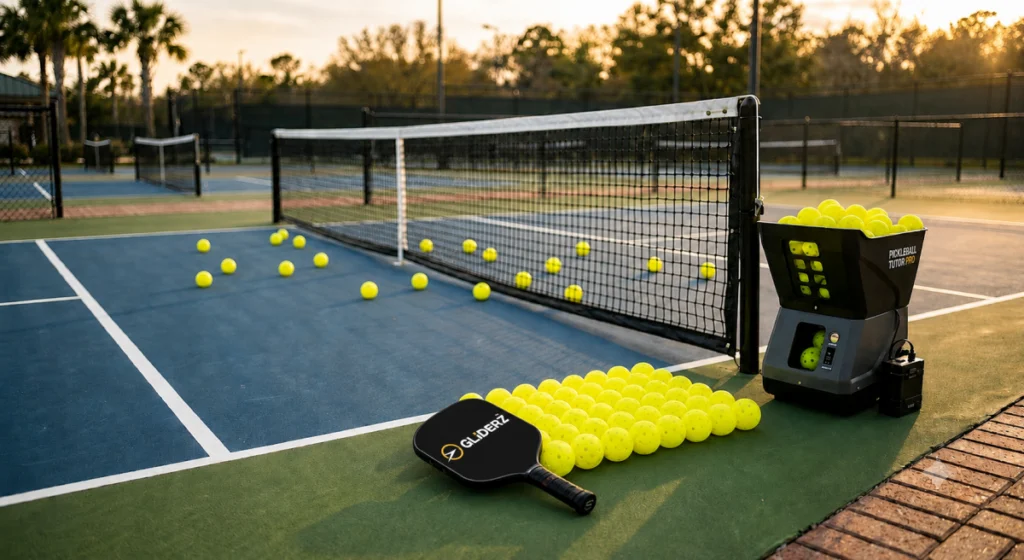
In this guide, we’ll break down what separates a practice ball from a tournament ball, why training balls matter for everything from solo drills to full multiball practice sessions, and how to choose one that fits your court, climate, and coaching goals. We’ll also cover multiball drills, using a pickleball ball thrower for solo reps, and why clubs and academies increasingly place a pickleball bulk order instead of buying balls one sleeve at a time.
Whether you’re a weekend player trying to fix a shaky third shot drop, a coach building a curriculum, or a club director stocking a pro shop, this article will help you understand exactly why the ball in your hand matters as much as the paddle.
What is a Practice Ball in Pickleball?
A practice ball is a pickleball made specifically for repeated, high-volume training rather than sanctioned match play. It’s built to handle constant contact with paddles, ball throwers, walls, and courts without losing its shape or bounce pattern too quickly.
Featured Snippet Answer: A practice ball in pickleball is a durable, purpose-built ball designed for drills, coaching sessions, and repetitive training. Unlike tournament balls, which prioritize precise flight and sanctioned specs for competitive matches, practice balls prioritize durability, consistent bounce, and cost-efficiency for high-volume use.
Most practice balls still follow the general size and weight profile players are used to, but manufacturers often adjust the plastic blend or hole pattern slightly to extend the ball’s life under heavy drilling. That’s an important distinction: a good practice ball should still feel familiar in your hand and off your paddle. It just needs to survive far more contact than a ball used for a handful of matches a month.
You’ll typically see practice balls used in:
- Individual skill sessions and solo drilling
- Group clinics and pickleball coaching
- Pickleball academy curriculums
- Pickleball club open-practice hours
- School and youth training programs
- Ball machine and thrower sessions
Why Dedicated Practice Balls Improve Your Game
Here’s the core idea: repetition only builds good habits if the conditions stay consistent. If the ball’s bounce keeps changing because it’s cracked, warped, or worn unevenly, your body starts adjusting to the ball’s flaws instead of learning the correct swing path.
A dedicated practice ball removes that variable. When the bounce is predictable, your muscle memory develops around the shot, not around compensating for a bad ball.
Expert Tip: Coaches often recommend keeping a separate set of balls exclusively for drilling and another set reserved for match simulation. This keeps your “feel” calibrated for both training intensity and real competitive conditions.
This matters most during three phases of development:
- Beginners learning the dink, drive, and drop need a ball that behaves the same way every time so they can build correct technique from the start.
- Intermediate players working on shot consistency need thousands of reps with predictable bounce to groove muscle memory.
- Coaches and academies running back-to-back sessions need balls that hold up under volume without needing constant replacement mid-drill.
A ball that changes character every few games actively works against skill development. That’s the entire reason pickleball training programs at serious clubs and academies use dedicated practice equipment rather than leftover tournament stock.
Benefits of Using Training Balls
Training balls aren’t just a convenience purchase – they solve real, measurable problems for anyone trying to improve consistently. Here are the main advantages:
- Consistent bounce across hundreds or thousands of hits, so your timing calibrates to the shot instead of the ball’s inconsistencies
- Higher durability against paddle impact, court abrasion, and repeated ball machine feeding
- Lower cost per rep, since training balls are priced for bulk use rather than premium tournament packaging
- Better feedback loop, letting players and coaches isolate technique issues instead of blaming a bad bounce
- Longer usable lifespan, which matters enormously for academies running daily sessions
- Reduced wear on premium tournament balls, keeping your match-day stock in better condition longer
For coaches specifically, training balls also standardize the learning environment. If every student across every session drills with the same type of ball, technique corrections become easier to teach and easier to measure over time.
Practice Ball vs Tournament Ball
Both balls look similar at a glance, but they’re engineered for different jobs. A tournament ball is optimized for sanctioned play – consistent flight, verified bounce specs, and performance that meets the standards used in officiated matches. A practice ball is optimized for volume – surviving thousands of reps without cracking, denting, or losing its bounce profile.
| Feature | Practice Ball | Tournament Ball |
|---|---|---|
| Primary Purpose | High-volume drilling and coaching | Sanctioned match play |
| Durability | Built for extended, repeated contact | Built for shorter competitive use |
| Cost Efficiency | Lower cost per ball, ideal for bulk buying | Higher cost, purchased in smaller quantities |
| Bounce Consistency | Optimized for repetition and predictability | Optimized for precise, regulated flight |
| Best Used By | Coaches, academies, solo drillers, clubs | Tournament players, sanctioned event organizers |
| Typical Setting | Practice courts, ball machines, clinics | Officiated matches and competitive tournaments |
Important Note: Practice balls are not designed to replace tournament balls in officiated matches. They’re a training tool. Always check current USA Pickleball Official Rules for approved equipment before competitive play.
How Multiball Practice Speeds Up Skill Development
Multiball practice is one of the fastest ways to build reliable technique because it removes the downtime of chasing balls or resetting rallies. Instead of playing out a full point after every shot, a coach or partner feeds ball after ball so the player can repeat the same motion dozens of times in a few minutes.
This approach works because skill development depends heavily on repetition density – how many quality reps you get in a given session. Multiball drills let you compress hours of match-based repetition into a fraction of the time.
Common multiball formats include:
- Feed-and-reset drills, where the coach feeds one ball after another to the same spot
- Random-placement feeds, which train reaction time and shot selection
- Combination feeds, mixing dinks, drives, and resets in a single sequence
- Pressure feeds, where balls come faster to simulate competitive intensity
Because multiball sessions rely on constant, repeated contact, they put more stress on the ball than a normal match would. This is exactly why dedicated practice balls matter here – a ball that degrades quickly will throw off bounce consistency halfway through a session, undermining the entire point of the drill.
Using a Pickleball Ball Thrower for Solo Training
Not everyone has a coach or hitting partner available every time they want to practice. That’s where a pickleball ball thrower becomes valuable. Also known as a ball throwing machine or pickleball launcher, this equipment feeds balls at a consistent pace, speed, and placement so players can drill independently.
Expert Tip: When practicing with a ball thrower, use a dedicated set of practice balls rather than mixed stock. Machines feed balls at a consistent rate, and a ball with inconsistent bounce will make it harder to tell whether a missed shot was a technique error or an equipment issue.
Ball throwers improve training in a few specific ways:
- They deliver a consistent bounce feed, which helps players groove technique without human variability in the toss
- They allow unlimited repetition without needing another person on court
- They support adjustable speed and placement settings, which helps simulate different opponent styles
- They free up coaches to focus on technique correction instead of manually feeding every ball
For solo players, pairing a ball thrower with a quality practice ball creates a training loop that’s hard to replicate any other way – steady reps, predictable bounce, and the ability to isolate one specific shot for as long as needed.
Best Drills Using a Practice Ball
Here are ten drills that make full use of a dedicated practice ball, whether you’re training solo, with a partner, or in a coached group session.
- Dink Consistency Drill – Rally cross-court dinks for a set number of reps without a miss, focusing on soft hands and paddle angle.
- Third Shot Drop Repetition – Feed balls from the baseline and practice dropping into the kitchen consistently.
- Reset Drill – Have a partner or machine feed hard-driven balls so you practice softening your hands to reset the point.
- Volley Wall Drill – Rapid-fire volleys at close range to build reflexes and paddle control.
- Serve and Return Repetition – Serve into target zones repeatedly to build accuracy under pressure.
- Cross-Court Dink Targeting – Aim for specific zones during dink rallies to sharpen shot placement.
- Multiball Footwork Drill – Combine footwork patterns with rapid ball feeds to build court movement alongside shot technique.
- Speed-Up Drill – Practice recognizing and executing speed-ups from the kitchen line during dink rallies.
- Two-Ball Combination Drill – Alternate between two shot types (like a drop followed by a dink) in a single feed sequence.
- Pressure Feed Drill – Increase feed pace gradually to simulate the tempo of competitive rallies.
Running these drills with a durable, consistent practice ball ensures the results actually reflect your technique – not the unpredictable bounce of a worn-out ball.
Choosing the Right Practice Ball
Not all practice balls perform the same way, and picking the right one depends on where and how you play. Here’s what to evaluate:
Bounce – A good practice ball should bounce consistently, hit after hit, without developing dead spots or flat sides over time.
Durability – Look for balls built to withstand heavy paddle contact and court abrasion, especially if you’re running daily drills or machine sessions.
Visibility – Bright, high-contrast colors help players track the ball during fast exchanges, which matters even more during multiball feeds.
Wind Resistance – For outdoor courts, ball weight and hole design affect how much wind knocks the ball off its intended path.
Outdoor vs Indoor – Outdoor pickleball balls typically have smaller, more numerous holes and a harder plastic to resist wind and rough court surfaces. Indoor pickleball balls usually have larger holes and softer plastic, since indoor courts are wind-free and typically gentler on equipment.
Important Note: Using an indoor ball outdoors (or vice versa) often leads to poor bounce and shortened ball life. Always match the ball type to your playing surface.
Why Clubs, Academies and Coaches Buy Pickleball Bulk Orders
Running a club, academy, or coaching program means going through practice balls fast. A single afternoon of group clinics or multiball drilling can use more balls than a casual player goes through in months. That’s why a pickleball bulk order makes sense for anyone managing consistent, high-volume programming.
Buying in bulk offers a few clear advantages:
- Lower cost per ball compared to buying individual sleeves repeatedly
- Consistent supply, so sessions never get interrupted by running out of usable balls
- Uniform quality across every ball, which matters for coaches trying to standardize training conditions
- Simplified inventory management for facilities running multiple courts or programs
For pickleball academy directors and pickleball club managers, a reliable bulk supplier also means less time spent reordering and more time focused on actual coaching. If your program includes daily pickleball training sessions, bulk purchasing quickly becomes a practical necessity rather than a luxury.
Not sure how many balls your program needs, or want a custom quote? Contact Us and we’ll help you figure out the right order size.”
How USA Pickleball Paddle Performance Improves with Quality Practice Balls
Your paddle and ball work together – and that relationship matters more during training than most players think. A USA Pickleball paddle is built to deliver specific feel, spin, and pop, but that performance is only reliable if the ball you’re hitting behaves consistently.
When a ball’s bounce is unpredictable, it’s harder to tell whether a mishit came from your paddle technique or from the ball itself. A consistent practice ball lets you evaluate your paddle’s true performance – how it grips the ball, how much pop it generates, and how it handles spin – without that signal getting muddied by equipment inconsistency.
This is especially relevant for players testing new equipment. If you’re breaking in a new paddle from a Pickleball Paddle Collection , pairing it with a dependable practice ball gives you a much clearer read on how the paddle actually performs, rather than how it performs with a worn-out or inconsistent ball.
For clarity: using a specific practice ball does not certify or guarantee compliance with any paddle for sanctioned play. Always confirm equipment approval through USA Pickleball Official Rules before competitive use.
Common Mistakes Players Make During Practice
Even motivated players can slow their own progress with a few avoidable habits:
- Practicing with mismatched or worn-out balls, which makes it hard to build reliable muscle memory
- Skipping warm-up reps before jumping into high-intensity drills
- Drilling without a clear focus, hitting balls aimlessly instead of targeting a specific shot or weakness
- Ignoring footwork during ball feeds, which limits how well drills translate to real match movement
- Ending sessions before reps become automatic, stopping too early to actually groove the habit
- Using tournament balls for daily drilling, which wears them out faster and adds unnecessary cost
Important Note: Sports injury prevention resources recommend proper warm-up and gradual intensity increases during any repetitive training, including pickleball drilling sessions, to reduce strain on shoulders, wrists, and knees.
Statistics: Pickleball’s Growth and What It Means for Training
Pickleball’s rapid growth is well documented, and it directly explains why structured training tools like practice balls, ball throwers, and coaching programs have become more common.
According to the Sports & Fitness Industry Association (SFIA), an estimated 24.3 million Americans played pickleball in 2025, representing a 22.8% year-over-year increase, with participation climbing 171.8% over the past three years – making it the fastest-growing sport in the country for multiple consecutive years. That surge in participation has fueled demand for more structured coaching, academy programs, and the training equipment that supports them, including dedicated practice balls and ball throwers.
Pros & Cons of Dedicated Practice Balls
| Pros | Cons |
|---|---|
| Consistent bounce across heavy use | Not approved for sanctioned tournament play |
| Lower cost per ball for bulk buyers | Slightly different feel from premium tournament balls |
| Built to withstand ball machine and multiball drilling | Requires separate storage from match-day stock |
| Ideal for coaches, academies, and clubs | May need indoor/outdoor-specific selection |
Summary Table
| Category | Key Takeaway |
|---|---|
| Practice Ball | Built for durability and consistent bounce during high-volume drilling |
| Tournament Ball | Built for sanctioned, competitive match play |
| Multiball Practice | Speeds up skill development through repetition density |
| Ball Thrower / Launcher | Enables consistent solo training without a partner |
| Bulk Orders | Reduces cost and simplifies supply for clubs and academies |
| Indoor vs Outdoor Balls | Match ball type to court conditions for best performance |
Frequently Asked Questions
1. What is the difference between a practice ball and a tournament ball? A practice ball is built for durability and repeated drilling, while a tournament ball is designed for the precise flight and bounce standards used in sanctioned competitive play.
2. Can I use practice balls in an actual match? Practice balls can be used for casual play, but for sanctioned or officiated matches, players should use tournament-approved balls that meet current USA Pickleball Official Rules.
3. How often should I replace my practice balls? Replacement frequency depends on usage volume, but balls used daily in academy or multiball sessions typically need replacing more often than balls used for occasional solo practice.
4. Are outdoor and indoor practice balls really different? Yes. Outdoor balls are built with harder plastic and smaller holes to resist wind, while indoor balls use softer plastic and larger holes for indoor court conditions.
5. Do ball throwers work with any practice ball? Most ball throwers work with standard-sized practice balls, but consistent bounce and weight help the machine feed more accurately and reliably.
6. Why do coaches use multiball drills instead of regular rallies? Multiball drills increase repetition density, letting players practice a specific shot many more times per session than they would during normal point play.
7. Is it worth buying practice balls in bulk? For clubs, academies, and coaches running frequent sessions, bulk buying significantly lowers cost per ball and keeps supply consistent across sessions.
8. Does the practice ball affect how my paddle performs? Yes. A consistent ball makes it easier to evaluate your paddle’s true feel, spin, and pop without inconsistent bounce muddying the feedback.
9. What should beginners look for in a practice ball? Beginners should prioritize consistent bounce and durability, since a predictable ball helps build correct technique from the start.
10. Can schools and youth programs use practice balls for training? Yes. Practice balls are commonly used in school and youth pickleball coaching programs because of their durability and cost-efficiency across high student volume.
👉 Looking to start? Explore GLIDERZ Pickleball Balls – Made in India for Indian players.