
Quality Control in Pickleball Paddle Manufacturing is the single biggest factor that separates a paddle you can trust from one that lets you down mid-rally. If you have ever wondered why two paddles that look almost identical perform so differently on court, the answer usually comes down to how carefully each one was made.
Pickleball is growing fast across India, and players at every level – from weekend enthusiasts to competitive tournament athletes – are becoming more aware of what actually goes into a good paddle. It is not just about a flashy design or a trendy color. It is about the raw materials, the precision of the manufacturing process, and the testing that happens before a paddle ever reaches your hands.
Player performance depends directly on paddle consistency. A paddle with an uneven core, poor weight distribution, or a weak edge guard can affect your shot control, your power, and even your safety on court. Durability matters too. Nobody wants to invest in equipment that cracks or delaminates after a few weeks of regular play.
This is exactly why GLIDERZ focuses so heavily on quality at every stage of production. As a pickleball paddle manufacturer based in India, we understand that our reputation depends on the reliability of every paddle that leaves our facility. In this article, we will walk you through how quality control in pickleball paddle manufacturing shapes performance, why it matters for bulk and corporate buyers, and what to look for when choosing your next paddle.
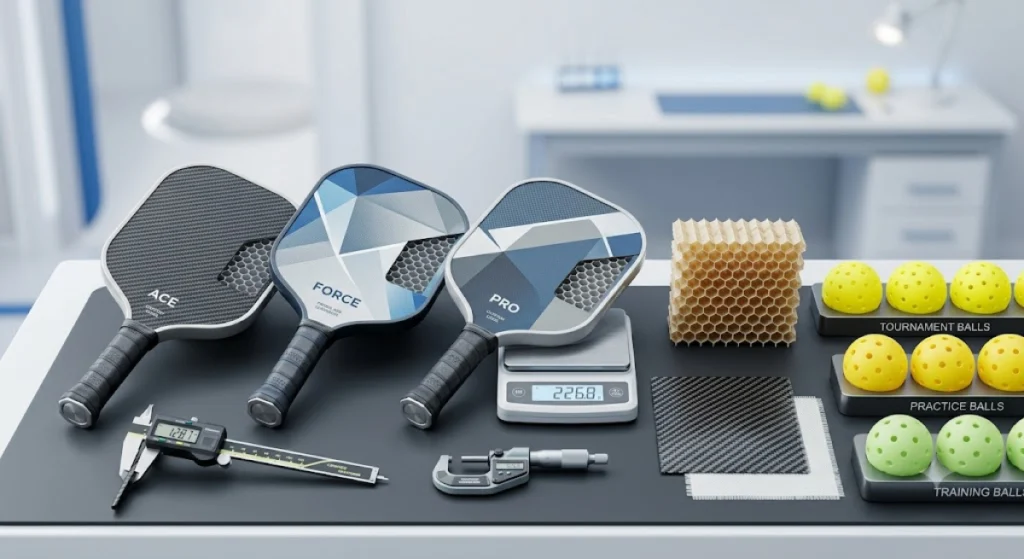
Why Quality Control in Pickleball Paddle Manufacturing Matters
Quality control in pickleball paddle manufacturing starts long before a paddle takes its final shape. It begins with the raw materials themselves. If the inputs are inconsistent, no amount of finishing work can fix the final product.
Raw Material Inspection
Every batch of material that enters a serious production line should be inspected before it is approved for use. This includes checking for:
- Consistent thickness across sheets
- Absence of air bubbles or surface defects
- Proper curing of resins and adhesives
- Uniformity between batches from the same supplier
Skipping this step is one of the most common reasons budget paddles fail early. A manufacturer that takes quality control in pickleball paddle manufacturing seriously will never let substandard material move forward in the process.
Fiberglass Quality
Fiberglass face sheets are popular for their soft feel and forgiving sweet spot. However, not all fiberglass is created equal. Lower-grade fiberglass can feel “dead” on contact, reduce spin potential, and wear out faster under repeated impact. Careful sourcing and inspection of fiberglass sheets is a core part of quality control in pickleball paddle manufacturing, ensuring every paddle delivers a lively, responsive feel.
Carbon Fiber Quality
Carbon fiber paddles are known for their stiffness, power, and control. But carbon fiber is also more sensitive to manufacturing errors. Inconsistent weave patterns or poor resin bonding can lead to a paddle that feels harsh or inconsistent across the face. That is why testing carbon fiber sheets for weave uniformity and bonding strength is treated as a non-negotiable checkpoint.
Honeycomb Core Inspection
The core is the heart of any paddle. Whether it is a polymer, aluminum, or Nomex honeycomb core, it needs to be checked for:
- Uniform cell size and structure
- No crushed or collapsed cells
- Even thickness throughout the paddle face
An inconsistent core is one of the leading causes of dead spots on a paddle face. Rigorous core inspection is a critical part of quality control in pickleball paddle manufacturing that directly affects how the ball responds off the face.
Weight Balance
Weight distribution affects swing speed, maneuverability, and control. Paddles are typically weighed at multiple stages of production, and any unit outside the accepted tolerance range is rejected. This attention to weight balance is what allows players to trust that the paddle in their hand will feel the same as the one they tested in a demo.
Grip Inspection
A grip that is too thin, too thick, or unevenly wrapped can cause discomfort and even blisters during long matches. Grip diameter, tackiness, and wrap consistency are checked before a paddle is approved for packaging.
Surface Finish
The surface texture of a paddle face directly affects spin generation. Uneven texture or coating defects can lead to inconsistent spin and control. A smooth, consistent surface finish is one of the final visual and functional checks in the production line.
For players who want a paddle built around their exact preferences, our Custom Pickleball Paddles service lets you choose the weight, grip size, and design while our quality checks remain exactly as strict as they are for standard models. If you are curious about how to Customize Your Pickleball Paddle, our team can guide you through the available specifications.
How GLIDERZ Maintains High Manufacturing Standards
At GLIDERZ, quality control in pickleball paddle manufacturing is not a single inspection at the end of the line. It is a continuous process built into every stage of production.
Quality Testing
Every paddle batch goes through structured quality testing before it is cleared for shipment. This includes visual inspection, weight verification, and dimensional checks against specifications approved by USA Pickleball, the sport’s official governing body for equipment standards.
Performance Testing
Beyond visual checks, paddles are tested for actual on-court performance characteristics such as ball response, sweet spot consistency, and vibration dampening. This step ensures that the paddle does not just look good on paper but genuinely performs well during play.
Durability Testing
Paddles are subjected to repeated impact tests to simulate months of regular use. This helps identify weaknesses in edge guards, core bonding, or face lamination before the paddle ever reaches a customer.
Edge Guard Inspection
The edge guard protects the paddle from chips and cracks caused by accidental contact with the ground or net. A poorly fitted edge guard can peel away or crack, exposing the core to damage. Each unit is checked to confirm the edge guard is securely bonded around the entire perimeter.
Handle Strength
The handle needs to withstand repeated gripping pressure and occasional impact without loosening or cracking. Handle strength testing simulates this stress to confirm long-term reliability.
Printing Quality
For branded and custom paddles, print quality matters just as much as structural integrity. Faded logos or peeling graphics reflect poorly on both the player and the brand. Printing is checked for color accuracy, adhesion, and resistance to fading from sun and sweat exposure.
Consistency Across Units
One of the hardest things to achieve in manufacturing is consistency across thousands of units. Quality control in pickleball paddle manufacturing means that the hundredth paddle off the line should feel identical to the first one, whether it is a single retail order or a large bulk shipment.
OEM and Private Label Manufacturing
As an experienced OEM Pickleball Paddle partner, GLIDERZ supports businesses that want to launch their own paddle line under their own brand name. Our private label manufacturing process follows the same quality control standards used for our in-house products, so partner brands can confidently put their name on every paddle we produce for them.
Quality Accessories That Improve Training and Match Performance
Good paddle quality is only part of the picture. Serious players and coaching programs also depend on reliable training equipment to build consistent skills, and quality control in pickleball paddle manufacturing extends naturally into how we approach accessories too.
Training Balls and Practice Ball Quality
Training balls need to hold up to repeated hits without losing shape or bounce consistency. A poor-quality practice ball can develop flat spots or crack under regular drilling sessions, which throws off a player’s timing and feedback. Reliable training balls give players accurate, repeatable feedback during every session.
Tournament Ball Standards
A tournament ball is held to a stricter standard than a practice ball. It needs consistent bounce, hole pattern, and hardness so that match play remains fair and predictable. Clubs and academies that host competitive events should always verify that their tournament ball selection matches official approved specifications.
Multiball Practice and MultiBall Drills
Multiball practice has become one of the most effective ways to improve reaction time, footwork, and shot repetition. MultiBall drills allow a coach or training partner to feed balls quickly, giving players far more reps in a shorter session than traditional rally-based practice. Having a reliable supply of durable balls is essential for these high-volume drilling sessions to run smoothly.
PickleBall Ball Thrower and Ball Throwing Machine
A PickleBall Ball Thrower, sometimes called a Ball Throwing Machine, allows players to practice independently without needing a partner or coach on the other side of the net. These machines are especially useful for:
- Solo practice sessions
- Consistent, repeatable shot feeding
- Academies running group training programs
- Building muscle memory for specific shot types
PickleBall Launcher for Structured Training
A PickleBall Launcher gives coaches precise control over ball speed, spin, and placement, which is invaluable for structured skill-building programs. Schools and academies that invest in a quality launcher can design progressive training drills that scale with a player’s skill level.
Whether you are outfitting a home practice setup or building out a full academy training program, equipment quality affects results just as much as paddle quality does. That is why we apply the same disciplined mindset from paddle production to every training accessory we recommend.
Quality Control for Bulk Orders and Corporate Pickleball Products
Bulk buyers face a unique challenge: every single unit in a large order needs to meet the same standard. A single inconsistent batch can create real problems for schools, academies, and corporate clients who are counting on uniformity.
PickleBall Bulk Order Standards
When a business places a PickleBall Bulk Order, they are trusting the manufacturer to replicate quality across potentially hundreds or thousands of units. This requires:
- Standardized production runs
- Batch-level quality sampling
- Consistent weight and grip specifications across the entire order
- Careful packaging to prevent shipping damage
Corporate Pickleball Paddle Programs
A Corporate Pickleball Paddle order is often tied to a company event, wellness initiative, or client gifting program. These orders need to reflect well on the brand commissioning them, which means both paddle quality and branding accuracy have to be flawless.
Our Corporate Pickleball Paddles program is designed specifically for this use case, combining reliable manufacturing with flexible branding options. Businesses exploring Corporate Pickleball Gifts can work with our team to align paddle specifications with their brand guidelines.
Brand Consistency and Logo Printing
For Custom Corporate Pickleball Paddles, logo printing needs to remain sharp and consistent across every unit. This means calibrating print equipment regularly and checking sample units from each production run before the full batch is approved.
Bulk Manufacturing for Schools, Academies, and Clubs
Schools, sports academies, and pickleball clubs often need dozens or hundreds of paddles at once for group training programs. These buyers benefit most from a manufacturer that treats quality control in pickleball paddle manufacturing as a fixed process rather than something that varies with order size.
Corporate Gifting Programs
Many companies now use pickleball equipment as part of corporate gifting programs, given the sport’s rising popularity among working professionals in India. A well-made, nicely branded paddle makes a memorable gift, but only if the underlying manufacturing quality holds up beyond the first few uses.
If your organization is planning a bulk purchase, our team can walk you through specifications, timelines, and customization options. Feel free to Request a Quote for your upcoming order.
Why Choose GLIDERZ for Premium Pickleball Products
GLIDERZ was built around one core idea: quality control in pickleball paddle manufacturing should never be an afterthought. It should be the foundation of every decision we make, from sourcing materials to packaging the final product.
Premium Manufacturing Standards
We apply consistent testing protocols across raw materials, core construction, weight balance, and surface finish. This is what allows us to call our paddles a genuinely Premium Pickleball Paddle line rather than just marketing language.
Made in India, Built for Indian Players
As a Made in India Pickleball Paddle manufacturer, we understand the climate, playing conditions, and preferences of players across the country. Local manufacturing also means faster turnaround times and better support for domestic bulk and corporate orders.
Rigorous Quality Inspection
Every stage of our process, from raw material intake to final packaging, includes a quality checkpoint. This layered approach to inspection is central to how we maintain quality control in pickleball paddle manufacturing at scale.
Fast Delivery and Bulk Production Capability
Our production capacity is built to handle everything from individual custom orders to large-scale bulk manufacturing runs for academies, schools, and corporate clients, without compromising on turnaround time.
Customization Options
From paddle weight and grip size to full branding packages, our customization options are built to serve players, dealers, distributors, and businesses looking for a Private Label Pickleball Paddle solution.
Reliable Support
Our team stays involved through the entire ordering process, from initial specification discussions to post-delivery support. For dealers, distributors, and institutions, this ongoing relationship matters just as much as the product itself.
If you are ready to experience the difference that disciplined manufacturing makes, Talk to Our Team today and find out how GLIDERZ can support your paddle, training equipment, or bulk order needs.
FAQs
1. What is quality control in pickleball paddle manufacturing? Quality control in pickleball paddle manufacturing refers to the systematic checks applied at every production stage, including raw material inspection, core construction, weight balance, and final testing, to ensure each paddle meets consistent performance and durability standards.
2. Why does quality control improve paddle performance? Consistent quality control in pickleball paddle manufacturing eliminates defects like uneven cores, poor weight distribution, and weak edge guards, all of which directly affect ball response, control, and how long a paddle lasts.
3. How are pickleball paddles tested? Paddles typically go through visual inspection, dimensional checks, weight verification, performance testing for ball response, and durability testing that simulates repeated impact over time.
4. What materials are used in premium pickleball paddles? Premium paddles commonly use fiberglass or carbon fiber face sheets combined with a polymer, aluminum, or Nomex honeycomb core, along with reinforced edge guards for added protection.
5. What are Training Balls? Training Balls are practice-grade balls designed to withstand repeated hitting during drills and skill-building sessions, offering consistent bounce and durability for regular use.
6. What is the difference between Practice Ball and Tournament Ball? A Practice Ball is built for everyday drilling and durability under heavy use, while a Tournament Ball meets stricter bounce, hardness, and hole-pattern specifications required for official competitive match play.
7. How does a PickleBall Ball Thrower improve training? A PickleBall Ball Thrower delivers consistent, repeatable shot feeding, allowing players to practice independently and build muscle memory without needing a training partner.
8. What is a Ball Throwing Machine? A Ball Throwing Machine is an automated device that feeds balls to a player at adjustable speed and intervals, commonly used for solo practice and structured academy training programs.
9. What is MultiBall Practice? MultiBall Practice, often run through MultiBall Drills, involves feeding multiple balls in quick succession so players get significantly more reps for footwork, reaction time, and shot repetition in less time.
10. Can I place a PickleBall Bulk Order with GLIDERZ? Yes, GLIDERZ supports PickleBall Bulk Order requests for schools, academies, clubs, dealers, distributors, and corporate buyers, with consistent quality control applied across the entire order regardless of size.
Conclusion
Quality control in pickleball paddle manufacturing shapes nearly every aspect of a paddle’s performance, from how it feels on contact to how long it lasts under regular play. Durability, consistency, and precision are not accidental outcomes. They are the result of disciplined inspection at every stage, from raw material sourcing to final packaging.
For players, this means a paddle that performs the way it is supposed to, match after match. For schools, academies, clubs, and corporate buyers, it means confidence that a bulk order will deliver the same quality across every single unit. For dealers and distributors, it means a manufacturing partner they can rely on for consistent, customizable products.
At GLIDERZ, quality control in pickleball paddle manufacturing is not a marketing phrase. It is the process behind every paddle, every training ball, and every custom or corporate order we produce as a Made in India Pickleball Paddle manufacturer.
👉 Looking to start playing? Explore GLIDERZ Pickleball paddles – Made in India for Indian players.