
Pickleball is growing quickly across India, and along with the sport, the equipment used to play it has become far more advanced. Walk through any online paddle store today and you will notice how often paddle descriptions mention carbon fiber, and more specifically, terms like “T700 carbon fiber.” For someone new to the sport, or even for players who have been rallying for a while, this raises an obvious question: what exactly is T700 carbon fiber in pickleball paddles, and does it really make a difference on the court?
If you have been researching paddles before making a purchase, you have probably come across this term multiple times without a clear explanation of what it means. Some listings treat it as a marketing buzzword, while others barely explain it at all. This article breaks it down in plain language, covering what T700 carbon fiber actually is, why manufacturers use it, how it can influence paddle performance, and how it compares with other materials like fiberglass and T300 carbon fiber. If you are new to the game itself, you can also [learn more about pickleball] before diving into equipment details. By the end, you should have a clear, honest picture of where T700 carbon fiber fits into your paddle-buying decision.
What Is T700 Carbon Fiber?
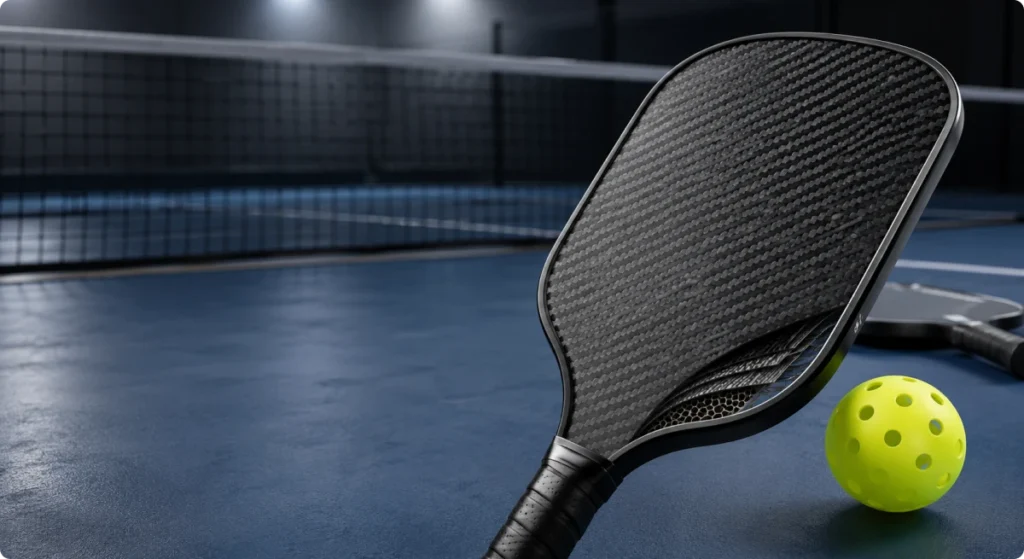
Carbon fiber is a material made of extremely thin strands of carbon atoms, woven together into a fabric-like sheet and then bonded with resin to form a rigid, lightweight structure. It is widely used across industries that need strong yet light materials, including aerospace, automotive manufacturing, cycling, and sports equipment. In pickleball paddles, carbon fiber is commonly used as the face material, the layer that actually makes contact with the ball.
Not all carbon fiber is the same. Manufacturers classify carbon fiber into different grades based on how it is produced and the mechanical properties it offers. “T700” is one such classification, originally developed by Toray Industries, a major Japanese carbon fiber manufacturer. The “T” series grading system is an industry-wide reference point that many manufacturers use when describing the type of carbon fiber used in their products, including paddle brands.
In general terms, T700-grade carbon fiber is known for offering a solid balance of strength and stiffness relative to its weight. This is why it shows up frequently in sporting goods, not just pickleball paddles but also cycling components and other performance equipment.
That said, it is important to understand that the carbon-fiber grade is just one ingredient in a much bigger recipe. A paddle is not made of carbon fiber alone. It also includes a core (usually polymer honeycomb), edge protection, resin layers, and a finishing process that all interact with the carbon-fiber face. Two paddles can both use T700 carbon fiber and still play very differently, because the way the material is layered, bonded, and combined with the core determines the final feel far more than the raw material grade does on its own.
Why Is T700 Carbon Fiber Used in Pickleball Paddles?
Manufacturers select T700 carbon fiber for paddle faces for a few practical reasons, most of which come down to how the material behaves under repeated impact.
Strength-to-weight ratio: T700 carbon fiber generally offers good strength without adding significant weight, which allows manufacturers to build paddles that feel light in the hand without sacrificing structural integrity.
Stiffness: Carbon fiber, including T700, tends to be stiffer than materials like fiberglass. A stiffer paddle face can transfer energy from the swing to the ball more directly, though how this translates into “power” or “control” depends heavily on the rest of the paddle construction.
Consistent response: Because carbon fiber is manufactured under controlled conditions, it can offer a more predictable and repeatable response across the paddle face compared to some other materials.
Durability considerations: Carbon fiber faces are often chosen for their ability to hold up under regular play, though actual durability also depends on the resin used, the quality of the layup process, and how the paddle is manufactured and finished.
It is worth repeating this clearly: T700 carbon fiber does not automatically make a paddle better than one built with a different material. A paddle described as using “T700 carbon fiber” could still underperform a well-engineered fiberglass or lower-grade carbon-fiber paddle if the core, surface texture, weight distribution, or manufacturing quality are not well matched to the material. The material is a component, not a finished product.
As pickleball continues to expand globally, players are paying closer attention to paddle materials, construction, and performance. Understanding factors such as carbon-fiber composition, paddle thickness, core design, and surface texture can help players make more informed equipment choices. For more information about pickleball and equipment standards in the United States, visit the USA page.
How Does T700 Carbon Fiber Affect Pickleball Paddle Performance?
Once you understand what T700 carbon fiber is, the more useful question becomes how it might actually show up in your game. Here is a practical breakdown.
Power
Because T700 carbon fiber is relatively stiff, paddles built with it can offer efficient energy transfer when you strike the ball firmly. However, power on a pickleball paddle is not determined by the face material alone. Core thickness, paddle weight, swing weight, and the player’s own technique all play a significant role. A stiff carbon-fiber face paired with a soft, absorbent core will feel very different from the same face paired with a firmer core.
Control
Control largely comes down to how consistently the paddle face responds to the ball at different contact points and different speeds. Many players who prefer carbon-fiber paddles say they appreciate the steady, predictable feel during dinks and resets, but this again depends on the complete construction, not the carbon fiber alone.
Spin
Spin potential is influenced more by the surface texture of the paddle face, such as the roughness or grit pattern applied during manufacturing, than by the carbon-fiber grade itself. A T700 carbon-fiber face with a textured finish can help generate friction against the ball, but the underlying carbon-fiber type is a secondary factor compared to surface texture and manufacturing technique.
Feel and Feedback
Carbon fiber is often associated with a firmer, more direct feel at contact compared to fiberglass, which some players describe as “softer” or more forgiving. Whether this firmer feedback suits your game usually comes down to personal preference and playing style rather than one material being objectively superior.
Weight and Maneuverability
Carbon fiber can help manufacturers build lighter paddle faces without compromising strength, which can support quicker hand speed at the net. That said, the final weight of the paddle depends on the combination of the face material, core, edge guard, handle, and grip, so the material alone does not decide how maneuverable a paddle will feel.
T700 Carbon Fiber vs Fiberglass Pickleball Paddles
Fiberglass, sometimes labeled as “composite” or “fiberglass composite,” is another common material used in pickleball paddle faces. Comparing it with T700 carbon fiber can help you understand which direction might suit your playing style.
| Factor | T700 Carbon Fiber | Fiberglass |
|---|---|---|
| Stiffness | Generally stiffer | Generally more flexible |
| Feel | Firmer, more direct | Softer, more cushioned |
| Power | Can offer efficient energy transfer with firm contact | Can offer a springier, more forgiving response |
| Control | Consistent response across the face | Can feel more forgiving on off-center hits |
| Spin potential | Depends mainly on surface texture, not material alone | Depends mainly on surface texture, not material alone |
| Weight | Often supports lighter builds | Can vary depending on layup |
| Durability | Generally durable with quality manufacturing | Generally durable with quality manufacturing |
| Typical price range | Often positioned as a premium material | Often more budget-friendly |
Neither material is universally “better.” Players who prefer a firmer, more locked-in feel and consistent response often lean toward carbon-fiber paddles. Players who enjoy a softer, more cushioned feel, particularly around the kitchen line, sometimes prefer fiberglass. The right choice depends on your playing style, comfort with different paddle feels, and budget, rather than any single material guaranteeing better results.
T700 Carbon Fiber vs T300 Carbon Fiber: What’s the Difference?
Within the carbon-fiber grading system, T300 is another commonly referenced classification, generally considered an earlier or more standard grade compared to T700.
Carbon-fiber grade: T700 is typically positioned as a higher-performance grade compared to T300 within the Toray classification system, generally associated with a stronger fiber structure.
Tensile strength: In general industrial terms, T700 carbon fiber is associated with higher tensile strength than T300, meaning it can typically withstand more stress before breaking, though exact figures vary by manufacturer and production batch.
Stiffness and material characteristics: T700 is often described as offering a stiffer, more rigid structure, while T300 can behave slightly differently depending on how it is processed and layered.
Why manufacturers choose one over the other: The decision often comes down to cost, target price point, and desired paddle feel rather than one grade being suitable for every product. Some brands use T300 in more budget-friendly paddles, while T700 is often positioned in mid-to-premium paddle lines. However, the specific manufacturing process still plays a major role in the final result.
What players should actually consider: Rather than assuming a T700 paddle will always outperform a T300 paddle, it is more useful to look at the complete paddle specification sheet, read about the core material, surface texture, weight, and shape, and, where possible, try the paddle or read detailed reviews. The carbon-fiber grade is one data point among several, not a standalone performance guarantee.
Is a T700 Carbon Fiber Pickleball Paddle Worth Buying?
Whether a T700 carbon fiber paddle is worth buying depends on your playing level, style, and what you value on the court.
Beginners: New players can certainly use T700 carbon-fiber paddles, though beginners may not immediately notice the subtle performance differences that carbon fiber can offer over other materials. What often matters more at this stage is comfortable weight, a manageable grip size, and a forgiving sweet spot.
Intermediate players: As players develop more consistent technique, they often start to notice differences in feel, control, and shot consistency. This is where the qualities associated with T700 carbon fiber, such as a firm, predictable response, can become more noticeable and appreciated.
Advanced and competitive players: Experienced players who rely on precise touch shots, resets, and controlled power often gravitate toward carbon-fiber paddles because of the consistent feedback they tend to offer.
Players who prioritize control and feel: If your game leans on dinks, drops, and placement rather than pure power, the steady response many carbon-fiber paddles provide can be a good match.
Regardless of skill level, the carbon-fiber grade should not be the only factor in your decision. When evaluating any paddle, including a T700 carbon fiber paddle, consider:
- Paddle weight
- Paddle thickness
- Paddle shape (standard, elongated, or hybrid)
- Core material and density
- Surface texture
- Handle length
- Grip size
- Balance point (head-heavy vs handle-heavy)
- Manufacturing quality
- Your own playing style
- Your budget
If you are searching for the best pickleball paddle India has to offer, or planning to buy pickleball paddle India options online, treat the carbon-fiber grade as one useful detail among many rather than the deciding factor on its own.
How to Choose the Best T700 Carbon Fiber Pickleball Paddle in India
For players in India exploring Pickleball India options, choosing the right paddle involves a mix of practical and personal considerations.
1. Identify your playing style first. Are you a power player, a control-focused player, or somewhere in between? This will guide how much you should prioritize stiffness versus a softer feel.
2. Consider your experience level. Beginners often benefit from a slightly more forgiving paddle with a comfortable weight, while advanced players may prioritize the firmer response associated with carbon fiber.
3. Check the paddle weight and grip size. Even the best carbon-fiber construction will feel wrong in your hand if the weight or grip size does not suit you.
4. Look at core construction. The core material and density work together with the carbon-fiber face to shape the final feel, so read the full specification rather than focusing on the face material alone.
5. Review the surface texture. If spin is a priority for your game, pay attention to how the manufacturer describes the surface finish, not just the carbon-fiber grade.
6. Compare paddle dimensions. Standard, elongated, and hybrid shapes each offer different trade-offs between reach, power, and maneuverability.
7. Factor in price and value. Premium pickleball paddles India shoppers look for should offer a reasonable balance between construction quality and cost, not just an impressive-sounding material name.
8. Check brand reliability and availability. Look for pickleball paddle manufacturer in India options that are transparent about their construction, offer clear customer support, and are easy to reach if you have questions before or after purchase.
9. Confirm manufacturing quality control. Ask or research whether the paddles are properly quality-checked, since inconsistent manufacturing can affect performance regardless of the materials used.
10. Consider warranty and support. Reliable after-sales support matters, especially for players investing in pickleball paddles made in India for long-term use.
Brands like GLIDERZ, which manufacture pickleball paddles and balls specifically for Indian players, are worth exploring when comparing your options, since local availability and support can make a real difference to your overall buying experience. You can [choose the best pickleball paddle in India] by comparing specifications side by side rather than relying on a single material label.
About GLIDERZ Pickleball
GLIDERZ is an Indian pickleball equipment brand that manufactures paddles and balls designed for players across different skill levels in India. The brand offers a range of paddle constructions, including carbon-fiber options, built with a focus on quality-driven manufacturing for players who are just starting out as well as those looking for more performance-oriented equipment.
Rather than relying on a single material or specification to define its products, GLIDERZ aims to offer paddle options suited to different playing requirements, along with accessible retail and purchasing channels for Indian players. If you want to see how these principles come together in an actual product lineup, you can explore [GLIDERZ pickleball paddles] to compare the available constructions. If you have questions about a specific paddle before buying, you can always [contact GLIDERZ]directly.
Frequently Asked Questions About T700 Carbon Fiber Pickleball Paddles
What is T700 carbon fiber in pickleball paddles? T700 is a carbon-fiber grade, originally classified by Toray Industries, known for offering a strong, relatively stiff structure at a light weight. In pickleball paddles, it is commonly used as a face material, though overall paddle performance depends on the complete construction.
Is T700 carbon fiber good for pickleball paddles? T700 carbon fiber can be a good choice for paddle faces because of its strength-to-weight balance and stiffness. However, “good” performance also depends on the core, surface texture, weight distribution, and manufacturing quality, not the face material alone.
Is T700 better than fiberglass for pickleball? Neither material is universally better. T700 carbon fiber tends to offer a firmer, more direct feel, while fiberglass often feels softer and more forgiving. The right choice depends on your playing style and personal preference.
What is the difference between T700 and T300 carbon fiber? T700 is generally considered a higher-performance grade than T300, typically associated with greater tensile strength and stiffness. However, the way each grade is used in a paddle’s construction matters as much as the grade itself.
Does T700 carbon fiber provide more spin? Spin potential mainly depends on the paddle’s surface texture rather than the carbon-fiber grade. A textured T700 carbon-fiber face can support spin, but the material alone does not determine how much spin a paddle generates.
Are T700 carbon fiber paddles suitable for beginners? Yes, beginners can use T700 carbon-fiber paddles, though they may not notice every subtle performance benefit right away. Comfortable weight and grip size are usually more important for new players than the specific carbon-fiber grade.
How long does a T700 carbon fiber pickleball paddle last? Durability depends on build quality, how often the paddle is used, and playing conditions, rather than the carbon-fiber grade alone. Proper care and storage can also help extend a paddle’s usable life.
How do I choose a T700 carbon fiber paddle in India? Compare weight, grip size, core material, surface texture, and shape alongside the carbon-fiber grade. Buying from a reliable pickleball paddle manufacturer in India with clear specifications and support can also make the decision easier.
Final Thoughts
Understanding what T700 carbon fiber actually is helps you look past marketing language and focus on what really matters: how a paddle’s complete construction suits your game. The carbon-fiber grade is a meaningful detail, but paddle weight, core material, surface texture, and manufacturing quality all work together to shape your on-court experience. Use this understanding as a starting point, then compare full specifications before making a decision.
👉 Looking to start playing? [Explore GLIDERZ Pickleball paddles] – Made in India for Indian players.