
pickleball paddle technology trends 2026
Pickleball paddles have changed more in the last few years than in the sport’s entire earlier history. What started as simple wooden boards is now a category of precision-engineered sporting equipment. Anyone tracking pickleball paddle technology trends 2026 will notice manufacturers are no longer just tweaking paint jobs – they’re rethinking materials, core structures, surface textures, and weight distribution.
This matters because paddle construction directly affects how much power you generate, how much control you retain, how easily you create spin, and how comfortable your hand feels after a long session. As players – from weekend hobbyists to competitive athletes – pay closer attention to these details, paddle companies are responding with more thoughtful engineering rather than louder branding.
This is also a good time to look at these trends because Pickleball India is growing quickly, with new courts, clubs, and academies appearing across the country. Indian players now have more paddle options than ever, and understanding what’s actually changing under the hood helps you buy smarter instead of chasing whatever looks flashiest online.
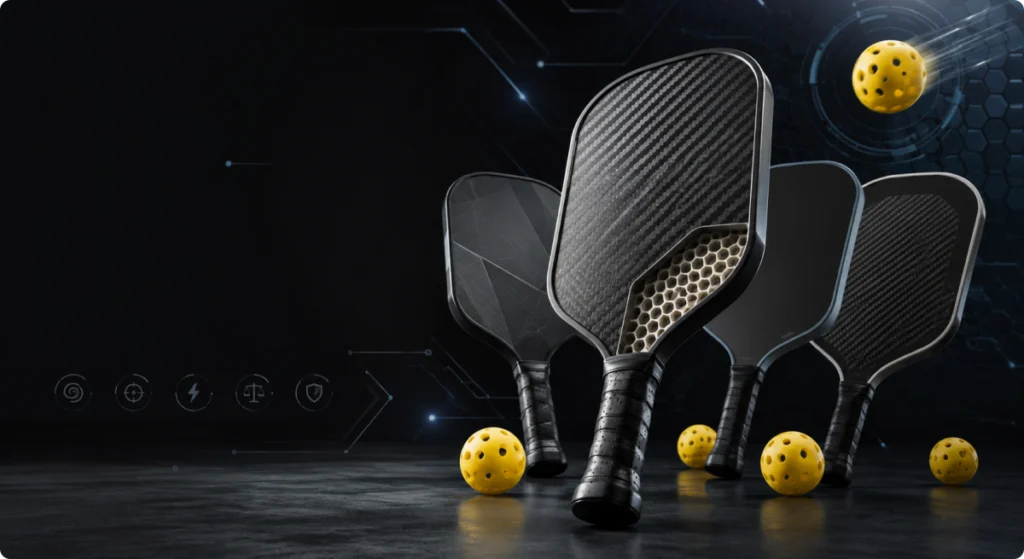
1. Smarter Carbon Fiber and Advanced Paddle Face Materials
The paddle face is what actually contacts the ball, so it has an outsized influence on feel and performance. Carbon fiber has become the dominant material among performance-oriented paddle makers, and the engineering behind it keeps evolving.
You’ll often see references to T700 carbon fiber, a grade originally developed for aerospace and automotive use, prized for its strength-to-weight ratio. Used in a paddle face, it can offer a firm, responsive surface. But the grade is only one factor – how it’s layered, bonded, and finished affects performance just as much as the raw spec.
Raw carbon surfaces – left unpainted or minimally coated – have also become popular for their grittier texture and “performance” look, though raw carbon isn’t automatically superior to a textured fiberglass face; it’s a different approach with its own trade-offs.
This brings us to the ongoing carbon fiber pickleball paddle versus fiberglass debate:
- Carbon fiber faces tend to be stiffer, giving a more consistent, controlled response.
- Fiberglass faces tend to flex more, which some players feel produces a springier, more powerful pop.
Neither material is universally “the best.” It depends on your swing style and what feedback you prefer through your hand. Surface texture matters too – a rougher face can briefly grip the ball on contact, feeding into spin.
Durability is another area where pickleball paddle materials genuinely differ. Carbon fiber surfaces generally resist wear well, while some fiberglass finishes show wear faster under aggressive play. Still, manufacturing quality – how well the face is bonded and finished – often matters more than the base material alone. Don’t buy a paddle purely because the marketing highlights an impressive-sounding material; understand what it actually does for power, control, and durability. You can browse the latest GLIDERZ pickleball paddles to compare carbon fiber and fiberglass options side by side.
2. New Core Technology for Better Power and Control
If the face is the “skin” of a paddle, the core is its skeleton. Most modern paddles use a polypropylene honeycomb core – a lightweight structure of hexagonal cells sandwiched between the two faces. The design isn’t new, but how manufacturers refine it is:
- Core thickness: thicker cores (around 16mm) offer more control and a softer feel; thinner cores (13mm) feel firmer and produce more pop.
- Honeycomb cell structure: smaller, denser cells generally improve control and reduce vibration; larger cells can feel livelier.
- Core density: denser cores give a controlled, “dead” feel good for dinking; less dense cores generate more free power.
Think of the core like cushioning in a running shoe – firmer transfers more energy back into the ball, softer absorbs it for a more controlled response. Neither is “correct”; it depends on what you’re optimizing for.
Manufacturers are also refining how the core bonds to the face, since inconsistent bonding creates dead spots or uneven power. A well-engineered core reduces harsh vibration into your wrist and elbow, helping both comfort and fatigue over long sessions.
Beginners often find thicker, control-oriented cores more forgiving of imperfect contact, while advanced players may prefer thinner, denser cores that reward precise technique with more power. This is exactly the kind of pickleball paddle technology decision worth testing in person rather than judging from a spec sheet.
3. Spin, Surface Texture, and Paddle Face Innovation
Spin has become one of the most talked-about aspects of modern pickleball, and surface technology plays a direct role in how much spin a player can generate. Textured surfaces briefly increase friction between paddle and ball on contact, letting a well-executed swing impart more rotation. Carbon-fiber textures tend to be grittier than smoother fiberglass, which is part of why carbon paddles are often linked to spin-friendly play.
It’s important to resist thinking more texture always means more spin. Spin generation combines surface texture, swing speed and technique, contact angle, and face consistency. A heavily textured paddle in a flat, non-brushing swing won’t spin much more than a smoother one – technique is a multiplier, not a replacement for skill.
Surface consistency matters too. Cheaper paddles can wear unevenly, creating inconsistent spin response, while better manufacturing keeps texture uniform over hundreds of games. As regulations tighten, some governing bodies test surface roughness for fair competition, so tournament-legal paddles must balance spin-friendly texture with compliance – another reason to buy from manufacturers transparent about construction rather than those making vague “maximum spin” claims.
As pickleball has shifted toward strategic dinking, resets, and third-shot drops, spin has become a genuine tactical tool for creating awkward, low-bouncing shots that are hard to attack. This is why pickleball paddle innovations in surface technology have drawn so much attention from serious players recently.
4. Improved Weight Distribution, Shape, and Balance
Paddle shape and weight distribution may be the most underrated aspects of paddle technology, affecting nearly every shot you hit.
Weight: lighter paddles (under ~7.3 oz) allow faster hand speed at the net but sacrifice some drive power; heavier paddles (above 8 oz) generate more power but are harder to maneuver during fast exchanges.
Balance point matters as much as total weight. Head-heavy paddles carry mass toward the top, adding power to drives but slowing reflex volleys. Evenly balanced paddles shift weight toward the grip, favoring quick hands over raw power.
Shape has diversified too. Elongated shapes add reach and leverage for power, at the cost of a smaller sweet spot. Widebody shapes are shorter and wider, offering a larger, more forgiving sweet spot – helpful for players still developing consistent contact.
Practical fit:
- Beginners often do well with widebody, evenly balanced paddles.
- Aggressive players may prefer elongated, head-heavy builds for reach and power.
- Control-oriented players often favor evenly balanced paddles for quick maneuverability.
- Doubles players, who live at the net, often favor lighter, faster paddles over heavier, power-focused ones.
There’s no single “correct” combination – it depends on your playing style, strength, and how you want to construct points.
5. Vibration Reduction and More Comfortable Grip Technology
As players spend more hours on court, comfort has become just as important to manufacturers as raw performance. Anti-shock and vibration-dampening technologies reduce the jarring sensation traveling into your hand, wrist, and elbow on contact, achieved through core design, face bonding, and sometimes added dampening layers.
Grip technology has advanced too. Grip materials vary in tackiness, cushioning, and sweat absorption. Grip circumference affects comfort directly – too thick strains the forearm, too thin causes over-gripping fatigue, which is why manufacturers now commonly offer multiple sizes. Grip length matters for players who like extra room for hand placement during fast exchanges. Sweat management has also improved, with breathable, moisture-wicking wraps helpful for outdoor play in India’s warmer months.
Ergonomics – how naturally the handle fits your hand – affects fatigue over longer sessions. A paddle that feels great for ten minutes but strains your hand after an hour isn’t serving you well, no matter how advanced its face material is.
It’s worth being upfront: paddle comfort is genuinely subjective, depending on hand size, grip style, and playing frequency. Trying a paddle in person, or reading reviews from players with a similar profile, is more useful than relying purely on spec sheets.
6. Customization, Smart Manufacturing, and the Future of Pickleball Paddles
Manufacturing precision is quietly becoming one of the more important pickleball paddle technology stories, even if it gets less attention than flashy materials.
Custom paddle designs and branding have become more accessible, particularly for clubs, academies, and corporate teams. OEM manufacturing – where a factory produces paddles to a client’s specifications under their own branding – has made it easier for smaller pickleball businesses in India to offer branded equipment without building manufacturing infrastructure from scratch.
More precise manufacturing is also improving consistency between paddles of the same model, closing the historical gap where two units of the same paddle felt noticeably different due to inconsistent bonding or weight distribution. Digital design and UV printing have improved graphic durability as well – UV-cured prints bond more securely than older methods and hold up better over months of play.
For bulk, OEM, or custom paddle requirements, contact GLIDERZ to discuss branding, quantity, and design options.
Looking ahead, the broader industry is discussing more standardized ball-response testing and materials analysis that could eventually make paddle specifications easier to compare across brands. It’s worth being clear this is still emerging and not yet universal practice – treat forward-looking claims with the same scrutiny you’d apply to any developing field.
How These Paddle Technology Trends Matter for Pickleball Players in India
Pickleball India has grown from a niche activity into a fast-expanding sport, with new courts, clubs, and academies appearing across metro cities and smaller towns alike. As the player base grows, so does awareness of paddle quality – players are comparing materials, core construction, and manufacturer reputation rather than just picking up whatever’s available locally.
This matters because paddle technology affects how quickly a player improves. A mismatched paddle – say, an overly heavy, power-focused one in a beginner’s hands – can slow learning and even cause strain from overcompensating. The availability of advanced materials has also improved: Indian players can now access carbon fiber faces, honeycomb cores, and textured surfaces without importing gear, which used to be a common workaround.
If you’re new to the sport, it helps to start with the basics – read our guide on what pickleball is before diving into equipment decisions. For those comparing equipment, it’s worth exploring a dedicated resource on the best pickleball paddle in India, which breaks down options across budgets and skill levels.
Before purchasing, check whether the paddle meets recognized construction standards, whether the manufacturer is transparent about materials, whether sizing and grip options are available, and whether it actually suits your playing style rather than a trend. This applies whether you’re an individual looking to buy a pickleball paddle in India, or a club or academy sourcing equipment in bulk.
Retail and bulk requirements have evolved too – academies, clubs, and corporate wellness programs usually favor durable, moderately priced, forgiving paddles over specialized, expensive equipment meant for competitive players. This is where locally manufactured paddles become genuinely relevant. Brands manufacturing within India – including GLIDERZ, which uses carbon fiber and fiberglass face options paired with polypropylene honeycomb cores – can offer more predictable pricing and equipment tuned to Indian conditions, alongside custom branding, OEM, and bulk supply for growing programs.
Pickleball’s growth isn’t limited to India – the sport has expanded rapidly in markets like pickleball in the USA, where paddle standards and innovation have often set early benchmarks that manufacturers worldwide pay attention to.
How to Choose a Pickleball Paddle in 2026
Break the decision into clear categories rather than getting overwhelmed by marketing language:
- Material – carbon fiber favors control and durability; fiberglass favors a springier power feel.
- Core construction – thicker cores favor control; thinner, denser cores favor power.
- Paddle thickness – tied to core thickness; affects feel and tournament compliance.
- Weight – lighter suits fast-hands net play; heavier suits power-driven baseline play.
- Shape – widebody offers forgiveness; elongated offers reach and power.
- Balance – head-heavy adds power; evenly balanced adds maneuverability.
- Surface texture – can assist spin when paired with proper technique.
- Grip – circumference, length, and material should match your hand and intensity.
- Playing style – drivers, dinkers, and all-court players benefit from different combinations above.
- Budget – higher price often reflects materials and manufacturing consistency, more relevant for advanced players.
- Durability – look for transparency about bonding, core quality, and expected lifespan.
- Manufacturer quality – consistency, support, and warranty matter as much as specs.
- Certification/compliance – confirm tournament approval if you plan to play competitively.
The “best” paddle isn’t the same for every player – one a tournament player loves might feel wrong for a beginner still learning basic dinks and drives.
Beginners should prioritize forgiveness: a widebody shape, moderate weight, and a thicker, control-friendly core. Intermediate players should lean into their natural tendencies – drivers can try head-heavy or elongated options, soft-game players should stick with evenly balanced control paddles. Advanced players can fine-tune around specific strengths, from thinner cores for finishing power to lighter builds for hand speed. Competitive players should prioritize compliance and manufacturer quality control. Clubs and academies generally benefit more from durable, versatile paddles available in bulk at consistent quality than from specialized, premium equipment.
Frequently Asked Questions About Pickleball Paddle Technology
What are the biggest pickleball paddle technology trends in 2026? Refined carbon fiber and fiberglass constructions, evolving honeycomb core designs, more attention to spin-generating surface texture, varied paddle shapes and weight distributions, and better vibration-dampening and grip comfort. Manufacturing consistency and customization have also advanced, giving players more reliable, personalized options.
Is carbon fiber better than fiberglass for pickleball paddles? Neither is universally better. Carbon fiber offers a stiffer, more controlled response and strong durability; fiberglass flexes more, producing a springier feel some players associate with extra power. The right choice depends on your swing style and whether you prioritize control or power.
How does paddle core technology affect performance? The core determines how much energy is absorbed versus returned on contact. Thicker, denser cores favor control and reduce vibration; thinner, less dense cores produce more power with a firmer feel, also affecting how forgiving the paddle feels on off-center hits.
Does a textured paddle surface create more spin? Texture helps by briefly increasing friction on contact, but it isn’t the only factor – swing technique, contact angle, and surface consistency matter just as much. A flat, non-brushing swing won’t generate much extra spin from texture alone.
What paddle shape is best for beginners? Widebody shapes with a larger sweet spot are generally more forgiving, tolerating off-center contact better than elongated shapes. Paired with moderate weight and a thicker, control-oriented core, this combination makes early learning less frustrating.
How does paddle weight affect gameplay? Lighter paddles allow faster hand speed and quicker reactions at the net, benefiting doubles and reflex volleys. Heavier paddles generate more power with less swing effort but can feel slower to maneuver during fast exchanges.
What should I look for when buying a pickleball paddle in India? Check face material, core construction, weight, shape, and grip size against your playing style and skill level. Confirm construction standards for competitive play, and consider manufacturer transparency, especially with growing options to buy a pickleball paddle in India from both established and newer local brands.
Are advanced pickleball paddles worth the investment? For intermediate and advanced players with a clear sense of their style, better materials and consistent manufacturing can meaningfully improve performance and comfort. Beginners often benefit more from an affordable, forgiving paddle while developing fundamental technique first.
Conclusion
Pickleball paddle technology has moved well beyond face colors and marketing slogans. Today’s paddles reflect real engineering decisions across carbon fiber and fiberglass face materials, honeycomb core structures, surface texture for spin, shape and weight distribution, and grip and vibration-dampening systems designed for comfort during long sessions. Manufacturing precision and customization are also playing a growing role, giving clubs, academies, and individual players more consistent, personalized equipment than before.
None of this means chasing the paddle with the most advanced-sounding specifications. The right paddle matches your playing style, comfort needs, and skill level – not the flashiest carbon weave or boldest marketing claim. Testing a few options and buying from manufacturers transparent about their materials will serve most players better than following trends blindly.
As Pickleball India continues to grow, brands like GLIDERZ are part of a broader shift toward accessible, well-engineered equipment built with Indian players and playing conditions in mind – without needing to look abroad for quality gear.
👉 “Looking to start playing? Explore GLIDERZ Pickleball paddles – Made in India for Indian players.”