
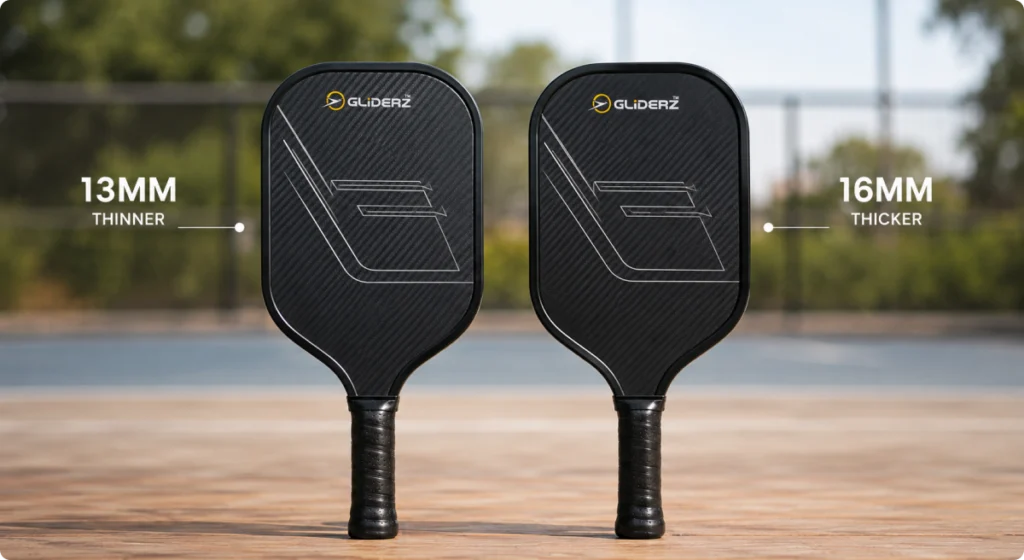
If you’ve spent even twenty minutes browsing paddles online, you’ve probably noticed that every listing mentions core thickness – 13mm, 14mm, 16mm – like you’re supposed to already know what it means. You’re not alone if you don’t. The 13mm vs 16mm pickleball paddle debate is one of the most common questions new and intermediate players ask, and honestly, it deserves a proper answer instead of a one-line spec sheet.
Core thickness isn’t just a number manufacturers throw on a box. It directly changes how the ball comes off your paddle face – how much pop you get on a drive, how soft your dinks feel, how forgiving the sweet spot is when you’re not hitting dead centre. In this 13mm vs 16mm pickleball paddle guide, we’ll break down exactly what separates a 13mm paddle from a 16mm one, who each is built for, and how to pick the right thickness for your own game, whether you’re just starting out on a badminton court turned pickleball court or you’re already grinding out tournaments.
As Pickleball India grows year after year, more first-time buyers are landing on this exact question before their very first purchase, and getting it right early saves a lot of trial and error later.
What Does Paddle Thickness (Core Thickness) Actually Mean?
Every composite pickleball paddle has three main layers: the outer face (usually fibreglass, carbon fibre, or a graphite blend), the core in the middle, and a resin layer holding it together. Core thickness refers to the depth of that middle layer, measured in millimetres. Most paddles on the market today fall somewhere between 11mm and 16mm, with 13mm and 16mm being the two most popular benchmarks – think of them as the two ends of the spectrum that most other thicknesses sit between.
The core is almost always made from a honeycomb polymer material, and its job is to absorb shock and determine how much the paddle face flexes on contact. A thinner core flexes less on impact, which means energy transfers to the ball faster – more pop, more power, less time the ball spends “sitting” on the paddle face. A thicker core absorbs more of that shock itself, which softens the response and gives you more time to feel and control the ball before it leaves the paddle.
This is really the whole story in one sentence: thinner cores trade control for power, thicker cores trade power for control. Everything else in this 13mm vs 16mm pickleball paddle breakdown is really just an expansion of that one trade-off.This is really the whole story in one sentence: thinner cores trade control for power, thicker cores trade power for control. Everything else in this article is really just an expansion of that one trade-off.
It’s worth noting that paddle thickness works alongside other specs – weight, grip size, and face material – to shape overall feel. A 16mm paddle with a stiff carbon face can still hit harder than a 13mm paddle with a softer fibreglass face. So thickness matters, but it’s one variable among several, not the whole equation. If you’re brand new to the sport and terms like “core,” “face material,” and “dink” still feel unfamiliar, it’s worth first reading up on what is pickleball before diving into equipment specs – it’ll make the rest of this guide click faster.
13mm Paddles: Pros, Cons & Best For
A 13mm paddle sits on the thinner end of the spectrum. Because there’s less honeycomb material to flex and absorb energy, the ball comes off the face noticeably faster. Among Pickleball India players who favour aggressive, fast-paced rallies, the 13mm option remains a popular pick.
Pros:
- More power with less swing effort. You don’t need a full, aggressive swing to generate pace – the paddle does more of the work for you.
- Faster ball speed on drives. If your game relies on hard, flat groundstrokes to push opponents back, a 13mm core gives you an edge.
- Often lighter overall. Thinner cores generally (though not always) mean a lighter paddle, which helps with quick reflex volleys at the net.
- Good for players transitioning from tennis or badminton. If your instinct is to generate your own power rather than rely on paddle feel, a 13mm paddle feels more familiar.
Cons:
- Smaller margin for error on soft shots. Dinks and resets can fly further than intended because the paddle naturally adds pop, even when you don’t want it.
- Less forgiving sweet spot. Off-centre hits tend to feel harsher and less controlled compared to a thicker core.
- Can be tiring on the arm over long sessions. More vibration transfers through to your wrist and elbow since the core absorbs less shock itself.
Best for: Aggressive baseline players, those who already generate power naturally and want a paddle that keeps up, and players who prioritise put-away shots over soft-game finesse.
16mm Paddles: Pros, Cons & Best For
A 16mm paddle is on the thicker end, and it’s become the default recommendation for a large chunk of the Pickleball India community – especially as the sport is still growing here and a lot of players are picking up a paddle for the very first time.
Pros:
- Larger, more forgiving sweet spot. Off-centre contact still produces a usable shot instead of a mishit.
- Better control on dinks and third-shot drops. The extra core depth absorbs energy, so soft shots stay soft even if your touch isn’t perfect yet.
- Reduced arm and elbow strain. More shock absorption means less vibration reaching your joints – a real factor if you’re playing multiple times a week.
- More consistent at the non-volley zone (the kitchen). Since so much of competitive pickleball is decided at the net with soft, controlled shots, this thickness suits that style of play.
Cons:
- Less inherent power. You’ll need a bit more swing speed to generate the same pace you’d get from a thinner core.
- Slightly heavier in some models. Not always true, but thicker cores can add a touch more weight depending on the honeycomb density used.
- Can feel “dead” to players used to tennis-style power. If you’re chasing that satisfying pop on every shot, a 16mm might initially feel underwhelming.
Best for: Beginners still building touch and consistency, doubles players who spend a lot of time at the kitchen line, and anyone managing early signs of tennis elbow or wrist strain.
13mm vs 16mm Pickleball Paddle: Head-to-Head Comparison
Here’s how the two stack up when placed side by side in this 13mm vs 16mm pickleball paddle comparison – the kind of control vs power pickleball paddle breakdown worth bookmarking before you buy.
| Factor | 13mm Paddle | 16mm Paddle |
|---|---|---|
| Power | High – fast ball speed with minimal effort | Moderate – power needs to come from your swing |
| Control | Lower – less margin on soft shots | High – better touch on dinks and drops |
| Sweet Spot | Smaller, less forgiving | Larger, more forgiving |
| Arm Fatigue | Higher – more vibration transfer | Lower – better shock absorption |
| Spin Potential | Moderate, face-material dependent | Slightly better feel for controlled spin |
| Best Skill Level | Intermediate to advanced, power-focused players | Beginners to advanced all-round/soft-game players |
| Typical Price Range in India | ₹2,500 – ₹6,500 | ₹2,800 – ₹7,000 |
A quick reality check on spin: thickness itself doesn’t create spin – the paddle face’s grit and texture does most of that work. But because 16mm paddles give you more time and control over the ball at contact, many players find it easier to execute deliberate spin shots consistently, even if the raw spin ceiling depends more on the surface than the core.
Which Thickness Should Beginners, Intermediate & Advanced Players Choose?
Your skill level plays a bigger role in the 13mm vs 16mm pickleball paddle decision than most buyers expect, so here’s how it breaks down by stage.
Beginners: Start with a 16mm paddle. When you’re new, most of your points are lost – not won – through unforced errors: overhit dinks, mistimed volleys, shots that fly long because the paddle added more zip than you expected. A 16mm paddle’s forgiving sweet spot and softer response buys you time to build fundamentals without the paddle working against you. If you’re researching your first purchase, our guide to the best pickleball paddle in India breaks down specific models across price points that fit this exact need.
Intermediate players: This is where personal playstyle starts to matter more than a blanket recommendation. If you’ve settled into a net-heavy, patient game built around resets and dinks, stick with 16mm. If you’re the player who wins points by driving hard and taking the ball early, a 13mm – or a mid-range 14mm hybrid – might suit you better. A lot of intermediate players actually own two paddles for exactly this reason.
Advanced/competitive players: At this level, the decision comes down to strategy rather than confidence. Many top competitive players still choose 16mm paddles because modern face technology (raw carbon fibre, textured surfaces) has closed a lot of the power gap that used to exist. You get near-16mm control with power that rivals a 13mm core, which is why thicker paddles have become the more common tournament choice over the last couple of years – though 13mm and 14mm options still have a loyal following among power-first players.
How to Choose the Right Paddle Thickness for Your Game
A few practical questions to run through before you buy:
- What’s your natural playstyle? Power-hitters lean 13mm; control-and-touch players lean 16mm.
- Do you already have arm, elbow, or wrist issues? Go thicker. The extra shock absorption genuinely makes a difference over repeated sessions.
- How often do you play? If it’s a couple of times a month, a beginner-friendly 16mm all-rounder will serve you better than a specialised power paddle. If you’re playing multiple times a week and know your game, you can afford to specialise.
- What’s your budget? Thickness alone doesn’t dictate price – face material and brand matter more. You can find solid options at both thicknesses across most budget ranges.
- Indian playing conditions matter too. A lot of courts here are outdoor, concrete-based, and used in heat and humidity for long stretches. A slightly heavier or thicker paddle can feel more tiring in a 35°C afternoon session than it would in cooler climates, so factor grip comfort and overall paddle weight into your decision alongside core thickness.
If you’re still unsure after weighing all this, don’t guess – get in touch with our team and we’ll help you match a paddle to your actual game, not just a spec sheet.
For anyone wanting the official word on paddle specifications and certified equipment standards, USA Pickleball maintains the approved paddle list and equipment rules that most competitive events reference, including in growing markets like Pickleball India.
As Pickleball India courts open up across cities – from Mumbai and Bangalore to Delhi NCR – more players are asking this exact 13mm vs 16mm pickleball paddle question for the first time. Getting the thickness right early saves you from buying two or three paddles before landing on the one that actually fits your game. Whether you’re looking to buy a pickleball paddle in India for casual weekend play or you’re chasing the best pickleball paddle in India for competitive league matches, thickness should be one of the first specs you check – right alongside weight and grip size.
Common Myths About Paddle Thickness
Before you make a final call in the 13mm vs 16mm pickleball paddle decision, it’s worth clearing up a few misconceptions that trip up a lot of first-time buyers.
Myth 1: Thicker always means heavier. Paddle weight depends on the honeycomb density, face material, and edge guard construction – not just core depth. You’ll find plenty of 16mm paddles that weigh less than some 13mm models. Always check the listed weight separately from thickness.
Myth 2: A thinner paddle is always “better” because pros use it. Professional player preferences shift with technology. A few years ago, thinner cores dominated pro play because face materials couldn’t generate power on their own. That’s changed – raw carbon faces now produce plenty of pop even on a 16mm core, which is part of why so many competitive players have moved thicker.
Myth 3: You’ll instantly feel the difference between 13mm and 16mm. For brand-new players, the difference is noticeable but subtle at first – it becomes far more obvious once you’ve played 15-20 sessions and developed a consistent swing. Don’t judge a paddle after just one match.
Myth 4: Core thickness is the only thing that affects power and control. It’s a major factor, but face material (fibreglass vs carbon fibre vs graphite), paddle length, grip circumference, and even string tension on the honeycomb pattern all play a role. Treat thickness as one input in a bigger decision, not the entire answer.
Getting these myths out of the way makes the 13mm vs 16mm pickleball paddle choice a lot more straightforward – it comes down to your game, not just what’s trending.
Why GLIDERZ Builds Both Thicknesses for Pickleball India
At GLIDERZ, we didn’t want to force every player into one core thickness, because the truth is there isn’t a single “correct” answer for every game style. Our paddle lineup covers both 13mm and 16mm options, engineered and tested specifically for conditions common across Pickleball India – outdoor concrete courts, high heat and humidity, and players who are often picking up a paddle for the very first time in their lives.
Each GLIDERZ paddle goes through face and core testing to make sure the power-to-control balance holds up over repeated sessions, not just in a single demo hit. Whether you’re leaning toward a thinner core for faster drives or a thicker one for a steadier soft game, explore GLIDERZ pickleball paddles to see specs, weight, and grip details side by side before you decide.
FAQs
Is 13mm or 16mm better for beginners? 16mm is generally better for beginners because of its larger sweet spot and softer, more forgiving response. It gives new players more room for error while they’re still learning shot control and paddle positioning.
Does a thicker paddle core mean less power? Not always, but generally yes with all else equal. Thicker cores absorb more shock and flex less on contact, which softens the ball’s exit speed. Face material and swing technique can still make up a lot of that difference.
Which paddle thickness reduces tennis elbow risk? 16mm paddles are usually recommended for players managing elbow, wrist, or shoulder strain because they absorb more vibration on contact, transferring less shock through your arm.
Can I use a 13mm paddle for dinking and soft game? You can, but it takes more finesse and control since the paddle naturally adds pop even on soft shots. Most players find a 16mm paddle easier for consistent dinking and resets.
What thickness do professional pickleball players use? It varies, but a large number of competitive and professional players use 16mm paddles today, largely because modern paddle face technology has narrowed the power gap that used to favour thinner cores.
Is there a middle-ground option between 13mm and 16mm? Yes – 14mm paddles exist specifically as a hybrid option, offering a blend of power and control for players who don’t want to commit fully to either extreme.
👉 Looking to start playing? Explore GLIDERZ Pickleball paddles – Made in India for Indian players.