
Walk into any sports store in India right now and ask for a pickleball ball, and you’ll probably get handed whatever’s on the shelf – no questions asked about whether you play indoors or outdoors, on concrete or on a wooden court. That’s a problem, because the wrong ball doesn’t just bounce weird. It can throw off your entire game and leave you wondering why you’re shanking shots that used to be routine.
Finding the best pickleball ball isn’t about grabbing the most expensive pack or the one with the flashiest packaging. It comes down to a handful of specifics – material, hole pattern, hardness, and how it holds up against Indian heat and rough outdoor surfaces. Get those right, and you’ll stop replacing cracked balls every second week. In this guide, we’ll walk through everything a beginner (and honestly, a lot of intermediate players too) needs to know before buying.
If you’re brand new to the sport altogether, it’s worth first reading our breakdown of What is Pickleball before you get into the gear weeds.
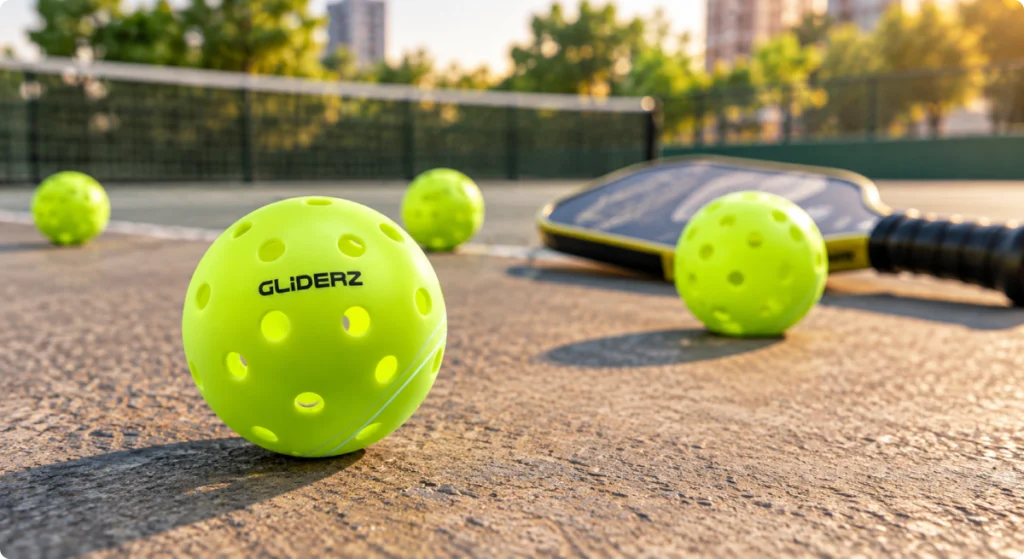
Indoor vs Outdoor Pickleball Balls: What’s the Difference?
This is the single most common mistake I see at courts across India – someone shows up to an outdoor session with an indoor ball, plays two rallies, and then wonders why the ball cracked or why it’s bouncing like it’s half-dead.
Indoor and outdoor pickleball balls are built differently, even though they look almost identical at first glance.
- Indoor balls have larger, fewer holes (usually around 26), a softer plastic construction, and are designed for smooth wooden or gym-court surfaces. They’re lighter and built to fly true in still air, since there’s no wind to fight indoors.
- Outdoor balls have smaller, more numerous holes (usually 40), a harder and thicker shell, and are built to resist wind drift and rougher surface impact. They’re heavier, which helps them cut through breeze on an open court.
In India, this distinction actually matters more than in a lot of other countries, because so much of our pickleball is played outdoors on repurposed tennis or basketball courts – concrete, asphalt, sometimes even terrace flooring. An indoor ball on concrete will crack within a session or two. It’s just not built for that kind of abrasion.
If you’re not sure which one you need, ask yourself where you play most. If it’s 80% outdoor sessions, buy outdoor balls as your default and keep one indoor pack for the occasional gym-court game.
Here’s a quick side-by-side if you want the specs at a glance:
| Feature | Indoor Ball | Outdoor Ball |
|---|---|---|
| Hole count | ~26 larger holes | ~40 smaller holes |
| Shell hardness | Softer | Harder |
| Weight | Slightly lighter | Slightly heavier |
| Best surface | Wood, gym courts | Concrete, asphalt |
| Wind performance | Not built for wind | Cuts through wind |
| Typical lifespan outdoors | Cracks fast on concrete | Built for abrasion |
Keep this table in mind when you’re comparing listings online – a lot of Indian sellers don’t clearly mention which category a ball falls under, so checking hole count and shell description before ordering saves you a wasted purchase.
Material & Durability: What Makes a Ball Last
Every pickleball ball is made from some form of durable plastic – usually a variant of polymer resin – but not all plastics are equal. Cheap balls, especially the unbranded ones flooding online marketplaces right now, tend to use a thinner, more brittle plastic that cracks the moment it hits a hard surface at pace.
Here’s what actually affects pickleball ball material quality and lifespan:
- Wall thickness – thicker outdoor shells survive concrete and asphalt courts far longer than thin-walled budget balls.
- Seam construction – a ball molded in one seamless piece (rather than glued in two halves) resists splitting under impact.
- UV resistance – outdoor balls left in Indian sun for hours can go brittle and discolored fast if the plastic isn’t UV-stabilized. This is a bigger deal here than in cooler climates, given how intense our summer sun gets.
- Hole uniformity – inconsistent hole sizing (common in poorly manufactured balls) causes unpredictable flight and premature cracking around the hole edges.
In my experience, the cheapest balls on the market look fine out of the box but start cracking within a week of regular outdoor play – especially once temperatures cross 35°C, when the plastic gets more brittle by the hour. A genuinely durable pickleball ball should survive several weeks of regular outdoor play before you see hairline cracks, not days.
Bounce, Weight & USA Pickleball Approval Standards
Bounce consistency is where a lot of budget balls fall apart – sometimes literally. A ball that bounces low on one shot and high on the next isn’t a minor annoyance; it actively messes with your timing and shot selection, especially on drop shots and dinks where precision matters most.
The internationally recognized reference point for ball specifications comes from USA Pickleball, the sport’s governing body in the United States, which maintains an official equipment approval list covering ball weight, diameter, bounce height, and hardness. A ball on their approved list has been tested to meet:
- Weight between roughly 22-26.5 grams
- Diameter around 2.87-2.97 inches
- Bounce height of 30-34 inches when dropped from 78 inches onto a granite surface
- Consistent hardness so the ball doesn’t go soft or oversized in heat
You don’t need an approved ball for a casual weekend hit with friends. But if you’re training seriously, playing in club matches, or prepping for any tournament format, buying USA Pickleball approved balls (or balls tested to those same specs) removes a huge variable. You’ll know the ball itself isn’t the reason your third shot drop keeps landing short.
Weight in particular affects power transfer. A slightly heavier outdoor ball needs a touch more paddle speed to generate the same pace as a lighter indoor ball – something worth remembering if you regularly switch between the two.
How to Test a Pickleball Ball Before You Commit to a Pack
If you’re buying in person rather than online, don’t just eyeball the packaging – actually check the ball itself. A few seconds of testing at the counter can save you a frustrating first session.
- Squeeze it gently. A good ball should have a firm, consistent give across its entire surface. If one section feels noticeably softer or harder than the rest, the molding is uneven and the bounce will be too.
- Roll it on a flat surface. Watch for wobble. A true, round ball rolls in a straight, steady line – any noticeable wobble usually means the ball isn’t perfectly spherical, which will show up as inconsistent bounce on court.
- Check the seam line. Run a finger around it. A raised or rough seam usually means a two-piece glued construction, which is more prone to splitting than a seamless mold.
- Look through the holes. Peek inside – you’re checking for uneven wall thickness, which is a common defect in cheaper balls and a leading cause of early cracking.
If you’re ordering online, this obviously isn’t possible upfront, so lean on brand reputation, buyer reviews mentioning durability specifically (not just “good ball”), and whether the listing states hole count and intended surface clearly.
Best Pickleball Balls for Indian Weather & Courts
This is where a lot of imported buying guides fall short – they’re written for climates that don’t deal with 40°C summers, monsoon humidity, and dusty outdoor courts all in the same calendar year.
A few things to specifically look for if you’re buying for Indian conditions:
- Heat tolerance: Balls that go soft or slightly oversized in extreme heat will bounce inconsistently. Look for balls specifically rated for outdoor/high-temperature use rather than generic all-weather claims.
- Grit and dust resistance: Outdoor concrete courts in India tend to be dustier than the manicured courts you’ll see in international pickleball footage. A textured, grippy surface finish on the ball helps maintain spin control even when the court’s a little gritty.
- Colour visibility: Bright yellow or optic-green balls are easier to track under harsh midday sun – a small detail, but it matters when you’re playing at 11 AM in Pune or Bengaluru with the sun directly overhead.
- Monsoon considerations: No ball performs great on a wet court, but balls with better surface grip handle light drizzle and post-rain dampness noticeably better than smooth-shell budget alternatives.
If you’re playing mostly on outdoor courts in cities like Delhi, Hyderabad, Mumbai, or Chennai, prioritize a hard-shell outdoor ball built for abrasion resistance over one marketed purely on “bounce quality” – durability will matter more to your wallet over a season.
How to Choose Between Buying Single Balls vs Bulk Packs
If you’re just testing out the sport, a single pack of 3-6 balls is fine to start. But once you’re playing regularly – or if you run a club, academy, or corporate pickleball session – the math shifts fast in favor of buying in bulk.
Here’s why bulk buying makes sense for regular players and organizers:
- Cost per ball drops significantly – bulk pricing on pickleball balls in India typically works out cheaper per unit than repeated small purchases.
- You always have a spare – nothing kills a rally’s momentum like realizing your last ball just cracked mid-session.
- Consistency across a group – if you’re coaching or organizing, having players use the same ball type keeps gameplay predictable for drills and matches.
- Reduced online shopping friction – ordering once in bulk instead of repeatedly reordering singles saves on delivery time and effort.
If you’re looking to buy bulk pickleball ball packs – whether for a club, an academy, or just your own regular game – it’s worth checking with a supplier who understands Indian court conditions rather than a generic international listing that may not account for our climate.
On pickleball ball price in India, expect a noticeable range depending on quality: unbranded budget packs sit at the low end but sacrifice durability, while balls built with UV-stabilized, thicker-shell plastic sit higher but last considerably longer per rupee spent over a season.
Common Mistakes Beginners Make When Buying Pickleball Balls
Having coached and played with a lot of first-timers, the same handful of mistakes show up again and again:
- Buying based on price alone. The cheapest pack often costs more in the long run once you factor in how fast it cracks.
- Ignoring indoor/outdoor labeling entirely. Many beginners don’t even realize there’s a difference until their ball splits open on a concrete court.
- Assuming all balls bounce the same. They don’t – hardness and hole pattern change bounce behavior significantly, and switching ball types mid-season can throw off your timing for a session or two.
- Not checking for approval standards before serious play. If you’re moving from casual games to structured practice or league play, an unapproved, poorly manufactured ball can genuinely hold your progress back.
- Storing balls in direct sun or a hot car boot. This accelerates plastic degradation faster than actual gameplay does, especially during Indian summers.
- Buying single packs repeatedly instead of bulk. If you play more than twice a week, you’re likely overspending compared to a bulk order.
Most players don’t realize how much of their inconsistency on court comes down to equipment rather than technique – and the ball is the cheapest, easiest variable to fix.
Frequently Asked Questions
What is the best pickleball ball for outdoor play in India? Look for a hard-shell outdoor ball with a 40-hole pattern, UV-resistant plastic, and a textured grip finish suited to concrete and asphalt courts common across Indian cities.
How many holes should a pickleball ball have? Indoor balls typically have 26 larger holes, while outdoor balls have 40 smaller holes. The difference affects wind resistance and bounce behavior.
Can I use an indoor pickleball ball outdoors? Technically yes, but it’s not recommended. Indoor balls are softer and thinner, so they crack quickly on rough outdoor surfaces like concrete or asphalt.
How long does a pickleball ball last? A good-quality outdoor ball can last several weeks of regular play before cracking, while cheaper budget balls may only survive a handful of sessions, especially in high heat.
Are USA Pickleball approved balls necessary for casual play? Not necessary for a casual weekend game with friends, but recommended once you’re training seriously, joining club sessions, or preparing for tournament-style play.
Where can I buy pickleball balls in bulk in India? Several Indian pickleball brands now offer bulk packs online, which work out significantly cheaper per ball than repeated small purchases – ideal for clubs, academies, and regular players.
Does ball color affect visibility on court? Yes, brighter colors like optic yellow or green are easier to track under strong midday sun, which is a real factor on India’s outdoor courts.
👉 Looking to start playing? Explore GLIDERZ pickleball balls – Made in India for Indian players. Have questions about which paddle or ball setup suits your game? Get in touch with our team.