
You line up a dink, swing through it the way you always do, and the ball still sails long or dies weakly into the net. Nothing about your form looked wrong. So what happened? More often than not, the answer isn’t your technique at all – it’s where the ball actually met your paddle face. That small, often misunderstood zone is the pickleball paddle sweet spot, and once you understand how it works, a lot of those “why did that happen” moments start making sense.
For most players, the sweet spot is something they feel long before they can name it. It’s the difference between a shot that feels effortless and one that stings your hand and dribbles off at a strange angle. Understanding this concept doesn’t just satisfy curiosity – it can genuinely change how you choose a paddle and how you approach practice. In this guide, we’ll break down what the sweet spot actually is, why it matters so much on court, what makes some paddles more forgiving than others, and how you can find that ideal contact point more consistently.
If you’re researching a pickleball paddle India option, understanding the sweet spot is especially useful because paddle specifications can vary considerably. Instead of choosing a paddle based only on appearance, price or brand, knowing how the hitting area works gives you a better foundation for comparing different pickleball paddles.
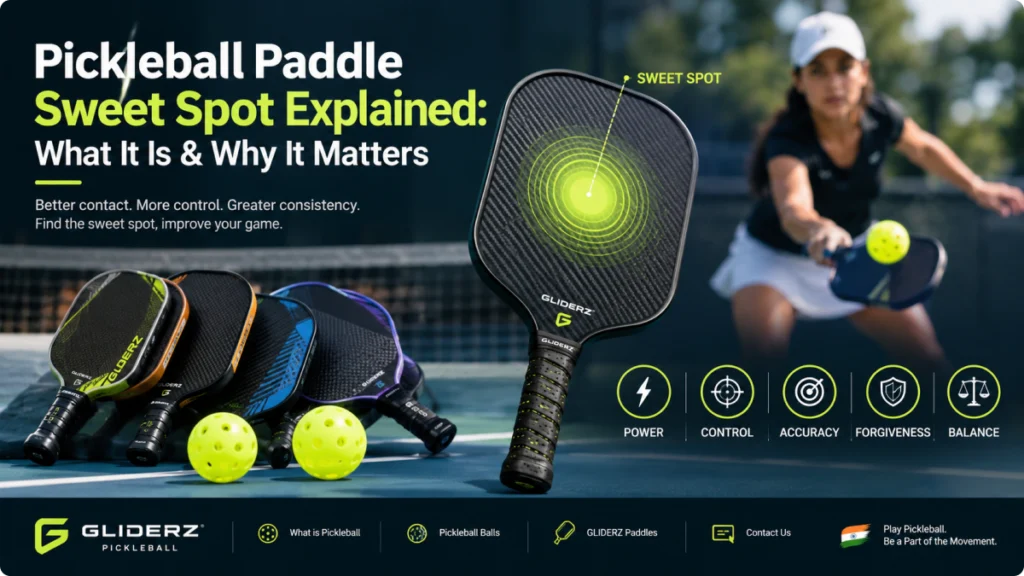
What Is the Sweet Spot on a Pickleball Paddle?
In simple terms, the sweet spot is the area on the paddle face where contact with the ball produces the most efficient, predictable, and comfortable result. Hit the ball here, and energy transfers cleanly – you get solid pop on power shots, soft control on dinks, and very little vibration traveling back into your hand. This is sometimes called the optimal hitting area, and it’s the zone every player is unconsciously trying to find on every single swing.
Most players assume the sweet spot sits exactly in the geometric center of the paddle – the middle point if you measured the face with a ruler. It’s usually close to there, but not identical. The true sweet spot is influenced by the paddle’s center of mass, which depends on how weight is distributed across the head, neck, and handle. On some paddles, particularly those with extra weight near the top, the sweet spot can sit slightly higher than the visual center. On others, it may lean slightly toward the throat. This is why two paddles that look similar on paper can feel noticeably different in your hand.
This is why two pickleball paddles that look similar on paper can feel noticeably different in your hand. The shape, weight, balance, core and face construction all contribute to how the paddle responds when the ball makes contact.
You don’t need a physics degree to notice the pickleball paddle sweet spot – you’ll feel it. A center-contact shot feels quiet, controlled and almost effortless. A shot near the edges or paddle tip, by contrast, often feels harsh, off-balance or accompanied by a rattling vibration.
Beginners frequently notice this without knowing the terminology, describing it as the paddle “working with them” versus “fighting them” on certain shots. Once you connect that feeling to the actual physical concept, you start making better decisions both in rallies and when shopping for a pickleball paddle.
It also helps to understand that the sweet spot isn’t a single pinpoint dot – it’s a region, and its size varies from paddle to paddle. That size, and how forgiving it is when you miss it slightly, is where paddle design starts to matter a great deal.
For players searching for a pickleball paddle India option, this is one of the most useful specifications to understand. A paddle with a forgiving hitting area can make everyday practice more comfortable, particularly while you’re developing consistent technique.
Why Does the Pickleball Paddle Sweet Spot Matter?
The sweet spot affects nearly every quality that makes a shot successful: power, control, accuracy, feel, stability, and consistency. When the ball strikes near the center of the paddle, the face flexes evenly and returns that energy back into the shot in a predictable way. Move away from that zone, toward the edges or near the throat, and the paddle behaves less predictably. Power drops off, the ball can fly off at odd angles, and vibration increases – which is exactly why a mishit often stings your palm or forearm.
This matters differently depending on the shot you’re hitting. On a hard drive, a shot struck away from the sweet spot loses pace and can sail wide or fall short of where you intended. On a dink, off-center contact tends to produce a ball that’s harder to control – either popping up invitingly for your opponent to attack, or dying into the net. Volleys at the kitchen line are especially unforgiving; because there’s so little time to react, hitting even slightly off the sweet spot can send a routine volley into the net or sailing long. Serves and returns, which require consistent depth and pace, also suffer noticeably when contact drifts away from center.
Think about a beginner reaching to volley a fast ball near the edge of the paddle. Instead of a clean block, the shot wobbles awkwardly off the frame area, and the player has almost no control over where it goes. Compare that to a player striking the same volley dead center – the ball comes off cleanly, with predictable pace, even under pressure. That contrast is the sweet spot in action.
Consistency is really the underlying theme here. Players who habitually find the center of the paddle face tend to produce more reliable rallies, fewer unforced errors, and shots that behave the way they expect. This is one reason experienced players talk so much about “clean contact” – it isn’t just a nice phrase, it’s a direct reference to hitting inside that optimal hitting area.
What Makes a Pickleball Paddle Have a Larger Sweet Spot?
Not all paddles are built the same, and the size of the sweet spot varies quite a bit depending on design choices. Several factors influence how large – and how forgiving that zone is:
- Paddle shape – the overall outline of the paddle face
- Paddle width and length – how the surface area is distributed
- Surface area – more total hitting area generally supports a larger sweet spot
- Core construction and thickness – affects how the paddle flexes on contact
- Face material – influences energy transfer and feel
- Weight and balance – where the mass sits changes how the paddle responds
- Edge guard design – protects the frame and slightly affects how close to the edge you can hit comfortably
Paddle shape is one of the biggest factors. Widebody paddles have a shorter, broader face, which typically gives them a larger, more forgiving sweet spot. This makes them a popular choice for players who want consistency and don’t want to be punished heavily for slightly off-center contact. Elongated paddles, on the other hand, trade some of that width for extra length, which extends reach and can add leverage for power, but usually results in a narrower, more concentrated sweet spot. A player using an elongated paddle to stretch for a tough return gets the benefit of extra reach, but has to be more precise to catch the true hitting zone. Standard-shaped paddles sit somewhere in between, balancing forgiveness with maneuverability.
Weight and balance matter too. A head-heavy paddle can shift the sweet spot slightly upward and add power on shots struck near the top, but it may feel less nimble on quick volleys. A more evenly balanced or handle-weighted paddle often feels more maneuverable and can make it easier to reset the sweet spot quickly during fast exchanges at the net.
There’s no free lunch in paddle design – every choice involves trade-offs. A larger sweet spot generally means more forgiveness, but it can come at the cost of maneuverability or the crisp feel that some competitive players prefer. A smaller, more precise sweet spot can reward great technique with sharper power and spin, but it punishes mishits more severely. Recognizing this trade-off is one of the most useful things a player can do before buying new equipment.
How Paddle Materials and Construction Affect the Sweet Spot
Shape and size aren’t the only variables. Paddle construction – the materials and internal structure – plays a major role in how forgiving the sweet spot feels and how energy moves through the paddle on contact.
Carbon fiber paddle faces, including options built with T700 carbon fiber or 3K carbon fiber twill weave, are known for a firm, controlled feel with efficient energy transfer. Many players find that carbon fiber faces produce a more consistent response across a wider portion of the face, which can make the usable hitting area feel more forgiving in practice, even if the “true” sweet spot itself isn’t dramatically larger. Fiberglass surfaces, by comparison, often provide a softer, more powerful pop, which some players prefer for driving shots, though the feel on off-center hits can be slightly less controlled.
Underneath the face, the polypropylene honeycomb core does a lot of the quiet work. Core thickness influences how much the paddle face flexes on contact – thicker cores tend to favor control and touch, while thinner cores often favor power. This flex behavior directly affects how contact feels across the paddle, including how noticeable mishits are outside the sweet spot.
Paddle stiffness and face texture also contribute to overall feel. A stiffer paddle can transfer energy quickly, which benefits power players, while a slightly more flexible paddle can absorb shock and soften the feel on contact, which many players associate with better touch on dinks and resets. Texture on the face can add grip on the ball for spin, but doesn’t meaningfully change where the sweet spot is located.
Finally, vibration absorption matters more than players often realize. Paddles that dampen vibration well tend to feel more forgiving even outside the exact center, because the negative feedback of a mishit – that jarring sting in your hand – is reduced. This is part of why two paddles with similar sweet-spot dimensions can feel completely different to play with. It’s worth noting that none of this is about chasing a single “best” material; it’s about understanding how construction choices shape feel so you can match a paddle to your own game.
How to Choose a Pickleball Paddle With the Right Sweet Spot
There’s no single “best” sweet spot that works for every player – the right choice depends on your skill level, playing style, and physical preferences.
Beginners
New players typically benefit from paddles with a larger, more forgiving sweet spot. Since consistent contact takes time to develop, a widebody shape with a generous hitting area can reduce frustration and help build confidence early on. Forgiveness matters more than raw power at this stage – a paddle that’s kind to off-center hits helps beginners stay in rallies longer and learn shot mechanics without being punished for every small mishit.
Intermediate Players
As technique improves, many players start prioritizing more than just forgiveness. Control, spin potential, and a paddle’s overall feel become bigger considerations. Intermediate players often experiment between widebody and standard shapes, looking for a paddle that still offers reasonable forgiveness but responds more precisely to touch shots like dinks and resets.
Advanced or Competitive Players
At the competitive level, players often know exactly what they want from a paddle and are willing to trade some forgiveness for specific performance traits. An elongated paddle might appeal to someone who wants extra reach and leverage for power, even though the sweet spot is narrower and demands more precise contact. Others prefer a more balanced, standard-shaped paddle that offers a blend of maneuverability and control tailored to their particular style – aggressive net play, baseline power, or an all-court game.
A few practical things to weigh when comparing paddles:
- Do you want more forgiveness or more precision-driven performance?
- Does your game rely more on power, control, or a mix of both?
- Are you comfortable trading some maneuverability for extra reach?
- Does the paddle’s weight and balance suit your arm and playing style?
If you’re exploring GLIDERZ pickleball paddles, you’ll find options built with different shapes and constructions to suit these varying needs – from beginner-friendly forgiveness to more performance-oriented builds for competitive players. It’s genuinely worth trying a paddle in hand, or at least reading detailed specs, rather than choosing based on price or looks alone. And if you’re still getting familiar with the sport itself, it’s worth reading up on What is Pickleball before diving into equipment decisions, since understanding the game’s demands makes it easier to judge what a paddle needs to do for you.
A large sweet spot pickleball paddle can be especially useful for beginners because it provides more forgiveness when the ball does not make perfect contact with the center of the paddle.
GLIDERZ pickleball paddles are designed with the needs of players in India in mind, combining modern paddle construction with characteristics that can support control, consistency and comfortable play.
How to Improve Your Game by Finding the Sweet Spot More Consistently
Even the most forgiving paddle can’t fully compensate for inconsistent contact. The good news is that finding the sweet spot more reliably is a trainable skill, not just a matter of luck.
Start with the basics: watch the ball carefully all the way to contact rather than looking up too early. A surprising number of off-center hits happen simply because a player’s eyes leave the ball a fraction of a second too soon. Pair this with better paddle preparation – getting your paddle back and ready early gives you more time to adjust your position instead of reaching or jabbing at the last second.
Footwork and spacing matter more than most players realize. If you’re consistently too close to or too far from the ball, you’re forced to make contact somewhere other than your natural sweet spot, regardless of how good the paddle is. Small adjustment steps to reset your distance from the ball can make a bigger difference than any equipment change.
On technique, focus on practicing controlled contact rather than swinging hard and hoping. Dedicated dink and volley practice, where the margin for error is small, trains your hands to consistently find center contact under pressure. Wall drills – hitting against a wall or backboard repeatedly – are excellent for building a feel for the paddle face without needing a partner, since the fast repetition quickly reveals whether you’re finding the center or drifting off it. Practicing return-of-serve contact is equally valuable, since it’s one of the shots where players most often mishit due to pace and limited reaction time.
Grip tension deserves a mention too. Avoiding excessive grip tension helps the paddle absorb small contact errors more naturally and gives you better feel overall – a death grip tends to transfer more shock into your hand and can actually make you more sensitive to off-center hits, not less.
Finally, remember that consistent contact starts with a paddle that matches your physical ability and style. A paddle that’s too heavy, too head-light, or shaped in a way that doesn’t suit your swing can undermine even good technique. Pairing solid fundamentals with the right equipment – and reasonable expectations about the learning curve – is the most reliable path to finding your sweet spot more often.
Good practice habits also extend beyond the paddle. Using consistent, quality balls during training – whether that’s a pickleball ball suited for indoor or outdoor play – helps you build a reliable feel for contact, since inconsistent ball quality can make it harder to judge whether a mishit was your technique or the equipment. Clubs and academies training larger groups often look to buy bulk pickleball balls for exactly this reason – consistent equipment across a group makes coaching contact and technique far more effective, whether it’s for casual sessions or pickleball balls for tournaments.
Frequently Asked Questions About Pickleball Paddle Sweet Spots
1. What is the sweet spot on a pickleball paddle? It’s the area on the paddle face where contact produces the most efficient energy transfer – meaning better power, control, and feel with minimal vibration. It sits near the center of the face but is influenced by the paddle’s weight distribution, so it isn’t always exactly in the geometric middle.
2. Why is the sweet spot important in pickleball? Hitting the sweet spot consistently leads to more predictable shots, better accuracy, and less shock traveling into your hand. Since pickleball involves fast exchanges at the net and quick reaction shots, consistent contact directly affects how well you can control rallies.
3. Do larger pickleball paddles have a bigger sweet spot? Generally, paddles with more surface area – particularly widebody shapes – tend to offer a larger, more forgiving hitting area. However, size alone doesn’t guarantee a bigger effective sweet spot; construction, core thickness, and weight distribution all play a role too.
4. Which pickleball paddle shape has the largest sweet spot? Widebody paddles typically offer the largest and most forgiving sweet spot due to their broader face. Elongated paddles usually have a narrower sweet spot in exchange for added reach and leverage, while standard shapes fall somewhere in the middle.
5. Does paddle material affect the sweet spot? Yes, to a meaningful degree. Carbon fiber faces tend to offer a firm, consistent response, while fiberglass surfaces often provide a softer, more powerful feel. Core thickness and vibration absorption also influence how forgiving contact feels across the paddle, even outside the exact center.
6. Is a larger sweet spot better for beginners? In most cases, yes. Beginners are still developing consistent contact, so a more forgiving paddle with a generous hitting area can reduce frustration and help build confidence while technique is still developing.
7. How can I hit the sweet spot more consistently? Focus on watching the ball closely, preparing your paddle early, maintaining good spacing and footwork, and practicing controlled contact through dinks, volleys, and wall drills. Reducing excessive grip tension also helps improve feel and consistency.
8. What should I look for when buying a pickleball paddle? Consider your skill level, playing style, and whether you value forgiveness or precision more. Beginners often benefit from widebody, forgiving designs, while advanced players may prioritize specific shapes, weights, and materials that match their competitive style. It also helps to check official specifications, such as those maintained by USA Pickleball, to understand approved paddle standards before purchasing.
Conclusion
The pickleball paddle sweet spot isn’t just a technical detail – it’s central to how consistently and confidently you play. It’s the zone on the paddle face where clean, efficient contact happens, and it directly shapes your power, control, accuracy, and feel on every shot from dinks to drives. Paddle shape, surface area, core construction, and materials all influence how large and forgiving that zone is, which is why widebody, elongated, and standard paddles each offer a different balance of reach, power, and forgiveness.
There’s no universal “best” sweet spot – the right choice depends on your skill level and how you play. Beginners often benefit from forgiving, generous designs, while more advanced players may prefer paddles that reward precision with sharper performance. Whatever stage you’re at, combining solid technique with a paddle suited to your style is the most reliable way to find consistent contact, rally after rally.
As pickleball in India continues to grow – across recreational courts, clubs, and academies training the next generation of pickleball players in India – understanding equipment fundamentals like this one can make a real difference in how quickly players improve. If you’re evaluating premium pickleball paddles or simply trying to understand pickleball paddle India options before you buy, it helps to start with the fundamentals covered here. For paddle recommendations, product details, or general questions, you can always Contact GLIDERZ directly.
When choosing a pickleball paddle, look beyond power alone. A well-designed pickleball paddle sweet spot can help improve consistency, control and confidence on the court.
👉 “Looking to start playing? Explore GLIDERZ Pickleball paddles – Made in India for Indian players.”