
Pickleball in India is officially India’s fastest-growing racket sport – and for good reason. It’s easier to learn than tennis, faster than badminton rallies, and far more social than squash. Whether you’ve just stepped onto a pickleball court for the first time or you’re still figuring out what is pickleball, one thing stands between you and a great game: knowing your shots.
The good news? You don’t need to master twenty different techniques to play well. Pickleball is built on four core shots, and if you can execute these four confidently, you will immediately compete with players who’ve been playing for months. In this guide, GLIDERZ breaks down each shot in detail – what it is, how to play it, when to use it, and what makes it work on Indian courts.
Ready? Let’s get into it.
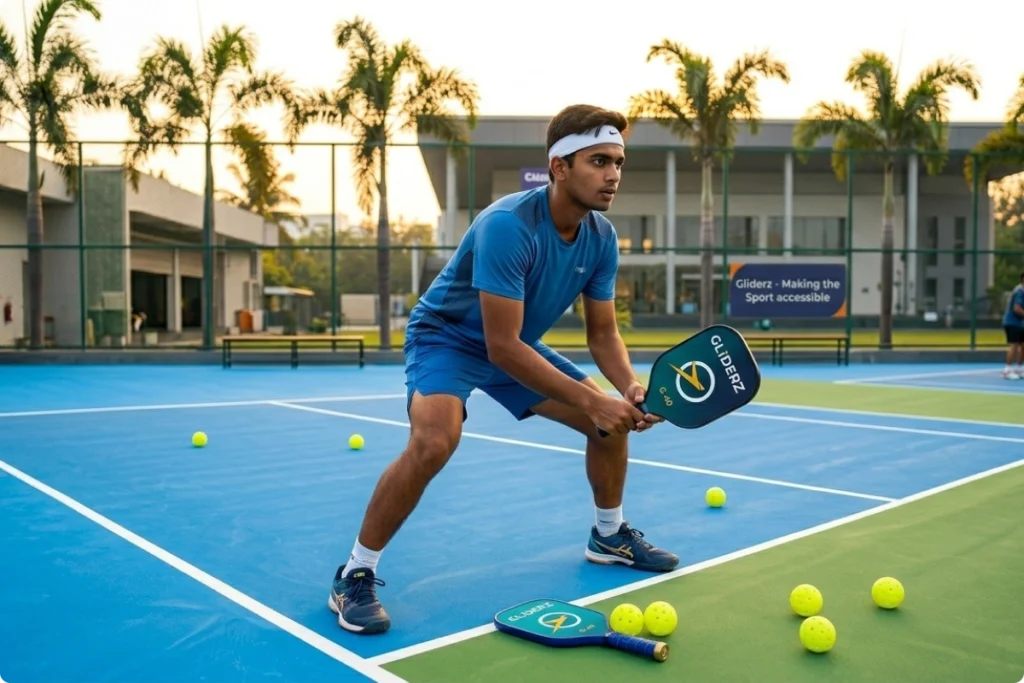
Why Basic Pickleball Shots Matter More Than Power in India
Before we talk technique, it’s worth understanding something most beginners get wrong: pickleball is not about hitting the ball as hard as possible. Unlike cricket or tennis where power wins rallies, pickleball rewards placement, patience, and smart shot selection.
Indian players transitioning from badminton or tennis often over-hit in their first few games. The court is smaller, the ball is slower, and the non-volley zone (called the “kitchen”) punishes aggressive rushing. The players who improve fastest are the ones who understand which shot to play, not just how to hit.
This is also why choosing the best pickleball paddle India has for beginners matters – a well-balanced paddle helps you feel the difference between a dink and a drive, giving you the touch and feedback that accelerates your learning.
Now, let’s break down the four shots you must know.
The 4 Basic Pickleball Shots Every Beginner Must Know
1.The Dink – The Most Important Shot in Pickleball
What it is: The dink is a soft, controlled shot hit from near the kitchen line that arcs gently over the net and lands inside the opponent’s non-volley zone. It barely clears the net – usually just 3 to 6 inches above it – and forces the opponent to hit upward, giving you a positional advantage.
How to play it: Stand close to the kitchen line with your knees slightly bent and your GLIDERZ paddle held in front of you at waist height. Use a short, relaxed push motion – no backswing, no wrist snap. The grip should be loose (about a 4 out of 10 in tightness). Aim for the net tape and let the ball float just over. Keep your elbow soft and let your shoulder guide the shot.
When to use it: During net rallies when both players are at the kitchen line. When you’re out of position and need to reset the point. When your opponent is rushing forward – a low dink forces them to stop and dig. In the Indian summer heat, the dink is your best friend because it conserves energy while keeping you in total control of the rally.
Beginner tip: Most beginners miss dinks into the net. Practice at home by softly tapping the ball upward with your paddle face open. The motion is closer to a gentle chip than a swing.
2.The Drive – Your Attacking Weapon
What it is: The drive is a fast, flat, low shot hit with pace from the baseline or mid-court. It travels in a relatively straight line and is designed to force a weak return or create a setup for a finishing shot. Think of it as the aggressive counterpart to the dink – where the dink is chess, the drive is a quick punch.
How to play it: Take your paddle back early and keep your swing compact. Contact the ball in front of your body at waist height. Follow through toward your target -either cross-court (the longer diagonal) or down the line. Keep the ball low and aim 6–10 inches above the net so it doesn’t sail out.
When to use it: When the opponent is at the net and you’re at the baseline – a sharp drive can jam them or force a pop-up. When you spot an open gap on the court after your opponent moves. When you want to speed up a slow dink rally that isn’t going your way.
Beginner tip: Don’t try to hit the drive too hard. A firm, controlled drive at 70% power with good direction beats a wild swing at 100% every single time.
3.The Volley – Win Points at the Net
What it is: A volley is any shot where you hit the ball out of the air before it bounces on the ground. Volleys are typically played from near the net or mid-court. Because you’re cutting off the ball early, volleys put enormous time pressure on your opponent and can end rallies quickly.
How to play it: Keep your paddle up and in front of your chest – this is called the “ready position” and it’s the most important habit you can build. When the ball comes, use a short, punching motion to redirect it. No big swing. Your paddle face should be firm and slightly angled down so the ball goes low over the net. For backhand volleys, bring your elbow up and push through.
When to use it: When your opponent hits a medium-pace shot and you’re positioned at the net. After a successful approach – move forward and intercept the return before it bounces. During fast exchanges close to the kitchen line.
Beginner tip: Indian players from a badminton background adapt to volleys quickly because the reflex timing is similar. The difference is the shorter swing – think “block and redirect,” not “smash.”
4.The Smash – The Rally Ender
What it is: The smash (also called the overhead) is an aggressive downward shot hit when a high ball or lob floats above your head. When executed well, the smash is almost unreturnable – it’s the most powerful and satisfying shot in the game.
How to play it: As soon as you see a high ball coming, take a step back to position yourself under it. Point your non-paddle hand toward the ball to track it, turn your shoulder sideways, and raise your paddle above your head. Contact the ball at the highest point you can reach, and drive it downward steeply into the opponent’s kitchen or sideline gap. Snap your wrist slightly at contact for extra pace.
When to use it: When the opponent hits a defensive lob that lands too short. When you’re at the kitchen line and they attempt a sky-high reset. After a strong approach shot forces a panicked high return.
Beginner tip: Don’t rush the smash. The biggest mistake beginners make is swinging too early. Let the ball come to its peak, track it, then fire. A patient smash wins; a rushed one goes into the net or flies long.
Putting It All Together – How These 4 Shots Work as a System
Here’s the thing every beginner should know: these four shots don’t work in isolation. They work as a system. A match point in pickleball often looks like this – you drive from the baseline, force a weak return, move into the net, play a few patient dinks to take control, then the opponent panics and lobs, and you finish with a smash. Drive → Volley → Dink → Smash. That’s pickleball.
The paddle you use plays a bigger role in this system than most beginners realize. A heavy paddle makes dinks clumsy. A too-light paddle makes drives feel weak. For Indian players learning all four shots, GLIDERZ paddles are specifically engineered with the right weight balance and grip size for Indian hand dimensions and playing style – giving you touch on the dink and power on the drive without changing your technique.
Frequently Asked Questions About Pickleball Shots in India
Q1: What is the most important shot to learn first in pickleball? The dink is the single most important shot for any beginner to learn first. It controls the pace of the game, reduces unforced errors, and forces opponents into difficult positions. Players who master the dink early consistently outperform those who focus only on power shots. Most professional pickleball coaches — including those at GLIDERZ clinics — recommend spending at least 60% of your first month of practice on dinking drills.
Q2: How is the pickleball drive different from a tennis forehand? The pickleball drive uses a much shorter swing than a tennis forehand. Because the pickleball court is smaller and the ball is lighter, a full tennis swing generates too much pace and sends the ball out of bounds. The drive in pickleball is a compact, punch-style motion with a short backswing and controlled follow-through. The contact zone and footwork principles are similar, which is why tennis players pick up the drive quickly – but adjusting the swing length is the critical habit to develop.
Q3: Can I play pickleball if I have never played a racket sport before? Absolutely. Pickleball has one of the fastest learning curves of any racket sport, making it ideal for complete beginners across all age groups. The court is small, the ball is slow enough to track easily, and the four core shots can be learned in two to three practice sessions. Many players across India who took up pickleball with no prior racket sport background were playing competitive games within their first month.
Q4: What type of pickleball paddle is best for learning these shots as a beginner in India? Beginners in India should look for a mid-weight paddle between 7.5 and 8.2 ounces with a polymer honeycomb core. This combination gives you the touch needed for dinks without sacrificing power on drives. GLIDERZ paddles are designed specifically for the Indian market — accounting for local temperature conditions, court surfaces, and the grip preferences of Indian players. You can explore the full range on the GLIDERZ product page.
Q5: Is pickleball popular in India, and where can I play? Pickleball is growing at a remarkable pace across India. Courts are now active in major cities including Mumbai, Delhi, Bengaluru, Hyderabad, Pune, Chennai, and Ahmedabad. India has its own national pickleball association, and local clubs and academies are opening regularly. GLIDERZ – as an Indian manufacturer – is actively supporting the sport’s growth with equipment, training resources, and community programs for players of all levels.
Q6: How do I stop making mistakes with my dink shot? The most common dink mistakes beginners make are: hitting the net (paddle face too closed), sending the ball too high (swing is too big), and losing balance (standing upright instead of bending the knees). Fix all three by practicing the dink as a push – not a swing. Use a loose grip, open paddle face slightly, and stay low with knees bent throughout. Practice 50 dinks in a row before each session until the motion becomes automatic.
👉 Looking to start playing? Explore GLIDERZ Pickleball paddles – Made in India for Indian players. Whether you’re perfecting your dink or unleashing your smash, GLIDERZ paddles are engineered for every shot in your game.