
If you’ve spent even ten minutes browsing pickleball paddles online, you’ve probably noticed something: no two paddles look, feel, or perform quite the same way. Some are wide and forgiving. Others are long and built for reach. Some have a stiff carbon face, while others flex slightly on contact. This isn’t random variation – it’s intentional design, and understanding it can make a real difference in how confident you feel on the court.
Whether you’re picking up a paddle for the first time or considering an upgrade, knowing the different types of pickleball paddles available will help you make an informed choice rather than guessing based on price or packaging. Paddles typically differ across shape, material, core construction, weight, grip, and surface texture – and this guide walks through each of these factors in plain language, whether you’re shopping in India or anywhere else in the world.
What are the different types of pickleball paddles? Paddles are generally categorised by shape (standard, widebody, elongated, hybrid), material (carbon fiber, fiberglass, composite, graphite), core (polypropylene honeycomb, Nomex, aluminium), and weight (lightweight, midweight, heavyweight). Each combination affects reach, power, control, and manoeuvrability differently.
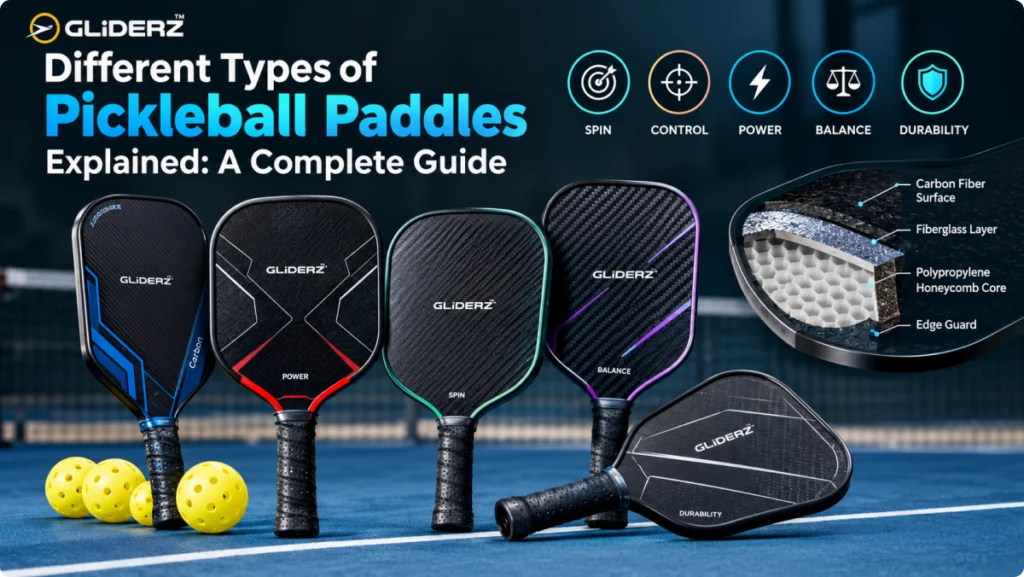
1. Different Types of Pickleball Paddles Based on Shape
Paddle shape is usually the first thing players notice, and it plays a meaningful role in how a paddle feels during play. There are four broad shape categories you’ll come across regularly.
Standard/Classic Paddles
Standard paddles follow a traditional, balanced shape – not too wide, not too long. They offer a fairly even blend of hitting surface and manoeuvrability, which is why many players find them a comfortable, no-fuss starting point.
Widebody Paddles
A widebody paddle has a broader face, which increases the total hitting area. This can make it slightly easier to make contact with the ball, since there’s more surface to work with, which is why many recreational and beginner players gravitate toward widebody designs. The trade-off is usually a shorter handle compared to elongated designs, meaning marginally less reach at the net.
Elongated Paddles
Elongated paddles stretch the length of the paddle face and often the handle too, within standard size regulations. This design tends to appeal to players who value extra reach – useful for stretching to return wide shots or adding leverage on swings. Because the hitting area is narrower relative to its length, some players feel elongated paddles need slightly more precision, especially off-centre.
Hybrid Paddles
Hybrid paddles sit between widebody and elongated designs, borrowing elements of both. The goal is usually a reasonably sized hitting area along with a bit of extra reach, without leaning too far in either direction – a practical middle ground for players unsure whether they prefer a wider face or a longer reach.
No single shape is universally “better.” Shape influences reach, hitting area, manoeuvrability, and balance differently for each player, and personal comfort often matters more than what’s trending. A player with quick reactions and a compact swing might prefer an elongated paddle, while someone who values a larger margin for error might lean toward a widebody design. If you’re still exploring the basics of the sport, our What is Pickleball page is a good starting point.
2. Pickleball Paddle Types Based on Materials
Once you move past shape, the next major differentiator is the material used for the paddle’s hitting surface, which affects how the ball responds on contact and how the paddle feels overall.
What is a carbon fiber paddle? A carbon fiber paddle uses a carbon fiber face, known for being stiff and durable. Many players associate carbon fiber surfaces with a consistent, controlled feel, though actual performance depends on the paddle’s full construction, including its core and build quality.
Carbon Fiber
Carbon fiber pickleball paddle faces are popular largely because of their stiffness and durability. A stiffer face generally transmits more of the player’s swing directly into the shot, which some players associate with a more consistent response, and carbon fiber surfaces tend to hold up well over extended use.
Fiberglass
Fiberglass pickleball paddle faces behave a little differently, with more flex than carbon fiber. This can create a different response on contact – often described as slightly “livelier.” Some players who enjoy generating pace prefer fiberglass for this reason, though the exact feel still depends on how the paddle is engineered as a whole.
Composite Materials
Composite paddles typically combine layers of different materials – often fiberglass blended with reinforcing fibers – to strike a balance between stiffness and flex. A composite pickleball paddle can offer a middle-ground playing feel, which is one reason composite construction remains common across many price points.
Graphite
Graphite is another face material, often grouped with carbon fiber since both are lightweight and rigid. Graphite faces are generally valued for being light without sacrificing too much stiffness, which can make swings feel quicker for some players.
There’s no strict hierarchy among these materials – carbon fiber isn’t automatically “better” than fiberglass, and composite doesn’t universally split the difference. What matters is how the material combines with the core, weight, and shape to produce the feel you’re after. As pickleball paddle materials continue to evolve, more Indian brands now offer a genuine range of options – a welcome shift for players shopping for pickleball paddles India buyers previously had limited access to.
3. Understanding Pickleball Paddle Cores
If the face material shapes how the ball reacts on the surface, the core largely determines how the paddle feels underneath. The core is the internal layer sandwiched between the two paddle faces, and it plays a major role in responsiveness, sound, and the balance between power and control.
What is a polypropylene honeycomb core? A polypropylene honeycomb core is an internal paddle layer made from a honeycomb-patterned polypropylene structure. It’s widely used in modern paddles because it offers a practical balance of weight, durability, and shock absorption, contributing to a comfortable, consistent feel during play.
Polypropylene Honeycomb Core
This core deserves particular attention because it has become something of an industry standard in contemporary paddle construction. The honeycomb structure – small repeating hexagonal cells – provides a good strength-to-weight ratio, meaning the core can be relatively light without compromising much on durability. It also tends to absorb vibration reasonably well, which many players notice as a more comfortable feel on off-centre hits. Because of this, polypropylene honeycomb cores are used across paddles ranging from entry-level to advanced.
Nomex Core
Nomex cores are made from a resin-coated material that is generally harder and denser than polypropylene. This density often translates into a firmer, more responsive feel with a noticeably louder sound on contact. Nomex paddles were more common in earlier paddle generations and are still used today, particularly by players who prefer a crisper response.
Aluminum Core
Aluminium cores use a honeycomb structure similar to polypropylene but made from aluminium instead. These cores are typically very light and can offer a soft, controlled feel, though they may be less durable over time, particularly with frequent hard use.
Core construction directly affects how “forgiving” a paddle feels, how loud it is on contact (relevant for noise-restricted courts), and how the power-versus-control balance leans. None of these cores is inherently superior – they simply produce different playing characteristics, and the right one depends on personal preference and how you play.
4. Pickleball Paddles Based on Weight and Playing Style
Weight is one of the more personal aspects of paddle selection, because it interacts directly with your swing speed, arm comfort, and playing style. Paddles are generally grouped into three broad categories.
Lightweight Paddles
Lightweight paddles are easier to manoeuvre quickly, which can help with fast net exchanges and rapid direction changes. Players who prioritise quick reflexes at the kitchen line, or those managing arm or wrist sensitivity, often find lighter paddles more comfortable over long sessions.
Midweight Paddles
Midweight paddles aim for balance – enough mass to provide natural power without feeling difficult to control. Many recreational and intermediate players use midweight paddles because they don’t require committing fully to either end of the spectrum while still developing their game.
Heavier Paddles
Heavier paddles carry more mass, translating into more inherent power on contact without needing as much added swing speed. Some players who enjoy driving shots find this appealing, though the added weight can require more arm strength and make quick reaction volleys feel more demanding.
Connecting Weight to Playing Style
- Power-oriented play often pairs with heavier paddles or stiffer carbon fiber faces, since more mass and a rigid surface contribute to firmer contact.
- Control-oriented play favours lighter to midweight paddles, where manoeuvrability and touch matter more than raw power.
- Spin-focused play benefits from textured surfaces combined with a weight the player can swing with enough head speed to generate spin comfortably.
- Balanced play usually points toward midweight paddles with a standard or hybrid shape.
There is no universally “best” weight category. Player preference, technique, strength, and comfort all factor in, and trying a few different weights, where possible, remains one of the most reliable ways to figure out what suits you.
5. How to Choose the Right Pickleball Paddle
With so many variables in play, choosing a paddle can feel overwhelming. Here’s a practical checklist.
- Paddle shape – Widebody for a larger hitting area, elongated for extra reach, hybrid for a middle ground, or standard for balanced proportions.
- Paddle weight – Lightweight for manoeuvrability, midweight for balance, heavier for added mass behind shots.
- Grip size – Too large can strain your wrist; too small can cause the paddle to twist in your hand.
- Handle length – Longer handles help with two-handed backhands and reach; shorter handles feel quicker for close-range play.
- Core thickness – Thicker cores often lean toward more control and a softer feel; thinner cores can feel more responsive and power-oriented.
- Surface material – Carbon fiber, fiberglass, composite, or graphite, each offering a different feel, as discussed above.
- Surface texture – Textured faces are generally associated with better ball grip, which can assist with spin.
- Power vs control – Consider whether your game leans toward driving shots or precise placement, and choose weight and material accordingly.
- Spin – If spin is a priority, look at surface texture and a weight you can swing comfortably and consistently.
- Comfort – Vibration dampening and grip comfort matter as much as specifications on paper.
- Durability – Frequency of play and playing surface (indoor vs outdoor) influence how quickly a paddle wears.
- Player experience – Beginners often benefit from forgiving, balanced paddles; advanced players may have specific preferences shaped by technique.
- Budget – A pricier paddle isn’t automatically right for your level; matching it to your stage of play matters more.
Advice by Experience Level
Beginners generally do well with a standard or widebody paddle, midweight construction, and a polypropylene honeycomb core – a forgiving combination that doesn’t demand a steep learning curve. If you’re searching for a pickleball paddle for beginners, prioritising comfort and a larger sweet spot over specialised features is usually a sensible start.
Recreational players often have room to experiment, since they’re playing primarily for enjoyment and fitness. A hybrid shape with a composite or fiberglass face can offer a versatile, well-rounded experience.
Intermediate players typically start developing preferences – perhaps favouring more spin, more reach, or a firmer response – and can narrow their choice around the playing style they’re gravitating toward.
Advanced players usually know precisely what feel they want and can be more deliberate about combining shape, weight, core, and material to complement an established technique.
If you’re specifically looking to buy pickleball paddle India options, consider not just specifications but also after-sales support, availability of spares, and whether a supplier understands the needs of Indian players and courts. When comparing best pickleball paddle India options, look beyond marketing claims and focus on how well the shape, weight, and material line up with your own game. GLIDERZ pickleball paddles are designed with these considerations in mind, and you can browse the current range on our GLIDERZ product page.
6. Pickleball Equipment in India: Paddles, Balls and More
Pickleball India as a sport has been growing steadily, with more courts, clubs, and academies appearing across cities. As participation grows, so does the need for accessible, well-made pickleball equipment India players and organisers can rely on – and that conversation isn’t limited to paddles alone.
Balls are just as important a part of the equation. Indoor and outdoor pickleball balls are built differently – outdoor balls are generally more durable with smaller, more numerous holes to handle wind and rougher surfaces, while indoor balls tend to be lighter with larger holes. You can learn more on our pickleball balls page.
For players simply getting started, a paddle and a sleeve of balls might be enough. But for clubs, academies, retailers, and event organisers, needs look quite different – bulk requirements, consistent quality across units, and reliable supply become far more important than for an individual player. Anyone researching best pickleball ball India options for a club or tournament, or looking to buy bulk pickleball ball supplies for group coaching, will typically have different priorities than a recreational buyer.
GLIDERZ is an Indian pickleball equipment manufacturer offering both paddles and balls, working with players, clubs, academies, and retailers, including support for wholesale and bulk requirements. For businesses with more specific needs, GLIDERZ also offers OEM, private-label, and custom solutions where suitable. Paddle construction across the range may include materials such as carbon fiber, fiberglass, and polypropylene honeycomb cores, depending on the product. If you have questions about sourcing equipment for your club, academy, or retail business, you can contact the GLIDERZ team directly.
Pickleball’s growth isn’t limited to India – the sport continues to expand across the [pickleball market in the USA](INSERT GLIDERZ USA PAGE LINK HERE), and Indian manufacturers are increasingly part of a more connected, global supply chain for paddles and balls alike.
Paddle Comparison at a Glance
| Paddle Type | Main Characteristic | Suitable For | Considerations |
|---|---|---|---|
| Widebody | Larger hitting area | Beginners/recreational players | Less reach than elongated designs |
| Elongated | Longer reach | Players who value reach | May feel less manoeuvrable |
| Hybrid | Balanced size and reach | Players wanting a middle-ground option | Doesn’t maximise either extreme |
| Lightweight | Easy manoeuvrability | Players preferring quick handling | May provide a different power feel |
| Midweight | Balanced handling | Many recreational/intermediate players | Personal preference matters |
| Heavyweight | More mass | Players seeking a heavier feel | Can require more effort to manoeuvre |
| Carbon Fiber | Stiff, durable face | Players interested in a consistent feel | Construction varies by paddle |
| Fiberglass | Flexible face characteristics | Players seeking a livelier response | Performance depends on overall construction |
Frequently Asked Questions About Pickleball Paddles
1. What are the different types of pickleball paddles? Pickleball paddles are generally categorised by shape (standard, widebody, elongated, hybrid), face material (carbon fiber, fiberglass, composite, graphite), and core type (polypropylene honeycomb, Nomex, aluminium). Weight further separates paddles into lightweight, midweight, and heavier options, and together these factors determine how a paddle feels and performs.
2. What pickleball paddle shape is best for beginners? There’s no single “best” shape for every beginner, but many new players find widebody or standard paddles comfortable to start with, since the larger or balanced hitting area can make consistent contact easier while they’re still developing their swing and timing.
3. What is the difference between a widebody and elongated pickleball paddle? A widebody paddle has a broader face, offering a larger hitting area, while an elongated paddle stretches the length for extra reach. Widebody paddles are often considered more forgiving, while elongated paddles can benefit players who want added leverage or reach at the net.
4. Are carbon fiber pickleball paddles better than fiberglass paddles? Neither material is objectively better – they offer different playing characteristics. Carbon fiber tends to be stiffer and more consistent, while fiberglass offers more flex and a livelier response. The right choice depends on personal feel preference and overall paddle construction.
5. What is a polypropylene honeycomb core? A polypropylene honeycomb core is an internal paddle layer built from a honeycomb-patterned polypropylene material. It’s widely used because it balances weight, durability, and shock absorption well, contributing to a comfortable, consistent feel across many modern paddles.
6. What paddle weight should a beginner choose? Many beginners find midweight paddles comfortable, since they balance manoeuvrability and natural power without requiring strong preferences either way. Comfort and personal strength matter too, so trying a few weights before committing is a sensible approach where possible.
7. Which pickleball paddle is better for power? Paddles with more mass, a stiffer face like carbon fiber, and a firmer core tend to be associated with more inherent power. Technique and swing mechanics play a significant role too, so paddle choice alone doesn’t guarantee more powerful shots.
8. Which pickleball paddle is better for control and spin? Lighter to midweight paddles with textured surfaces are often associated with better control and spin potential, since they’re easier to manoeuvre precisely and grip the ball more effectively on contact. Overall construction still plays a significant role in the final result.
9. How do I choose a pickleball paddle in India? Consider your experience level, preferred shape and weight, and budget, while checking for reliable after-sales support and availability of spares. Buying from an established pickleball paddle India supplier who understands local playing conditions can also make the process smoother.
10. What should I look for when buying a pickleball paddle? Look at shape, weight, grip size, core type, and surface material together, rather than just one factor. Matching these to your experience level, playing style, and comfort will generally serve you better than choosing on price or appearance alone.
Final Thoughts
There’s no single paddle design that works best for every player. The right choice comes down to shape, weight, material, core construction, grip comfort, and your own playing style – and even then, personal comfort often has the final say. Understanding the different types of pickleball paddles gives you a much stronger starting point than guessing, whether you’re buying your first paddle or considering an upgrade.
Players outside India can also explore paddle options based on their local market and playing requirements. For customers in the United States, GLIDERZ provides dedicated information on pickleball paddles in the USA, including available paddle solutions and product options.
As pickleball continues to grow across India, players now have access to a genuinely wider range of well-constructed options than ever before. GLIDERZ is part of that growing Indian pickleball ecosystem, offering paddles and balls built with materials like carbon fiber, fiberglass, and polypropylene honeycomb cores. Whatever stage you’re at, taking the time to understand what each paddle type offers will help you find something that genuinely suits the way you play.
👉 “Looking to start playing? Explore GLIDERZ Pickleball paddles – Made in India for Indian players.”