By Prajakta Shinde
Walk into any pickleball court in India on a weekend morning and you’ll see the same thing: a mix of brand-new players holding whatever paddle a friend lent them, and regulars with paddles they’ve clearly spent time choosing. The gap between those two groups isn’t only skill. It’s also equipment. Finding the best pickleball paddle for beginners is a different exercise from finding the right paddle for someone who has played for years, and treating them as the same problem is one of the most common reasons new players get frustrated.
This guide breaks down what separates a beginner paddle from an advanced one, how materials like carbon fiber and fiberglass change the way a paddle plays, and how to choose sensibly in the Indian market. It’s written by the team at GLIDERZ Pickleball, an Indian pickleball brand, but the goal is simple: help you pick a paddle that suits you, whatever you end up buying.
Why Choosing the Right Pickleball Paddle Matters
If you’re new to the sport, you may be wondering how much a paddle can really matter. After all, it’s a flat piece of material with a handle. In practice, the paddle shapes almost everything about how the game feels.
A paddle that’s too heavy tires your wrist and shoulder in the second game. One that’s too light can feel unstable when a fast ball arrives at your body. A paddle with a tiny sweet spot punishes every slightly off-centre hit, and a handle that doesn’t fit your hand makes your grip tense without you noticing. Tension in the grip is a quiet enemy of touch shots, especially the dinks and drops that win most recreational points.
The right paddle affects:
- Learning speed. Forgiving paddles let you rally more, and more rallies mean faster improvement.
- Control and consistency. Predictable response helps you build reliable shots.
- Confidence. Fewer mishits make it easier to commit to a swing.
- Power and spin. Experienced players use the paddle’s surface and weight to generate pace and rotation.
- Maneuverability. At the kitchen line, you need to react in fractions of a second.
- Comfort and injury risk. An ill-fitting paddle can aggravate the elbow and wrist over time.
Beginners and advanced players want different things from all of this. A newer player is still building technique, so the paddle should help cover for imperfect contact. An advanced player has the technique to place the ball precisely and wants a paddle that rewards that skill with spin, pace, and feedback. So the best pickleball paddle for beginners usually sits at a different point on the control, power, and forgiveness scale than an advanced paddle does.
If you’re still getting familiar with the sport itself, our guide on What is Pickleball covers the rules, court layout, and scoring before you start thinking about gear.
Pickleball Paddles for Beginners: What Should You Look For?
Most pickleball paddles for beginners look similar on a shelf, so it helps to know which specifications matter. Here are the ones worth your attention.
Weight
Paddle weight is usually the first spec people notice. As a rough industry convention, lightweight paddles sit toward the lower end of the range, midweight paddles in the middle, and heavyweight paddles at the upper end. Manufacturers draw those lines slightly differently, so check the actual listed weight rather than relying on the label.
A lightweight pickleball paddle is easy to swing, quick at the net, and gentle on the arm. That makes it appealing for newer players, juniors, and anyone returning to sport after a break. The trade-off is that lighter paddles can feel less stable on hard-hit balls, and you generate less pace on your own.
A midweight paddle is often a comfortable starting point. It offers a bit more stability and power than a very light paddle without being tiring to use. For many adults, it’s the safest first choice.
A heavyweight pickleball paddle brings more momentum behind each shot, but it asks more of your wrist, forearm, and timing. Most beginners don’t need it yet, and some find it slows their reactions at the kitchen line.
Paddle shape
Standard-shaped paddles are a little wider and shorter, which usually means a larger, more forgiving sweet spot. Elongated paddles are longer and narrower, giving extra reach and often more power, but with a smaller sweet spot toward the centre. For a first paddle, a standard or slightly widebody shape is generally easier to live with.
Grip size and comfort
Grip size is overlooked more than it should be. A grip that’s too small encourages you to squeeze harder, and one that’s too large limits wrist movement. A simple check: hold the paddle with your usual grip and see whether you can fit a finger of your other hand in the gap between your fingertips and palm. If you can’t, or there’s a large gap, the size probably isn’t right. When in doubt, a slightly smaller grip is easier to fix, since you can add an overgrip.
Control, sweet spot, and forgiveness
These three are linked. A large, consistent sweet spot makes a paddle forgiving: even off-centre hits behave reasonably. A pickleball paddle for control typically gives you a predictable response, so you can judge how hard a ball will come off the face. For newer players, this is worth more than raw power. Most points at the beginner level are lost to unforced errors, not to the opponent’s winners, so a paddle that reduces errors is doing real work for you.
Power
Power isn’t a bad thing, but beginners often chase it too early. A powerful paddle with a small sweet spot can send balls long or into the net when your timing is still developing. It makes more sense to add power later, once your contact is consistent.
Durability and price
Pickleball is played hard on rough outdoor surfaces, and in India, paddles also deal with heat, humidity, and being thrown in a kit bag. Look at the edge guard, the quality of the surface bonding, and how the handle is finished. As for price, you don’t need the most expensive paddle to learn well. A sensibly priced paddle with good construction beats a premium paddle you can’t yet take advantage of.
Carbon fiber and fiberglass, in plain language
You’ll see two surface materials mentioned constantly. Both are layered over a core (usually a polymer honeycomb) to form the hitting face.
A fiberglass pickleball paddle uses woven glass fibre on the surface. It tends to feel a bit livelier and more flexible, and it often gives a little extra pop with less effort. It’s commonly priced more accessibly, which is why it appears on many entry-level paddles.
A carbon fiber pickleball paddle uses carbon fibre on the surface. It’s usually stiffer and more precise, with a firmer feel that many players describe as more controlled. Carbon fiber paddles also tend to give better feedback on where and how you struck the ball.
Neither is automatically right for beginners. We’ll compare them properly in a later section.
What Makes the Best Pickleball Paddle for Advanced Players?
The best pickleball paddle for advanced players isn’t a single product, and an “advanced” label on the packaging doesn’t mean much on its own. Experienced players usually know their own game, so they shop by what it needs.
Here’s what they tend to weigh up.
Spin potential. Spin comes from how the paddle surface grips the ball during a brushing stroke. Textured carbon fibre surfaces are popular for this reason. A pickleball paddle for spin helps with topspin drives, heavy dinks, and serves that kick awkwardly. But spin only helps if you can swing with enough racket-head speed and a clean brushing motion, which is why it’s an advanced feature.
Power and swing weight. Swing weight describes how heavy the paddle feels when swung, which depends on both total weight and where that weight sits. A head-heavy paddle packs more punch but feels slower in fast hand battles. A pickleball paddle for power typically has a longer shape, more weight toward the head, or a stiffer face.
Control and feedback. Advanced players often want a paddle that talks back. They want to feel the ball and know instantly how it left the face. Core construction and thickness play a big part here: thicker cores generally feel softer and more controlled, while thinner ones feel crisper and more responsive.
Balance. A head-light paddle is quicker and easier to manoeuvre at the net. A head-heavy paddle adds power for baseline play. An even balance sits in between.
Sweet spot. Advanced players hit the centre more often, so they can trade some forgiveness for other qualities. But a good sweet spot still matters when you’re stretched wide or playing a fast exchange.
Edge guard, handle length, and grip. Edge guards protect the paddle and add stability, though they affect weight distribution. Handle length matters for two-handed backhands, which a number of experienced players use. Grip size matters just as much as for beginners, perhaps more, since subtle changes affect touch.
Durability. Frequent players wear out paddles faster. Surface texture can fade, and edge guards can crack, so construction quality matters more as playing hours go up.
Matching a paddle to your playing style
Experienced players usually fall into recognisable profiles, even if most of us are a mix.
- Power players like drives and put-aways. They often prefer longer paddles with some extra weight, accepting a smaller sweet spot for more pace.
- Control players win with placement, patience, and soft-hands play. A paddle with a softer feel and consistent response suits them.
- All-court players want a balanced paddle that doesn’t compromise too much in any area.
- Spin-focused players look for a textured carbon fibre surface and enough swing speed to make the most of it.
- Doubles players often value quick hands at the kitchen line, so lighter or head-light paddles are common. This matters in India, where doubles is the dominant social format.
- Aggressive net players want fast reactions and strong volleys, favouring a responsive face with a manageable swing weight.
A good test for any advanced paddle is simple: does it make your best shots easier, and does it hide your weaknesses or expose them? Neither answer is wrong. It just depends on what you’re training.
Beginner vs Advanced Pickleball Paddle: What’s the Difference?
Here’s a side-by-side view. Keep in mind that these are general tendencies, not rules. Plenty of exceptions exist.
| Feature | Beginner Paddle | Advanced Paddle |
|---|---|---|
| Weight | Lightweight to midweight, easy to swing | Wide range, chosen to match style; often midweight to heavier |
| Control | Predictable, forgiving response | Precise feedback, tuned to preference |
| Power | Moderate, easy to access | Higher potential, but needs good technique |
| Spin | Basic spin potential | Higher spin potential, often via textured surfaces |
| Forgiveness | High, helps with off-centre hits | Variable; often traded for performance |
| Sweet Spot | Larger, more generous | Can be smaller, especially on elongated shapes |
| Material | Fiberglass or entry-level carbon fibre | Carbon fibre or advanced composite constructions |
| Paddle Shape | Standard or widebody | Elongated, hybrid, or standard by preference |
| Grip | Comfortable, easy to adjust | Fine-tuned for touch, hand size, and backhand style |
| Skill Requirement | Low; suits new players | Higher; rewards consistent technique |
| Typical Player | New, recreational, returning to sport | Regular, competitive, or experienced player |
What the differences mean in practice
Weight. Beginners benefit from paddles that are easy to move. Advanced players choose weight based on what they want from the shot. Some prefer a lighter paddle for speed at the net, while others prefer heavier ones for stability and drive power.
Control. Both want control, but they define it differently. For a beginner, control means the ball goes roughly where intended. For an advanced player, it means precise depth, angle, and pace.
Power. Advanced paddles can offer more power, but power is only useful if you can direct it. A beginner with a high-powered paddle often sends balls long. This is the most common mismatch we see.
Spin. Spin is a technique skill first and an equipment feature second. A beginner won’t generate much extra rotation from a textured surface until their swing path improves.
Forgiveness and sweet spot. These matter most when your contact is inconsistent. As accuracy improves, players can trade forgiveness for performance.
Material, shape, and grip. These follow from everything above. Advanced players often fine-tune each one, while beginners do better keeping things simple.
The takeaway: an advanced paddle isn’t simply a better paddle. It’s a more specialised one. The best choice depends on your skill level, physical comfort, playing style, and goals. Someone playing for fitness and fun might never need an advanced paddle, and there’s nothing wrong with that.
Carbon Fiber vs Fiberglass Pickleball Paddles
This is one of the most discussed topics when comparing pickleball paddle materials, and one of the most oversimplified.
Feel and control
Carbon fiber surfaces tend to feel firmer and more precise. Players who like clear feedback often prefer this. Fiberglass usually feels a bit softer and more lively, which some players find more comfortable and forgiving. Both can be excellent for control depending on the core and overall construction.
Power and responsiveness
Fiberglass paddles often give a springy response that produces pace with less effort. Carbon fibre paddles are generally stiffer, so power comes more from your swing than from the paddle itself, which many advanced players prefer because it’s more predictable.
Spin
Surface texture matters as much as the base material. Many carbon fibre paddles are designed with textured faces that grip the ball better, which can help spin-focused players. Fiberglass can also be textured, so don’t assume it can’t spin.
Durability and weight
Durability depends heavily on build quality, so it’s risky to generalise. Carbon fibre is often associated with a strong, rigid structure, while fiberglass is often valued for toughness and flexibility. Weight varies by design, so check specifications rather than assuming one material is lighter.
Price and value
Fiberglass paddles are often more affordable, which makes them a reasonable first purchase. Carbon fiber paddles often cost more, though that depends on the brand and construction.
Which suits whom?
For beginners, a fiberglass pickleball paddle is a sensible starting point: forgiving, lively, and easier on the budget. But a well-designed carbon fibre paddle with a generous sweet spot can also suit a beginner, particularly someone who wants a paddle to grow into. For advanced players, carbon fibre is a common choice for its precision and spin potential, though plenty of experienced players enjoy the feel of fiberglass.
It’s also worth remembering that the surface is only one part of pickleball paddle technology. The core material, core thickness, paddle shape, edge guard, and total weight all shape how a paddle plays. Two carbon fibre paddles can feel completely different.
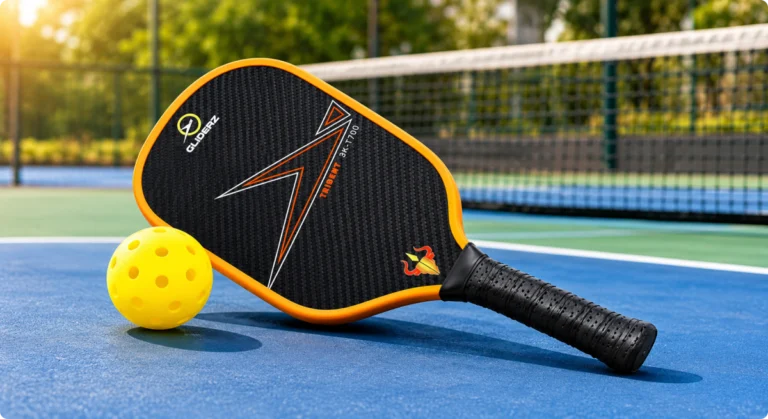
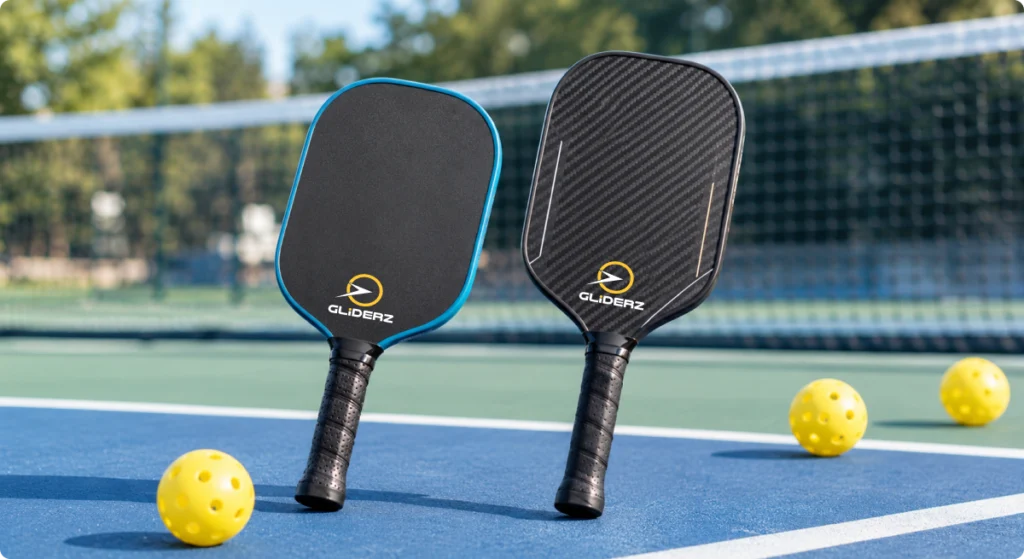
At GLIDERZ Pickleball, we make both carbon fibre and fiberglass paddles in India, because different players genuinely need different things. Our approach is to build paddles around specific player needs rather than pushing one material as the answer for everyone. If you want to see how the options compare, you can browse the range of GLIDERZ Pickleball Paddles.
How to Choose the Right Pickleball Paddle in India
Here’s a practical pickleball paddle buying guide for anyone looking to buy a pickleball paddle in India, taking local conditions into account.
1. Identify your skill level. Be honest. If you’ve been playing a few months, you’re a beginner or early intermediate. Choosing for the player you hope to become often backfires.
2. Understand your playing style. Are you patient and defensive, or aggressive? Do you mostly play doubles? A casual weekend player and a tournament-minded player need different paddles.
3. Choose an appropriate weight. Beginners usually do well with lightweight or midweight paddles. If your arm feels tired after one game, the paddle is probably too heavy for you right now.
4. Select the right grip size. Use the finger test described earlier. If you’re between sizes, go smaller and add an overgrip. In humid Indian conditions, a good overgrip also helps with sweaty hands.
5. Consider paddle material. Fiberglass is a friendly entry point, while carbon fibre suits players seeking precision and spin. Neither is universally better.
6. Weigh control against power. Beginners should lean toward control. Advanced players can tilt toward power or spin depending on style.
7. Look at the sweet spot. A bigger sweet spot means more forgiveness. If you’re still learning, prioritise it.
8. Consider paddle shape. Standard shapes offer forgiveness, while elongated shapes offer reach and power. Pick the one that suits your game.
9. Check durability and construction. Look at the edge guard, the surface finish, and the handle. Conditions in India, such as heat and dust, can be hard on equipment, so solid construction matters.
10. Set a realistic budget. You don’t need a premium paddle to start. A well-made mid-range paddle will serve a new player well, and you can upgrade as your game develops.
11. Choose a reliable brand or manufacturer. Look for a brand with a clear track record, transparent specifications, and honest descriptions. A pickleball paddle manufacturer in India can offer advantages in availability and understanding of local playing conditions.
12. Consider after-sales support and availability. A paddle is easier to live with when you can reach the seller, replace a grip, or order another paddle later. This is where buying locally often helps.
A note on rules: if you plan to play in organised events, check the paddle standards set by official bodies. USA Pickleball, the sport’s governing body in the United States, maintains equipment guidelines and an approved paddle list that many tournaments around the world use as a reference. You can read more at USA Pickleball.
When you’re ready to buy, our Pickleball Paddle India range is designed around the needs of Indian players, from first-time beginners to more experienced competitors. And if you’re looking for the best pickleball paddle India has to offer, the honest answer is the one that fits your game, budget, and comfort.
Don’t forget the balls
Paddles get the attention, but a good ball matters too. Quality Pickleball Balls keep a consistent bounce and hold up through regular play, and indoor and outdoor balls differ in design. If you coach, run a club, or manage a facility, you may want to buy bulk pickleball ball supply to keep sessions running smoothly. Searching for the best pickleball ball India options is worthwhile, because poor-quality balls can crack quickly or bounce unpredictably.
For clubs, academies, and bulk requirements across pickleball equipment India, you can Contact GLIDERZ to discuss what you need.
Frequently Asked Questions About Pickleball Paddles
1) What is the best pickleball paddle for beginners?
The best pickleball paddle for beginners is usually lightweight to midweight, with a large sweet spot, a comfortable grip, and a predictable feel. Prioritise control and forgiveness over raw power. Fiberglass paddles are a common starting point, though a well-built carbon fibre paddle can work too. The “best” depends on your hand size, strength, and how often you play.
2) What is the difference between beginner and advanced pickleball paddles?
Beginner paddles generally emphasise forgiveness, comfort, and easy control, with larger sweet spots. Advanced paddles tend to be more specialised, offering higher spin and power potential, more precise feedback, and a wider range of shapes and weights. Advanced paddles reward good technique but can be less forgiving when your contact is inconsistent.
3) Is a carbon fiber pickleball paddle good for beginners?
It can be. Carbon fibre paddles offer precision and durability, and some are designed with large sweet spots that suit newer players. However, they can feel firmer, and they often cost more. If you’re unsure whether you’ll stick with the sport, a fiberglass paddle may be a lower-risk first purchase.
4) Should beginners use a lightweight or heavyweight pickleball paddle?
Most beginners are better off with a lightweight or midweight paddle. It’s easier to swing, less tiring, and gentler on the wrist and elbow. Heavier paddles add stability and power but demand more strength and timing. Move to a heavier paddle later if you find yourself wanting more drive power.
5) What pickleball paddle is best for spin?
Paddles with textured surfaces, often carbon fibre, are popular for spin because they grip the ball better during a brushing swing. That said, spin depends mostly on your technique and swing speed. A textured paddle won’t create spin on its own, so it’s worth developing your stroke first.
6) How long does a pickleball paddle last?
There’s no fixed lifespan. It depends on how often you play, the playing surface, how you store the paddle, and its build quality. Signs of wear include a dull or worn surface, a cracked edge guard, or a hollow, dead sound on contact. Avoid leaving it in a hot car, as heat can damage the core.
7) How do I choose the right pickleball paddle in India?
Start with your skill level and playing style, then consider weight, grip size, material, and budget. Choose a brand with clear specifications and reliable availability, and check construction quality. Buying from an Indian brand or manufacturer can also make replacements and support easier. If possible, try a paddle before committing.
8) Can beginners use advanced pickleball paddles?
Yes, there’s no rule against it. But an advanced paddle may feel less forgiving, and its extra power or spin potential can be hard to control at first. Many beginners progress faster with a more forgiving paddle. If you’re keen to buy an advanced paddle, choose one with a reasonable sweet spot and weight.
Choosing a paddle shouldn’t feel like decoding a puzzle. Start with where you are as a player, pay attention to weight, grip, and sweet spot, and be willing to change as your game grows. The best paddle is the one that lets you enjoy playing more and improve steadily.
👉 “Looking to start playing? Explore GLIDERZ Pickleball paddles – Made in India for Indian players.”