By Prajakta Shinde
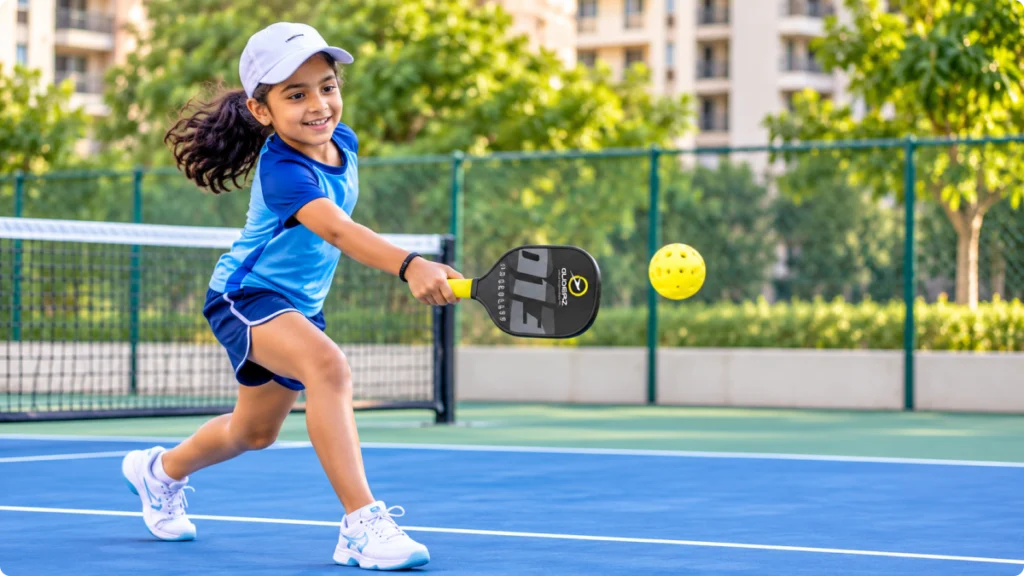
Your child has watched you play at the society court twice now and keeps asking for a turn. Or maybe the school has started a sports period and pickleball is suddenly on the list. Either way, you are probably wondering whether pickleball for kids actually works, what age is right, and which paddle to buy.
The short answer: it works very well. The court is small, the ball is slow and light, and the paddle is easy to hold. Children get long rallies early, which keeps them interested instead of frustrated.
This guide covers everything an Indian parent, teacher or coach needs: why the sport suits children, the right age to begin, simple rules to teach first, how to choose the correct paddle size and weight, and how schools and academies can set up a kids’ programme without spending a fortune.
Why Pickleball for Kids Is Such a Good Fit
If you are new to the sport itself, start with our complete beginner’s guide to what pickleball is. In brief, it is a paddle sport played on a badminton-sized court with a perforated plastic ball, in singles or doubles.
Here is why it works so well for children.
Quick success keeps them playing
In tennis, a young beginner can spend weeks just trying to get the ball over the net. In pickleball, most children are hitting back-and-forth rallies in their first session. That early success matters. A child who enjoys the first hour comes back for the second.
The equipment is light and the ball is slow
A plastic pickleball travels much slower than a tennis ball, and a kids’ paddle weighs less than many school water bottles. Small hands can control it, and there are no strings to break or tension to manage.
Small court, less running
A pickleball court is 20 feet wide and 44 feet long. Children can cover it without getting exhausted in five minutes, which means more time hitting and less time chasing balls.
It is social
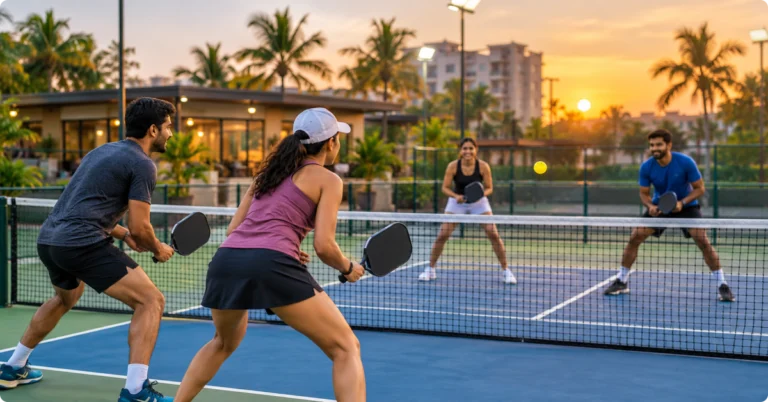
Doubles is the most common format, so children learn to talk to a partner, take turns and call scores out loud. Many parents tell us the best part is that the whole family can play together on the same court: grandparents, parents and kids.
Skills that carry over
Hand–eye coordination, footwork, balance and quick decisions all improve with regular play. These carry over to badminton, tennis, cricket and table tennis too, so pickleball is a useful base sport even if your child later picks something else.
Best Age to Start Pickleball for Children
There is no official minimum age for pickleball for kids. What matters more is whether your child can follow a moving ball and hold a paddle comfortably. As a general guide, most children can start somewhere around five or six years old, as long as the sessions are short and playful.
Here is a realistic picture of what each age group can do.
Ages 5–7: Play first, rules later
At this age, the goal is fun and coordination, not matches.
- Balloon or soft-ball tapping with the paddle
- Bouncing the ball on the paddle and counting
- Short rallies across a low net or even a rope
- Sessions of 20–30 minutes, with plenty of breaks
Do not worry about scoring yet. If they are laughing and asking for “one more”, you are doing it right.
Ages 8–12: The sweet spot for learning
This is when most children pick up the sport properly. They can:
- Learn the underhand serve and the double-bounce rule
- Understand the kitchen (non-volley zone)
- Play short games to 7 or 11 points
- Start doubles with a parent, sibling or friend
Most pickleball coaching for kids in Indian academies and schools focuses on this age group, and you will see children progress quickly once they play two or three times a week.
Ages 13 and above: Ready for full rules and match play
By this age, pickleball for kids becomes simply pickleball. Teenagers can play the full game with standard rules and scoring. Stronger players can move from a kids’ paddle to a lighter adult paddle, and some start entering junior events at local clubs. At this stage, technique (dinks, drops, positioning) becomes the focus.
Parent tip: Your child’s interest is a better guide than their age. A keen six-year-old will learn faster than a bored ten-year-old. Keep the first few sessions light and let them ask for more.
Simple Pickleball Rules for Kids
Pickleball has a handful of core rules, and the best pickleball rules for kids are the simplest ones. You do not need to teach them all on day one. Introduce them one at a time as your child gets comfortable. (For the full official rules, the USA Pickleball website is the governing body’s reference.)
The five rules to teach first
- Serve underhand. The paddle must make contact below the waist, and the serve goes diagonally across the court.
- Let it bounce twice. The serve must bounce once, and the return must bounce once. After that, players can hit the ball in the air or after a bounce. This is called the double-bounce rule, and it gives children time to reach the ball.
- Stay out of the kitchen. The kitchen is the area 7 feet from the net on each side. You cannot volley (hit the ball in the air) while standing in it. You can step in to hit a ball that has bounced.
- Keep it in. A ball that lands on a line is in.
- Call the score. In traditional scoring, only the serving side wins points, and games are usually played to 11 (win by 2).
How to adapt the rules for younger children
You know your child best, so bend the rules to keep the game moving:
- Play to 5 or 7 points instead of 11
- Allow two serve attempts while they are learning
- Skip the kitchen rule for the first few weeks, then add it once rallies are steady
- Use rally scoring (a point on every rally) so younger kids are not confused by the serving-side rule
- Shorten the court by playing only in the front half for very young children
The USA Pickleball explanation of the game is a good, simple read if you want to brush up before teaching.
Choosing the Right Kids Pickleball Paddle: Size and Weight
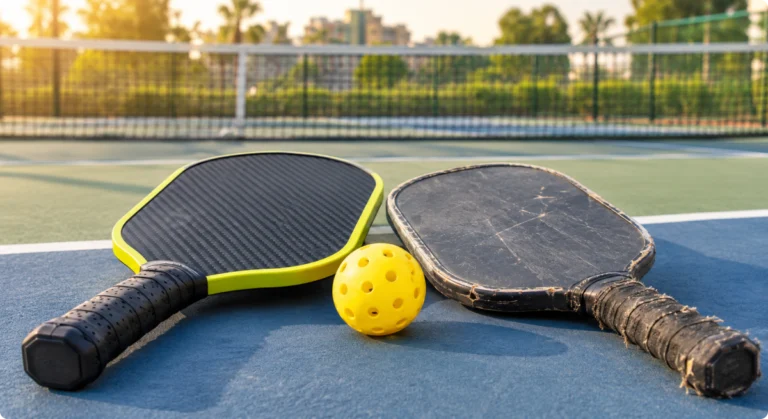
When it comes to pickleball for kids, the paddle is the most important purchase. A paddle that is too heavy or too big will tire your child’s wrist, ruin their timing and, honestly, make them lose interest. A well-sized kids pickleball paddle (sometimes sold as a junior pickleball paddle) does the opposite.
What to look for
- Weight: Lighter is better for children. It means faster reactions and less strain on the wrist and elbow.
- Size: A slightly shorter paddle is easier to swing and control for small arms.
- Grip: Small hands need a thinner grip. If your child’s fingers cannot wrap around the handle comfortably, the paddle is too big.
- Face material: Fiberglass is forgiving and gives a bit of extra “pop”, which helps children get the ball over the net without swinging hard.
- Thickness: 13 mm cores feel quicker and livelier; 16 mm cores feel softer and more controlled. Either works for children; 16 mm is a little more forgiving for absolute beginners.
Kids’ paddle vs adult paddle
| Feature | GLIDERZ Fiberglass Kids Paddle | Typical adult paddle |
|---|---|---|
| Weight | About 180 g | Usually 200–240 g (GLIDERZ adult paddles weigh 220–230 g) |
| Size | 38.1 × 19.0 cm | Usually a little longer |
| Face | Fiberglass | Fiberglass, 3K carbon or T700 carbon |
| Core thickness | 13 mm or 16 mm | 13 mm or 16 mm |
| Best for | Young beginners, schools, academies, family play | Teenagers and adults |
| Price | ₹699 | GLIDERZ adult paddles start from ₹799 |
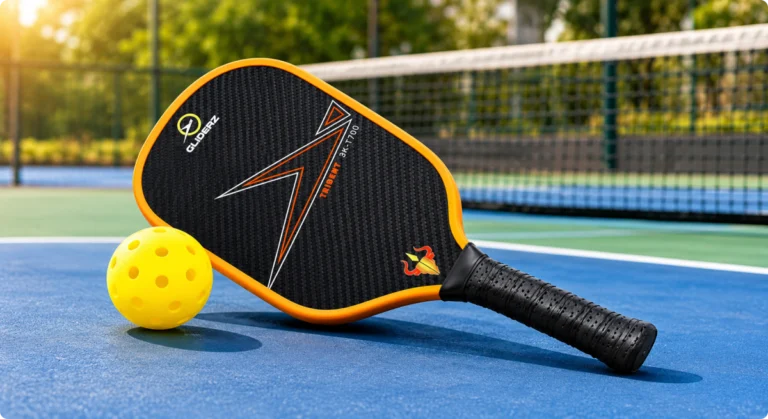
The GLIDERZ Fiberglass Kids Pickleball Paddle was designed with exactly this in mind. It is lightweight and easy to handle, it reduces strain on the wrist and arm, and at ₹699 it is a sensible first paddle. As a made in India pickleball paddle, it is also built for Indian conditions: heat, humidity and outdoor society courts.
If your child likes bright colours (most do), take a look at the kids and junior designs on our pickleball paddle designs page. A junior pickleball paddle they love the look of is a paddle they will actually pick up.
When to move to an adult paddle
Most children move to an adult paddle somewhere in their early teens. Signs it is time:
- The kids’ paddle feels too light, and they are over-hitting
- They are playing full games and want more power and reach
- Their hand has grown and the grip feels too thin
When that day comes, a light fiberglass or balanced adult paddle is a gentle next step. You can compare options on our GLIDERZ pickleball paddles page. Parents often ask us about pickleball paddle price in India for that second paddle: you do not need to jump straight to the most expensive carbon model. A good fiberglass paddle serves a teenager well for a long time. The best pickleball paddle India’s young players can own is simply the one that fits their hand, weight and level.
Balls, Shoes and Safety for Young Players
The paddle gets all the attention, but a few other things make a big difference to how much your child enjoys the game, and how safe they stay.
Pick the right ball
- Outdoor balls have more, smaller holes and a harder shell. They hold their line in the wind on open society and school courts.
- Indoor balls have fewer, larger holes and a softer feel. They are slower and a little easier for small children to control on indoor courts and halls.
For very young children, a softer, slower ball helps them get more rallies. You can compare indoor and outdoor options on our pickleball balls page. If you are looking for the best pickleball ball India players use for practice and coaching, choose one that matches where your child actually plays.
Shoes
Running shoes are built for forward movement. Pickleball involves a lot of side-to-side steps, so non-marking court shoes or badminton shoes with good grip are a safer choice. They reduce the risk of rolled ankles on smooth indoor floors.
Playing safely in Indian weather
Much of India plays outdoors, and our summers are no joke. Safe pickleball for kids comes down to a few simple habits:
- Avoid the hottest hours. Early mornings and evenings are best from April to June.
- Hydrate before, during and after. Keep a water bottle on the court and take a break every few games.
- Cap and sunscreen for outdoor sessions.
- Warm up for five minutes. Light jogging, arm circles and a few gentle rallies before any proper game.
- Stop if something hurts. Children should never “push through” wrist or elbow pain. If pain continues, check with a doctor.
Eye safety
Pickleball is low-risk compared with many sports, but a ball to the eye at close range can still happen, especially in the kitchen area. Some parents choose sports glasses for younger children, and it is worth teaching kids to keep the paddle up in front of their face at the net.
How Schools, Academies and Societies Can Start a Kids’ Programme
Pickleball India is growing quickly in schools, residential societies and coaching academies, and children’s programmes are a natural part of that. The good news is that starting pickleball in schools, societies or academies needs very little.
What you need
- A court: A marked pickleball court is ideal, but a badminton court with a lowered net works for beginners.
- A net: A portable pickleball net is enough for schools and societies.
- Paddles: One per child in the session, plus a few spares.
- Balls: Plenty of them. Children’s sessions involve a lot of mis-hits and ball collection, so more balls means more hitting time.
A simple starter kit for a group of 16 children
| Item | Suggested quantity | Notes |
|---|---|---|
| Kids’ paddles | 16–18 | One per child plus spares |
| Balls | 40–60 | Indoor or outdoor, depending on your court |
| Portable net | 1–2 | One per court |
| Cones / markers | 10–20 | For drills and mini-courts |
Running the sessions
- Groups of 4–8 per court keep everyone active
- 45–60 minute sessions suit most school periods
- Start with drills, end with games. Children remember the game, not the drill, so always finish with fun.
- Mix ages carefully. Older children can partner younger ones in doubles, which builds patience and leadership.
Good pickleball coaching for kids is less about drilling perfect technique and more about keeping every child busy, smiling and hitting. That is why pickleball in schools works so well as a PE activity: one court keeps eight children active at once.
Buying in bulk
If you run pickleball for kids at an academy, a school sports department or a society, buying equipment piece by piece gets expensive. Pickleball balls for clubs and academies are best bought in volume. You can buy bulk pickleball balls directly from GLIDERZ for coaching and school use.
For paddles, bulk orders of kids’ paddles for schools and academies can be arranged too, including custom colours or a school logo for larger orders. Contact our team with your numbers and we will help you plan the right mix of pickleball equipment India schools actually need.
Real-world example: A residential society in Pune might start with a Sunday-morning kids’ session on its badminton court: one portable net, a dozen kids’ paddles and a bucket of balls. Within a few weeks, the parents are usually asking for their own session too.
Frequently Asked Questions About Pickleball for Kids
What is the best age for kids to start pickleball?
Most children can start around five or six years old with short, playful sessions focused on tapping and simple rallies. Proper rules and scoring usually make sense from about eight onwards. Your child’s interest and coordination matter more than the exact age, so keep it fun and let them set the pace.
Is pickleball safe for children?
Yes, pickleball is generally a low-impact and safe sport for children. The ball is light, the court is small and there is less running than in tennis. Use a lightweight paddle, proper court shoes, warm-ups and water breaks. In hot Indian summers, avoid midday sessions, and stop play if your child feels pain or discomfort.
What size pickleball paddle should a child use?
Children should use a lighter, slightly smaller paddle with a thin grip. The GLIDERZ Fiberglass Kids Paddle weighs about 180 g and measures 38.1 × 19.0 cm, which suits most young beginners. If your child’s fingers cannot wrap comfortably around the handle, the paddle is too big for them.
Can kids use an adult pickleball paddle?
Teenagers often can, but younger children usually struggle. Adult paddles are heavier and longer, which tires the wrist and slows reactions. A light kids’ paddle helps children learn proper technique and enjoy longer rallies. Most children move to a light adult paddle in their early teens, once their hand and strength have grown.
How much does a kids pickleball paddle cost in India?
Prices vary by brand and material. The GLIDERZ Fiberglass Kids Pickleball Paddle, made in India, costs ₹699. That is a sensible first paddle for a child, school or academy. For teenagers moving to adult equipment, GLIDERZ adult paddles start from ₹799, so the upgrade does not need to be expensive.
How often should children play pickleball?
Two or three sessions a week is plenty for most children, with each session lasting 30–60 minutes depending on age. Younger children do best with shorter, more frequent play. Make sure they have rest days, and in pickleball for children keep the focus on enjoyment rather than winning so they stay keen over the long term.
Conclusion
Pickleball for kids is one of the easiest ways to get children moving, playing and socialising, whether at home, in school or on the society court. Start with short, playful sessions around age five or six, add the simple rules step by step, and give your child a paddle that actually fits their hands.
That last point matters most. A light, well-sized paddle turns early frustration into early success, and early success is what keeps children playing. Keep the sessions fun, play during cooler hours, and let your child’s enthusiasm set the pace.
If you are a school, academy or society planning a kids’ programme, think about equipment in bulk from the start: it saves money and keeps every child hitting. Browse the full range in our shop, or get in touch for a group order.
👉 Looking to start playing? Explore GLIDERZ Pickleball paddles – Made in India for Indian players.