By Prajakta Shinde
Ever watched two evenly matched pairs at your local club and wondered why one team keeps winning the long, scrappy rallies? It is rarely about who hits harder. A sound pickleball doubles strategy (where you stand, which shot you choose and how well you talk to your partner) wins far more points than raw power ever will. Across the growing Pickleball India community, from apartment-society courts in Pune to corporate leagues in Bengaluru, the teams that stay calm and play smart are the ones climbing the ladder. This guide covers positioning, serve and return, the third shot, dinking and teamwork, with practical examples for Indian heat, converted badminton halls and busy evening courts. Whether you are brand new or already playing weekly, you will find something to try at your very next game.
Why Pickleball Doubles Strategy Beats Raw Power
Walk onto any pickleball court in India on a weekend evening and you will see the same thing. One player smashes every ball as hard as possible, the rally ends within four shots, and the other pair calmly wins anyway. A good pickleball doubles strategy rewards placement, patience and teamwork far more than strength.
The court measures 20 ft by 44 ft, the same footprint as a badminton doubles court. That is why many Indian clubs and academies simply mark pickleball lines inside their existing badminton halls. With four players in such a small space, there is very little open court to hit into. Winning pairs create gaps by moving their opponents around, then finish the point with a simple, safe shot.
If you are completely new to the game, start with our guide on what is pickleball and come back once the basics make sense. Most players find that doubles is where the sport is at its most fun and most social.
The rules that shape your doubles tactics
Three rules quietly decide most doubles pickleball tactics:
- The two-bounce rule. The serve must bounce once before the receiving team returns it, and the return must bounce once before the serving team hits it. Only after that can anyone volley. This is why both teams start deeper than you might expect.
- The kitchen. The non-volley zone extends 7 ft from the net on each side. You cannot volley while standing in it or touching its lines. Knowing the pickleball kitchen rules properly saves you faults and gives you ideas for attack.
- Serving and scoring. Only the serving team scores. Games are usually played to 11 points and must be won by two. Both partners serve before the serve passes to the other side, except at the start of a game.
Always check the latest rulebook from USA Pickleball, the official governing body, so your club games match the rules used worldwide.
Think in patterns, not single shots
Strong teams do not hope for a winner on every ball. They build a pattern: serve deep, return deep, reach the kitchen line, dink until someone floats a ball up, then attack. Each shot has a job. If you remember one thing about how to win at pickleball doubles, make it this: make your opponents hit Positioning and Movement: Own the Kitchen Linethe difficult ball first, and wait for the mistake.
Good pickleball positioning is easy to understand, though it takes practice to do automatically, and it is the foundation of any pickleball doubles strategy that works at club level.
Every winning pickleball doubles strategy is really just a set of small patterns repeated calmly, point after point.
Positioning and Movement: Own the Kitchen Line
Most club-level matches are decided before anyone hits a clever shot. The team that reaches the kitchen line first usually has the advantage, because from there you can hit downwards, block quickly and keep your opponents pinned back. Good pickleball positioning is easy to understand, though it takes practice to do automatically.
Start deep, finish at the net
Because of the two-bounce rule, you cannot rush forward straight after serving. The server starts behind the baseline and, at most recreational levels, so does the partner, ready to play the third shot. The receiving team does the opposite: the returner stays deep to hit the return, while the partner waits near the kitchen line.
After your serve or return, move forward in steps rather than one mad sprint. Stop and take a small split-step each time your opponent hits, so you are balanced and ready to react. Running forward while the ball is already on its way is how players get caught off-balance.
Move like a pair
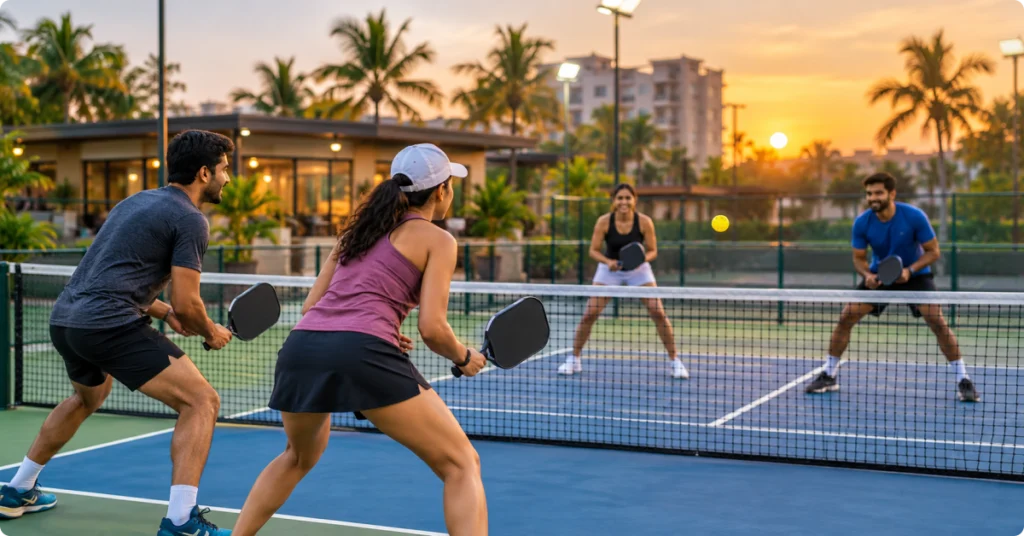
Think of you and your partner as two ends of a sliding door. When one of you slides left, the other slides left too. When one of you is pulled wide, the other covers the space that opens up in the middle. Keep roughly side by side, and keep about the same distance from the net.
The classic mistake is one player rushing the net while the other stays at the baseline. Your opponents will spot the gap between you in seconds and keep hitting into it.
Protect the middle
The net is lowest in the centre, so the middle is the safest target for any shot, and it is where most doubles points are won and lost. Hits down the middle also create confusion about who takes the ball. Agree a simple rule before you start. A common one is that the player with the forehand takes the middle, or whoever is closer and better balanced.
Here is a quick reference for where to be at each stage of the point:
| Moment in the point | Where you stand | Main goal |
|---|---|---|
| Serve | Behind the baseline, serving diagonally | Land it deep, ideally to the weaker backhand |
| Return of serve | Deep, near the baseline | Hit deep, then move forward quickly |
| Third shot | Behind the baseline | Drop into the kitchen, or drive if the return is weak |
| Kitchen battle | Both partners at the kitchen line | Dink patiently and wait for a high ball |
| Defending a lob | Retreat quickly, call who takes it | Return to the kitchen line as soon as possible |
Serve deep, return deeper
A deep serve pushes the returner back and makes it harder to attack you. A deep return does the same to the serving team, buying you time to reach the net. Neither shot needs pace. Depth and consistency matter far more than speed.
Playing outdoors in India adds a twist. On a windy evening, keep your serve and return a little lower and flatter. When you switch ends, check where the sun or floodlights sit, because a ball that is easy to see from one side can vanish against the glare on the other. Use your warm-up to judge this before the match begins.
Shot Selection: The Third Shot Drop, Dinks and Attacks
Once both teams settle at the kitchen line, the point becomes a game of touch. Smart shot selection sits at the heart of any pickleball doubles strategy, and it comes down to choosing the right shot for the ball you have been given, not the shot you would like to hit.
A control-focused pickleball paddle with a comfortable grip makes soft drops and dinks much easier to repeat.
The third shot drop: your route to the net
The third shot is the serving team’s first chance to hit after the return. If you stand at the baseline and drive every third shot, opponents at the kitchen line will happily volley it back at your feet. The third shot drop solves that problem. It is a soft, arcing ball that lands in the opponents’ kitchen, forcing them to hit upwards and giving you and your partner time to walk forward.
It is one of the hardest skills in the sport, so do not be discouraged if yours spends the first month landing in the net. Practise it in short sessions. Hit from the baseline into the opposite kitchen with a partner, and count how many out of ten land inside. Aim for a gentle arc with the highest point on your side of the net, not above your opponents’ reach.
| Third shot option | Best used when | Main risk | Quick tip |
|---|---|---|---|
| Drop | Opponents are already at the kitchen line and balanced | Pops up if hit too high | Aim low over the net, landing in the kitchen |
| Drive | The return is short or high and opponents are out of position | Easily blocked back at your feet | Aim at their feet or between the two players |
| Lob | Opponents are crowding the net | Becomes a smash if it falls short | Use sparingly, over the backhand side |
As a rule of thumb, drop when your opponents are set, drive when the return gives you a chance, and lob only when you need to push them back.
Pickleball dinking strategy: patience wins points
A dink is a soft shot hit from near the kitchen line that lands in the opponents’ kitchen. It looks dull until you realise it is where most doubles points are decided. Your aim is not to win the rally with one big shot. It is to make your opponents pop the ball up first.
Once you understand the pickleball kitchen rules, dinking makes perfect sense: your opponents cannot smash a ball that lands in the zone, so you can make them hit up instead.
A useful pickleball dinking strategy follows these habits:
- Keep it low. Let the ball barely clear the net so there is nothing to attack.
- Aim at feet and sidelines. Hard-to-reach spots force awkward, defensive replies.
- Target the weaker backhand. Most pairs have one player who is less comfortable on that side.
- Change pace and depth. A soft, short dink followed by a slightly deeper one breaks the rhythm.
- Stay patient. Speed up only when the ball rises above net height.
- Keep your paddle up and knees bent. Players who drop their paddle between shots get caught by quick hands.
Dink cross-court more often than straight ahead. Cross-court dinks pass over the lowest part of the net and cover a longer distance, which gives you more margin for error. Straight dinks bring the other player into the rally, so save them for when you have spotted a weakness.
When to attack, and when to reset
If the ball rises above net height, attack it. Hit down towards the feet, the hip or the gap between the two players. If your opponents attack you and you are pushed back, do not try to hit harder. Reset with a soft block or a drop into the kitchen, and rebuild the point. Speeding up when the ball is low and your opponents are ready is the most common way beginner pairs give away points.
Teamwork, Equipment and Playing in Indian Conditions
A strong pickleball doubles strategy is not only about shots. Partnership, equipment and local conditions matter just as much, especially in India, where heat, humidity and shared courts change the way you play.
Pickleball partner communication
Good pickleball partner communication starts before the first point. Agree a few short calls: “mine”, “yours”, “bounce”, “out” and “switch”. Decide who takes middle balls. Talk between points too, not just during them, and keep the tone positive after errors. Nothing loses a close game faster than two players sulking at each other.
Many Indian clubs run mixed doubles evenings, family games and corporate leagues where partners change every round. In those casual set-ups, the pair that agrees on calls during the first two minutes of warm-up usually plays better together.
As you improve, you may hear about stacking, where both partners start each point on the same side so each can stay on their stronger side. It is legal in doubles, but only worth trying once your basics are solid.
Pick equipment that supports your game
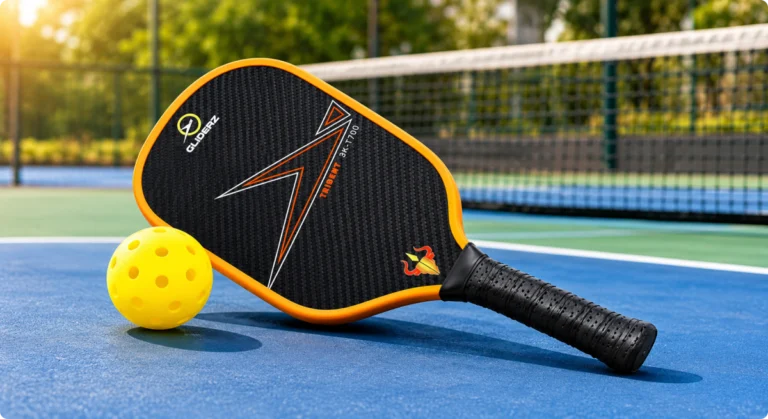
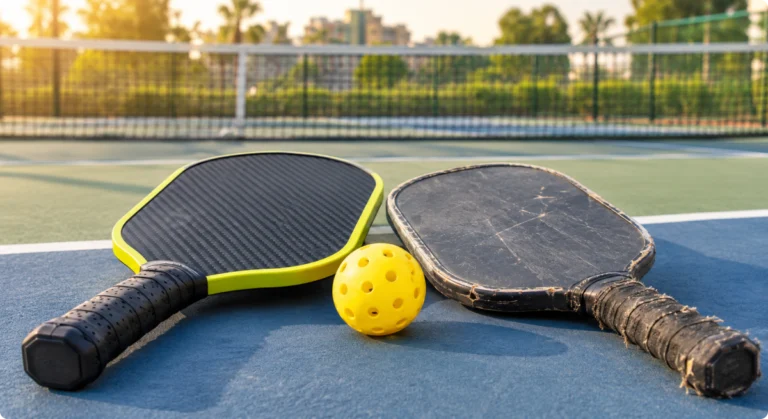
Your pickleball paddle will not win matches for you, but the wrong one can make winning harder. Dink-heavy doubles rewards control and a comfortable grip. If you like to attack, you might prefer a little more power. When you are searching for the best pickleball paddle India has to offer, look at weight, grip size, face material and how it feels on soft touch shots, rather than simply chasing the highest price tag.
Pickleball paddle price in India varies with materials and construction, so decide your budget first and compare within it. Choosing a Made in India pickleball paddle also means easier availability and local support if you have questions. You can see the full range on our GLIDERZ pickleball paddles page, or head to the shop to compare options side by side. Good pickleball equipment India players can rely on should not mean long waits or import headaches.
Choose the right ball for your court
Balls matter more than most people think. The best pickleball ball India players can use is one with a consistent bounce, good durability on rough hard courts and the right build for where you play. Outdoor balls generally have smaller holes and a harder shell to cope with wind and rougher surfaces, while indoor balls are softer with larger holes. Have a look at our pickleball balls page to see what suits your surface.
Clubs and coaches have extra needs. Pickleball balls for clubs and academies must survive daily coaching, round-robins and tournaments, and cheap balls crack or go out of shape quickly. If you want to buy bulk pickleball ball stock so every court is always supplied, our bulk pickleball balls page is the place to start.
Plan for Indian weather and courts
- Heat: In summer, play early morning or late evening, carry plenty of water and take shade breaks. Tired legs lead to lazy footwork, and lazy footwork loses doubles points.
- Sweaty grips: Humidity makes handles slippery. Keep a towel handy and use an overgrip so your paddle does not twist on soft shots.
- Converted courts: Tennis and badminton courts often have dust and taped lines. Sweep before play and wear proper court shoes, not running shoes, to protect your ankles.
- Wind: Outdoors, keep the ball lower and avoid high lobs, which can drift unpredictably.
- Busy courts: If you share courts at a club, warm up with a few minutes of cross-court dinks. It prepares your hands for the soft game.
These four drills turn your pickleball doubles strategy from something you read about into something your hands do automatically. Ten minutes before each game is enough.
Practice drills to try with your partner
- Cross-court dinking (10 minutes). Dink diagonally with your partner and try to reach 20 shots without an error.
- Third shot drop ladder. One player hits drops from the baseline while the other feeds from the kitchen. Count how many land in the kitchen out of ten, and try to beat your score next time.
- Dink and attack. Dink until someone hits above net height, then attack or reset. This builds patience and good decision-making together.
- Move-as-a-pair shadowing. Without a ball, practise sliding side to side and forward and back together while a coach or friend calls directions.
Contact your club or academy coach if you would like help setting these up, or reach out to us through our contact page for equipment guidance.
Frequently Asked Questions
What is the best pickleball doubles strategy for beginners?
Keep it simple: serve deep, return deep, and get to the kitchen line with your partner. Dink patiently, avoid hitting hard from the baseline, and attack only high balls. Add clear calls like “mine” and “yours”. A steady, low-error game beats power at beginner level almost every time.
Where should I stand in doubles pickleball?
Both partners should aim to stand at the kitchen line, side by side, once the ball is in play. On the serve and return you start deeper because of the two-bounce rule, then move forward together after your third shot or return. Shift sideways as a pair so no gap opens in the middle.
What is the third shot drop and why does it matter?
The third shot drop is a soft, arcing shot hit by the serving team after the return, landing in the opponents’ kitchen. It neutralises their net advantage and gives you time to move forward. It takes practice, but it is one of the most reliable ways to take control in doubles.
How do I communicate better with my doubles partner?
Agree on simple calls before you play: “mine”, “yours”, “bounce”, “out” and “switch”. Decide who takes middle balls, usually the player with the forehand. Talk between points, not just during them, and stay positive after errors. Good partner communication wins more points than any single shot.
Does my paddle affect my doubles game?
Yes. A paddle that suits your style helps you control dinks, blocks and drops, which matter most in doubles. Beginners usually do best with a balanced, comfortable paddle rather than the heaviest or most powerful option. Check weight, grip size and face material before choosing, and compare options in the GLIDERZ range.
How many pickleball balls does a club or academy need?
There is no fixed number, but clubs and academies should keep plenty of spare balls because they crack, wear and go missing quickly with heavy use. Many buy in bulk to keep every court stocked and save money per ball. Contact GLIDERZ with your number of courts and players for a suitable quantity.
Final Thoughts: Make Pickleball Doubles Strategy a Habit
A good pickleball doubles strategy comes down to a few repeatable habits. Stand where you can cover the court, hit shots that suit the ball you receive, stay patient in the kitchen, and talk to your partner on every point. You do not need a powerful smash or an expensive trick shot. You need steady play, smart choices and a partner you trust.
Pick one idea from this guide and practise it at your next session, whether that is the third shot drop, cross-court dinking or simply calling “mine” and “yours” with more confidence. Small improvements compound quickly, and before long you will be the pair that other players in your club are trying to figure out.
👉 Looking to start playing? Explore GLIDERZ Pickleball paddles – Made in India for Indian players.