
How to Build a Pickleball Court in India
Building a pickleball court in India involves selecting the right location, preparing the ground, constructing a durable base, applying an acrylic playing surface, installing nets, and adding lighting and fencing. The process typically takes 3–6 weeks depending on court size and site conditions.
Three years ago, most Indian sports facility owners had never heard of pickleball. Today, it’s one of the fastest-growing recreational sports in the country, and the question on everyone’s mind has shifted from “what is pickleball?” to “how do I build a court?”
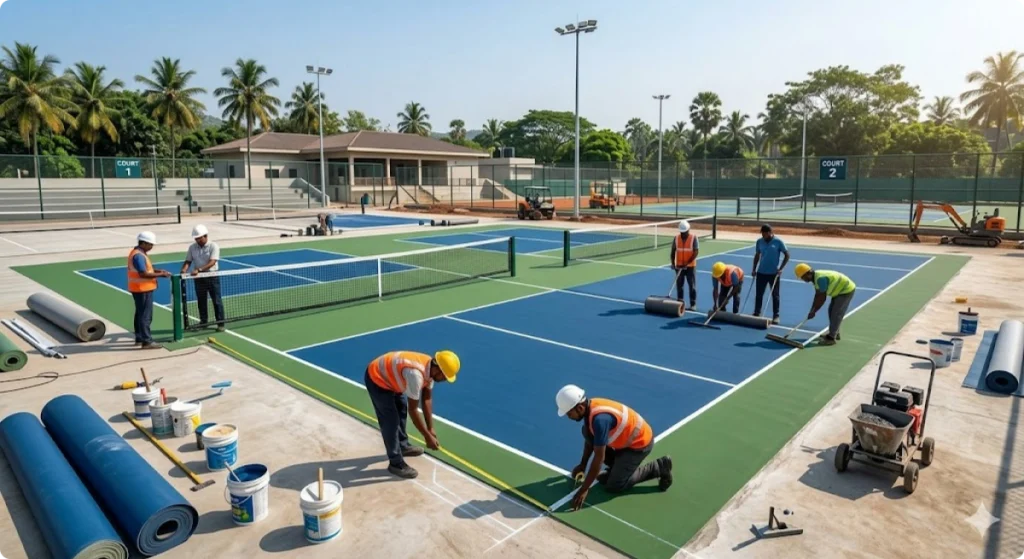
The numbers explain the urgency. Active pickleball participation in India has jumped roughly 150%, from around 60,000 players in 2024 to more than 150,000 in 2026, while the number of dedicated courts has grown six-fold over the same period – from about 200 to over 1,200. Industry analysts expect the Indian pickleball market to be worth thousands of crores by the end of the decade. For club owners, schools, residential societies, and developers, that growth curve is exactly why how to build a pickleball court in India has become one of the most searched sports infrastructure questions of the year.
The good news is that pickleball courts are small, relatively quick to build, and far less capital-intensive than a tennis or basketball court. This guide walks you through everything – dimensions, location planning, surface choices, the construction process, realistic costs, and the equipment you’ll need to open your doors.
Understanding how to build a pickleball court in India is becoming increasingly important for clubs, schools, residential societies, and sports academies looking to capitalize on the sport’s rapid growth.
Many facility owners researching how to build a pickleball court in India are looking for long-term investment opportunities in sports infrastructure.
What Is a Standard Pickleball Court?
A pickleball court is a rectangular playing surface measuring 20 feet wide by 44 feet long – the same size for both singles and doubles play, which is unusual among racket sports. A net divides the court down the middle, with each side split into a non-volley zone and two service boxes.
The non-volley zone, popularly called “the kitchen,” extends 7 feet back from the net on each side and runs the full width of the court. Players cannot strike the ball out of the air while standing inside this zone – a rule that defines much of pickleball’s strategy. Beyond the kitchen, each half-court is divided into two 10 ft × 15 ft service boxes by a centerline.
The net stands 36 inches high at the posts and dips slightly to 34 inches at the center, with posts set 22 feet apart. All boundary and zone lines are 2 inches wide and must contrast clearly with the court surface.
Quick-Reference: Pickleball Court Dimensions
| Element | Specification |
|---|---|
| Playing court | 20 ft × 44 ft (6.1 m × 13.4 m) |
| Minimum total area (with run-off) | 30 ft × 60 ft |
| Recommended area (new builds/tournament) | 34 ft × 64 ft |
| Non-volley zone (“kitchen”) | 7 ft from net, both sides |
| Service box | 10 ft × 15 ft (each of four) |
| Net height — sidelines | 36 inches |
| Net height — center | 34 inches |
| Net post spacing | 22 ft, inside post to inside post |
| Line width | 2 inches |
These specifications come from the official USA Pickleball rulebook and are followed by court builders worldwide, including in India, to keep facilities tournament-ready.
Before deciding how to build a pickleball court in India, it is essential to understand the official court dimensions and space requirements recommended for recreational and tournament play.
Choosing the Best Location for a Pickleball Court in India
Indoor vs Outdoor Courts
Outdoor courts dominate the Indian market – land is more available and construction costs are significantly lower. They suit societies, schools, and standalone academies. Indoor courts cost more, mainly due to flooring and structural requirements, but offer weather-proof, year-round play, which matters in cities with intense monsoons or heatwaves, and they command premium rental rates.
Space Requirements
Plan for a minimum of 30 ft × 60 ft per court, though 34 ft × 64 ft is recommended for tournament flexibility later. A standard tennis court can typically host up to four pickleball courts, making tennis-to-pickleball conversion attractive for clubs with existing infrastructure.
Climate Considerations
India’s diverse climate plays a major role in site selection:
- Coastal, high-humidity regions (Mumbai, Chennai, Kochi) need surfaces with strong anti-fungal and slip-resistant properties.
- North Indian cities with intense summer heat (Delhi, Jaipur, Lucknow) benefit from UV-stabilized acrylic coatings that resist cracking.
- Hill and northeastern regions with heavy rainfall require robust drainage planning above all else.
Drainage Requirements
Outdoor courts need a gentle slope – typically 1% – to direct rainwater away from the playing surface. Poor drainage is a leading cause of premature surface damage in Indian sports facilities, so this step shouldn’t be skipped to save cost.
Accessibility
Courts should sit near parking, washrooms, and changing areas, with clear pathways for players of all ages. For schools and societies, proximity to existing sports infrastructure reduces both construction and ongoing maintenance costs.
A suitable location is one of the most important factors when learning how to build a pickleball court in India successfully, as it directly impacts player experience, maintenance requirements, and long-term operating costs.
When evaluating how to build a pickleball court in India, location planning should always be completed before selecting construction materials.
A major part of understanding how to build a pickleball court in India is selecting a surface that performs well in local weather conditions.
Anyone planning how to build a pickleball court in India should prepare a detailed budget that includes construction, equipment, and maintenance costs.
Understanding Pickleball Court Surfaces
The surface you choose affects ball bounce, player safety, and long-term maintenance costs more than any other single decision in the build.
| Surface | Pros | Cons | Best For |
|---|---|---|---|
| Acrylic (multi-layer) | UV-resistant, consistent bounce, good grip, widely used internationally | Higher upfront cost than asphalt alone | Outdoor courts in most Indian climates |
| Concrete (with acrylic topcoat) | Extremely durable, minimal long-term deformation, lifespan of 20+ years | Higher base cost, longer curing time | Premium and tournament-grade facilities |
| Asphalt (with acrylic topcoat) | Lower base cost than concrete, faster installation | More prone to cracking over time, needs more frequent resurfacing | Budget outdoor courts |
| Modular interlocking tiles | Fast installation, easy to relocate or replace sections | Less suitable for permanent or competitive courts, can shift over time | Temporary or recreational setups |
For most parts of India, a concrete or asphalt base finished with a multi-layer synthetic acrylic system is the industry-preferred combination. It balances UV resistance, shock absorption, and weather durability against monsoon humidity and summer heat better than alternatives, and it remains the surface most commonly specified by professional pickleball court builders across the country.
Choosing the correct playing surface is a critical step in how to build a pickleball court in India, especially when considering extreme summer temperatures and monsoon conditions.
How to Build a Pickleball Court in India: Step-by-Step Process
Site Planning
Survey the plot, confirm it meets the minimum 30 ft × 60 ft footprint, check local zoning or society approvals, and orient the court north-south where possible to minimize sun glare for players facing the net.
Ground Preparation
Clear vegetation and debris, level the ground, and run a basic soil test. Soft or uneven soil needs excavation and compaction before any base material goes down – skipping this is one of the most common causes of cracked courts within the first two years.
Base Construction
- Lay and compact a sub-base of graded gravel or stone aggregate.
- Pour a concrete slab (commonly 4–6 inches thick) or lay an asphalt base, depending on budget and durability targets.
- Allow adequate curing time – typically 7–28 days for concrete – before surfacing begins.
Surface Installation
Apply the acrylic system in layers: a primer coat, resurfacer coats to smooth imperfections, a cushion or color coat, and a final textured top coat. Most professional installations use four to eight layers depending on whether a cushioned, joint-friendly finish is required.
Court Marking
Mark the boundary, kitchen, service box, and centerlines using the official 20 ft × 44 ft template, with 2-inch lines in a color that contrasts sharply against the surface – typically white or yellow against blue or green.
Net Installation
Install net posts 22 feet apart, anchored securely into the surface or sleeved for removability, and set the net to the regulation 36-inch sideline / 34-inch center height.
Lighting Setup
For evening play, install LED floodlights positioned to minimize glare and shadow across the kitchen and baseline – a frequent oversight that affects play quality more than people expect.
Fencing and Safety Measures
Install perimeter fencing, typically 8–10 feet high, to contain balls and protect spectators. Leave gates in low-traffic corners so they don’t interrupt rallies.
Pickleball Court Construction Cost in India
Pickleball court cost in India varies widely depending on surface quality, location, fencing, and lighting specifications. Based on current industry estimates, here’s a realistic breakdown.
| Tier | Typical Cost (single outdoor court) | What’s Included |
|---|---|---|
| Budget | ₹3.5 – 5 lakh | Asphalt/concrete base, basic 4-layer acrylic coating, simple fencing, line marking |
| Mid-range | ₹6 – 9 lakh | Quality concrete base, multi-layer cushioned acrylic, full perimeter fencing, basic LED lighting |
| Premium | ₹10 – 15 lakh+ | Tournament-grade acrylic system, professional fencing, full floodlighting, seating, signage, drainage engineering |
Acrylic flooring alone typically costs between ₹250 and ₹600 per square foot installed, depending on the number of coating layers and material grade, while a complete 1,800 sq ft playing area (the standard 30 ft × 60 ft footprint) generally takes 3–6 weeks from ground preparation to final marking. Indoor courts with wooden sprung flooring or air-conditioned facilities cost meaningfully more but suit premium sports academies aiming for a professional playing experience.
These figures are industry estimates and will vary by city, contractor, and site conditions – always get a detailed, itemized quote before committing to a builder.
Essential Equipment for a New Pickleball Court
A well-built court still needs the right gear to function as a usable facility:
- Nets – regulation 22-foot nets with sturdy, weather-resistant posts
- Balls – outdoor balls (harder, smaller holes) versus indoor balls (lighter, larger holes); stock both if your facility serves both formats
- Court accessories – ball baskets, line-marking touch-up kits, net height gauges, and storage benches
- Scoreboards – manual or digital, useful for academies and clubs hosting matches or coaching sessions
- Paddles – the single most important piece of player-facing equipment, since paddle quality directly affects how enjoyable (and competitive) a session feels
If you’re outfitting a new facility or pro shop, sourcing reliable, performance-tested gear matters as much as the court itself. For guidance on selecting the best pickleball paddle in India across skill levels and budgets, compare weight, grip size, and core material before stocking inventory. GLIDERZ offers a curated range of pickleball paddles and court accessories built for Indian conditions – humidity, heat, and high-frequency use – and facility owners can explore GLIDERZ pickleball equipment when planning opening inventory. Many academies also shop premium pickleball paddles directly for member resale, adding a steady secondary revenue stream alongside court bookings.
After learning how to build a pickleball court in India, investing in quality paddles and balls ensures a better playing experience.
Common Mistakes to Avoid During Pickleball Court Construction
- Wrong dimensions – building to “approximate” sizes instead of the official 20 ft × 44 ft spec causes disputes during competitive play and costly rework later.
- Poor drainage – skipping slope engineering leads to water pooling and surface degradation within a single monsoon season.
- Low-quality materials – cheap acrylic coatings crack and fade faster, often needing resurfacing within 2–3 years instead of 8–10.
- Inadequate fencing – undersized fencing means constant ball retrieval and safety complaints.
- Insufficient lighting – uneven or low-output lighting makes evening play genuinely unsafe and discourages repeat bookings.
Why Pickleball Courts Are Growing Rapidly Across India
Several forces are driving demand for pickleball sports infrastructure:
- Schools add courts as a low-maintenance way to expand racket-sport offerings without tennis-sized space demands.
- Clubs and academies see pickleball as a faster, lower-cost path to membership growth than traditional sports.
- Housing societies convert underused tennis or badminton courts, since pickleball’s compact footprint fits multiple courts into the same space.
- Corporate sports programs adopt pickleball for employee wellness, thanks to its low learning curve and social format.
- Government sports initiatives, including state-level promotion through bodies like the Sports Authority of India, are increasingly recognizing pickleball alongside other emerging sports as part of grassroots development.
The sport’s governance in India is led by the All India Pickleball Association (AIPA), affiliated with the International Pickleball Federation since 2015, lending the sport increasing structural legitimacy beyond casual recreation.
Future of Pickleball Infrastructure in India
With courts increasing six-fold in roughly two years and the player base following a similar trajectory, India’s pickleball infrastructure is still well behind demand – waitlists for court bookings are already common in major metros. Real estate developers are beginning to factor pickleball courts into amenity plans the way they once did pools or gyms, and standalone pickleball academies are emerging as a distinct business category.
For anyone evaluating the opportunity, the next two to three years represent a genuine first-mover window: court supply is still catching up to participation, infrastructure costs remain comparatively low, and a growing competitive ecosystem – leagues, state tournaments, coaching certifications – is creating demand beyond casual play.
Frequently Asked Questions
1. How to Build a Pickleball Court in India: What Size Is Required? A standard pickleball court measures 20 feet wide by 44 feet long for both singles and doubles play. The recommended total construction area, including run-off space for player movement, is 30 ft × 60 ft at minimum, with 34 ft × 64 ft preferred for tournament-grade facilities.
2. How much does it cost to build a pickleball court in India? Building a pickleball court in India typically costs between ₹3.5 lakh and ₹15 lakh, depending on surface quality, fencing, and lighting. Budget outdoor courts start around ₹3.5–5 lakh, mid-range courts with quality acrylic flooring and fencing run ₹6–9 lakh, and premium tournament-ready facilities with full lighting and seating can reach ₹10–15 lakh or more.
3. Can a badminton court be converted into a pickleball court? Yes. A badminton doubles court is almost identical in size to a pickleball court, which makes conversion straightforward – primarily requiring new line markings, a regulation-height net, and surface adjustments if needed.
4. What surface is best for pickleball courts in India? A concrete or asphalt base finished with a multi-layer synthetic acrylic coating is generally considered best for Indian conditions. It offers strong UV resistance, consistent ball bounce, and durability against both monsoon humidity and summer heat.
5. How long does pickleball court construction take? A standard outdoor court typically takes 3 to 6 weeks from ground preparation through final surfacing and line marking, depending on weather, base material (concrete cures longer than asphalt), and the number of acrylic coating layers used.
6. Is pickleball growing in India? Yes, significantly. Active participation has grown from roughly 60,000 players in 2024 to more than 150,000 by 2026, while the number of dedicated courts has increased six-fold over the same period, reflecting one of the fastest sport-adoption curves in the country.
7. What equipment is required to open a pickleball court? At minimum, a new facility needs a regulation net and posts, indoor or outdoor balls depending on court type, line-marking materials, and paddles for players. Many facilities also add scoreboards, ball baskets, and storage benches for member convenience.
8. What is the ideal location for a pickleball court? An ideal location offers at least 30 ft × 60 ft of level space, good drainage with a slight slope, accessibility to parking and washrooms, and – for outdoor courts – orientation that limits direct sun glare for players facing the net.
9. How often does a pickleball court need maintenance? Acrylic-surfaced courts generally need routine cleaning, periodic crack repair, and recoating every 5–10 years depending on usage and climate exposure. Drainage systems and fencing should be inspected at least twice a year, especially before and after monsoon season.
10. Where can I buy a pickleball paddle in India? Pickleball paddles in India are available through specialty sports retailers and online stores, with brands like GLIDERZ offering paddles designed specifically for Indian playing conditions. When choosing one, consider weight, grip size, and core material based on your skill level and playing style.
11.Why is there growing demand for information about how to build a pickleball court in India? The rapid growth of pickleball across schools, clubs, residential societies, and sports academies has increased interest in how to build a pickleball court in India. As player participation rises, more organizations are investing in dedicated facilities.
👉 “Looking to start playing? Explore GLIDERZ Pickleball paddles – Made in India for Indian players.”