
Ask any experienced pickleball coach what separates players who improve quickly from those who plateau, and the answer is almost always the same: repetition with intention.
You can play recreational games every weekend for a year and improve slowly. Or you can dedicate a few focused sessions each week to multiball practice and compress that same improvement into a month. The difference is not talent – it is volume of quality repetitions.
Multiball practice works because it removes the gaps. In a normal rally, you might hit fifteen to twenty shots in two minutes. With structured multiball drills, you can hit sixty or more. Every extra repetition builds muscle memory, sharpens reflexes, and reinforces technique. Over time, that volume adds up to a measurable, noticeable change in how you play.
This guide covers everything you need to know about multiball practice – from beginner-friendly drills to advanced competitive training, ball selection, training equipment, and how coaches and academies use bulk orders to keep sessions running efficiently.
What is Multiball Practice?
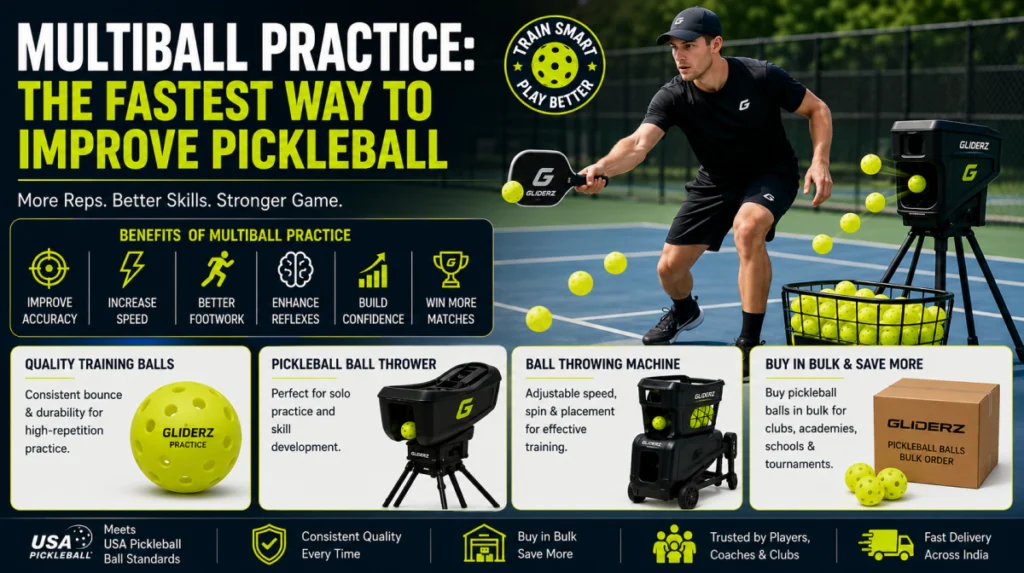
Multiball practice is a training method where a coach, partner, or ball feeding machine delivers a continuous stream of balls to a player in quick succession. Instead of waiting for a rally to develop naturally, the player receives shot after shot, allowing them to repeat the same movement pattern many times without stopping to collect balls or reset play.
The term “multiball” comes from table tennis, where the technique has been used for decades. Pickleball coaches have adopted and refined the same principle, and it has become a core training method in competitive academies, school programs, and club coaching sessions worldwide.
The setup is simple. A feeder stands at one side of the net with a basket or hopper of training balls. The player positions themselves at the relevant court location – the kitchen line, mid-court, or baseline – and the feeder delivers balls at a pace that challenges without overwhelming.
Sessions can focus on a single shot type – dinks, volleys, third-shot drops – or cycle through a sequence of shots that simulates real match situations.
Why Every Pickleball Player Should Practice with Multiple Balls
If you are only playing games to improve, you are leaving a lot of improvement on the table. Here is why multiball practice changes everything.
Faster Repetitions A standard rally gives you unpredictable, low-volume practice. Multiball eliminates downtime between shots, dramatically increasing how many times you execute the same movement in a session.
Better Muscle Memory Skills become automatic through repetition. The more times your body executes a dink, a drive, or a reset, the more deeply that pattern is encoded in your neuromuscular system. Multiball accelerates this process significantly.
Improved Reflexes Receiving balls at a consistent or gradually increasing pace trains your reaction time. Over weeks, your response to fast incoming shots becomes instinctive rather than deliberate.
Shot Consistency When you only practice a shot occasionally in a live rally, consistency is difficult to build. Multiball isolates a shot and lets you repeat it until the technique becomes reliable under pressure.
Reduced Downtime In a traditional practice session, a large portion of time is spent chasing and collecting balls. With a full hopper of pickleball training balls and an organized reset routine, active practice time increases dramatically.
Better Footwork Because the feeder controls ball placement, drills can be designed specifically to work on movement patterns – side-to-side transitions, split-step timing, and approach footwork – without relying on a random rally to produce the right situation.
Benefits of Multiball Practice
The gains from consistent multiball training extend well beyond technique. Here is what players report across the key performance areas.
Accuracy Repetition under controlled conditions lets you fine-tune shot placement. After hundreds of crosscourt dink repetitions, your ability to consistently land the ball within a two-foot zone improves markedly.
Speed As your technique becomes more automatic, you can execute shots faster without losing control. Multiball accelerates the point at which your technique becomes fast and reliable simultaneously.
Endurance A well-designed multiball session is genuinely aerobic. The constant movement – split-stepping, resetting, reaching – builds cardiovascular fitness alongside skill development.
Confidence Confidence in sport is largely built on evidence – on knowing you have executed a shot successfully many times before. Multiball creates that evidence faster than any other training format.
Match Preparation By sequencing multiball drills to simulate real match patterns – for example, a serve return followed by a third-shot drop followed by a transition to the kitchen – you prepare the body and mind for competitive situations.
Tournament Readiness Players who use structured multiball training consistently report feeling more composed during tournaments. The situations they encounter feel familiar because they have already practiced them hundreds of times.
Top Multiball Drills for Beginners
If you are new to structured practice, these eight drills will build your foundation quickly. You need a coach or practice partner as the feeder, and a hopper of quality practice balls to keep sessions flowing.
1. Straight Dink Drill Stand at the kitchen line. The feeder delivers soft, slow balls from the opposite kitchen. Return each ball softly over the net into the same kitchen zone. Focus on keeping the ball low. Run for two to three minutes per side.
2. Groundstroke Consistency Drill Position yourself at the baseline. The feeder delivers balls to alternating forehand and backhand sides. Focus on clean contact and controlled depth. Do not try to hit hard – aim for consistency above everything else.
3. Volley Warm-Up Stand at mid-court. The feeder delivers gentle volleys at chest height alternating forehand and backhand. This builds hand-eye coordination and reinforces the compact volley swing.
4. Serve Practice Sequence Use a ball hopper and practice serve delivery repeatedly. Focus on placement – targeting specific court zones – rather than power. Beginners should aim to develop a reliable serve before adding spin or pace.
5. Return of Serve Drill The feeder stands at the baseline and serves balls repeatedly. The player practices returning consistently to a designated target zone. This trains the eyes to pick up the ball early and develop a controlled return.
6. Kitchen Approach Drill The feeder delivers balls to mid-court. The player hits a shot and immediately transitions toward the kitchen line. This trains the approach movement that is critical in competitive play.
7. Soft Reset Drill The feeder drives balls firmly at the player’s midsection or feet. The player practices absorbing pace and resetting the ball softly into the kitchen. This is one of the most valuable defensive skills in the game and requires dedicated repetition.
8. Lob and Overhead Sequence The feeder alternates between a soft dink and a lob. The player practices transitioning from kitchen defense to overhead smash. Teaches players to read shot type and respond appropriately.
Advanced Multiball Drills for Competitive Players
For players at an intermediate to advanced level, multiball drills become more complex, targeting the specific patterns and pressure points of competitive play.
Crosscourt Dink Drill The feeder delivers balls to your backhand kitchen corner. You return crosscourt consistently for two minutes, then switch sides. The goal is precise placement under mild time pressure.
Speed Volley Drill At the kitchen line, the feeder delivers volleys at increasing pace. The player keeps volleys compact and controlled, progressively adapting to faster incoming balls. Builds reflexes and confidence at speed.
Third-Shot Drop Sequence The feeder simulates a return of serve by delivering balls to the mid-baseline area. The player practices executing a third-shot drop to the kitchen – arguably the most important single shot to develop in competitive pickleball. Repetitions should number fifty to one hundred per session.
Transition Zone Drill The feeder delivers balls to different court depths as the player moves from the baseline toward the kitchen. The player must select the correct shot – drive, drop, or reset – based on ball position. This trains decision-making under movement.
Defensive Lob and Reset Sequence The feeder alternates between hard drives and lobs. The player must first reset the drive, then move back to handle the lob, then transition forward again. A demanding conditioning drill that closely mirrors real point patterns.
Smash Repetition Drill The feeder delivers repeated lobs to various zones. The player executes overhead smashes, focusing on footwork positioning before contact rather than just swinging. Consistency and placement over raw power.
Crosscourt Attack and Defend Player receives a crosscourt dink, then attacks down the line, then resets a counterattack. A three-shot sequence repeated rapidly – trains decision-making alongside execution.
Using a Pickleball Ball Thrower for Solo Practice
One of the biggest obstacles to quality practice is simply not having a partner available. A pickleball ball thrower – a manual or mechanical device that feeds balls to a player – solves this problem completely.
With a ball thrower, you can run a full multiball practice session entirely on your own. Load the machine with a full basket of outdoor pickleball balls, set your target zone, and begin your drill. There is no waiting for a partner, no scheduling conflicts, and no interruptions.
Solo practice with a ball thrower is particularly valuable for:
- Drilling a specific shot weakness without a partner needing to feed the same ball repeatedly
- Training when courts are limited and sharing time with others is necessary
- Building volume outside of formal coaching sessions
- Evening or early-morning practice when partners are unavailable
The key is arriving with a specific goal. Solo sessions without structure tend to become casual hitting. Decide in advance which shot you are working on, how many repetitions you will complete, and what quality standard you are aiming for.
Why a Ball Throwing Machine Improves Training
A ball throwing machine takes everything a manual feeder does and adds precision, consistency, and programmability.
Adjustable Speed You can set the machine to deliver balls at exactly the pace your drill requires – slow and controlled for technique work, fast for reflex and pressure training.
Spin Control Many machines allow topspin, backspin, or side spin to be set, helping players practice handling different ball behaviors.
Placement Precision Consistent delivery to an exact court location is nearly impossible for a human feeder to maintain over a long session. A machine does it perfectly every time.
High-Volume Practice Load the machine’s hopper with a bulk order of 40 hole pickleball balls and run a session that might see two hundred or more ball deliveries without stopping.
Consistency Because the machine never tires, compensates, or varies its delivery unconsciously, the practice environment remains truly controlled throughout.
Pickleball Launcher vs Ball Throwing Machine
Both tools serve the multiball practice goal but differ in several key areas.
| Feature | Pickleball Launcher | Ball Throwing Machine |
|---|---|---|
| Price Range | Lower | Higher |
| Portability | Highly portable | Moderate to heavy |
| Speed Control | Limited | Fully adjustable |
| Spin Options | Minimal | Multiple spin settings |
| Placement Accuracy | Moderate | High |
| Hopper Capacity | Smaller | Larger |
| Power Source | Manual or battery | Electric/battery |
| Best For | Solo casual practice | Academy and club training |
| Setup Time | Fast | Moderate |
| Durability | Moderate | High |
For individual players on a budget, a basic pickleball launcher handles most solo practice needs well. For coaches running academy sessions or clubs managing team training, a full ball throwing machine justifies the investment through consistency, volume, and time saved.
Choosing the Right Pickleball Training Balls
Not all pickleball balls are the same, and choosing the right ball for your practice environment matters more than most players realize.
Practice Ball Practice balls are designed for high repetition use. They are built to be durable across hundreds of sessions rather than optimized for maximum performance characteristics. If you are buying in bulk for a training program, a quality practice ball delivers the best cost-per-session value.
Tournament Ball Tournament balls meet official specifications and are designed for competitive play. Training with the same ball you will use in a tournament means no adjustment period.
Outdoor Pickleball Balls Outdoor balls feature 40 holes and a harder construction to handle wind, rough court surfaces, and varying temperatures. They are the standard for most competitive and recreational play.
Indoor Pickleball Balls Indoor balls are softer with larger holes, designed for smooth gym floors and controlled environments. Coaches running school or academy programs indoors should use indoor-specific balls for appropriate bounce and ball behavior.
Durability For multiball practice, durability is a priority. Balls that crack after limited use increase your cost per session significantly. Quality training balls from a reputable pickleball ball manufacturer will last through many more repetitions before replacement is needed.
Bounce Ball bounce affects how drills feel and how well they replicate match conditions. Use balls with consistent, predictable bounce – avoid cheap options that vary noticeably between balls in the same batch.
Visibility High-visibility yellow or neon green balls improve visibility during fast-paced drills, reducing eye strain and helping players track the ball more accurately during high-speed exchanges.
What Does USA Pickleball Recommend?
USA Pickleball maintains official specifications for balls used in sanctioned competition. Understanding these standards helps coaches and serious players make informed equipment decisions.
According to USA Pickleball guidelines, approved balls must fall within specified diameter and weight ranges, meet bounce height requirements when dropped from a set height, and feature a consistent, smooth surface without textured or rough finishes. The ball must also have between 26 and 40 circular holes – 40 holes being the standard for outdoor play.
Using USA Pickleball balls in training is particularly important for players preparing for sanctioned tournaments. When your practice ball behaves exactly like the competition ball, there is no adjustment period on match day.
For coaches running AIPA-affiliated academies, using AIPA approved balls ensures your players train with equipment that meets national competitive standards – a detail that matters during inter-academy and school-level competition.
It is also worth noting that USA Pickleball occasionally updates its approved ball list. Checking the current approved equipment list before making a large bulk order ensures your purchase remains compliant for competitive use.
Why Coaches and Academies Prefer Bulk Orders
Any coach who has run a multiball session with too few balls understands the frustration immediately. Practice stops. Players collect balls. Momentum breaks. The session loses its effectiveness.
This is why coaches and academies consistently choose to buy pickleball balls in bulk. A full basket of balls – sixty to one hundred or more – means a session can run continuously for twenty minutes or longer without stopping to collect or refill. That uninterrupted flow is exactly what makes multiball practice so effective.
Cost Savings Buying pickleball balls in bulk significantly reduces the per-ball cost. For clubs and academies running multiple sessions per week, those savings accumulate quickly across the year.
Inventory Management A standing bulk order ensures balls are always available. Running out of training balls mid-season disrupts programs unnecessarily.
Team Training When multiple courts are running simultaneously, each requires its own supply. A pickleball bulk order covers every court without the expense and inconvenience of buying small quantities repeatedly.
School Programs Schools and physical education programs benefit enormously from buying wholesale pickleball balls. Large class sizes require large ball volumes, and consistent equipment quality ensures a better experience for every student.
Club Usage Clubs that offer coaching programs, open play sessions, and member training need a reliable, ongoing ball supply. Establishing a relationship with a trusted supplier for regular bulk orders simplifies administration and keeps costs predictable.
How to Select the Best Pickleball Equipment
A complete multiball training setup covers more than just balls. Here is what to consider across your full equipment selection.
Balls Select balls appropriate for your court type (indoor vs outdoor), your training purpose (practice vs tournament preparation), and your budget. For volume training, quality practice balls bought in bulk offer the best value.
Ball Throwers For individual players, a portable pickleball launcher handles solo practice sessions well. Look for adjustable delivery speed, adequate hopper capacity, and a sturdy build that withstands outdoor conditions.
Launchers and Machines Academy and club environments benefit from dedicated ball throwing machines with programmable delivery patterns. Machines with a large hopper capacity reduce refill frequency during long sessions.
Training Accessories Court cones or targets help players develop accuracy. Agility ladders improve footwork patterns. Resistance bands support strength training for paddle-specific movements. A quality ball hopper with wheels makes ball collection efficient after sessions.
Common Mistakes During Multiball Practice
Even structured practice can be undermined by habits that limit its effectiveness. Here are ten mistakes to avoid.
- Practicing at too fast a pace – Speed should challenge without causing breakdown in technique. If your form collapses, slow down.
- Skipping warm-up – Cold muscles increase injury risk. Always spend five to ten minutes warming up before high-repetition drilling.
- Using poor quality balls – Cheap balls with inconsistent bounce make it harder to develop reliable technique. Invest in quality training balls.
- No specific goal per session – Practicing without a clear objective leads to unfocused hitting. Set one or two specific improvement targets per session.
- Neglecting weak shots – Players naturally gravitate toward their strengths. Deliberately spending more time on weaknesses is uncomfortable but essential.
- Too much variety too soon – Changing drills every few minutes prevents deep repetition. Stay on one drill long enough for genuine learning to occur.
- Ignoring footwork – Many players focus entirely on paddle technique while standing flat-footed. Good movement is inseparable from good shot execution.
- Forgetting recovery position – After each shot, return to your base position. Practicing recovery is just as important as practicing the shot itself.
- Not tracking progress – Without recording what you practice and how it goes, it is difficult to see improvement or identify persistent weaknesses.
- Practicing tired – Fatigued practice reinforces poor technique. If your form deteriorates significantly due to tiredness, end the session rather than grinding through bad repetitions.
Frequently Asked Questions
1. What is multiball practice in pickleball?
Multiball practice is a training method where a coach, partner, or ball throwing machine delivers a continuous series of balls to a player in quick succession. It dramatically increases the volume of repetitions per session, accelerating skill development compared to standard rally practice.
2. How many pickleball training balls do I need for a multiball session?
Most coaches recommend a minimum of fifty balls for a productive multiball session. For uninterrupted academy or club training across multiple courts, a bulk order of one hundred or more balls per court keeps sessions flowing without constant collection breaks.
3. What is the difference between a practice ball and a tournament ball?
A practice ball prioritizes durability for high-volume repetition, while a tournament ball is built to meet official specifications – including USA Pickleball standards – for competitive play. Many competitive players train with tournament balls to ensure no adjustment is needed on match day.
4. Does USA Pickleball have specifications for pickleball balls?
Yes. USA Pickleball specifies approved diameter, weight, bounce, and hole count requirements for balls used in sanctioned events. Players preparing for competitive play should train with USA Pickleball balls to ensure their practice replicates tournament conditions.
5. What is a pickleball launcher and how is it used?
A pickleball launcher is a portable device that feeds balls automatically to a player, enabling solo multiball practice without a partner. The player loads the launcher’s hopper with pickleball balls, sets the delivery direction, and begins drilling. It is particularly useful for improving a specific shot type independently.
6. How does a ball throwing machine differ from a launcher?
A ball throwing machine offers greater precision and programmability than a basic pickleball launcher, including adjustable speed, spin, and placement settings. Machines are preferred by coaches and academies for structured, high-volume training. Launchers tend to be more portable and affordable for individual use.
7. Is it worth buying pickleball balls in bulk?
Absolutely, especially for coaches, academies, clubs, and schools. Buying pickleball balls in bulk reduces the per-unit cost significantly, ensures consistent ball availability, and prevents practice sessions from being interrupted by running low on balls. A pickleball bulk order is the standard approach for any organized training program.
8. What are 40 hole pickleball balls used for?
40 hole pickleball balls are the standard for outdoor play. The 40-hole design handles wind better and suits the harder outdoor court surfaces. Most competitive outdoor tournaments use 40 hole balls, making them the right choice for players training for outdoor competition.
9. Can beginners benefit from multiball practice?
Definitely. Multiball practice is beneficial at every level, but beginners arguably gain the most because the high repetition volume builds fundamental technique quickly. Starting with simple straight drills and progressing gradually is the recommended approach for new players.
10.Where can I buy pickleball balls in bulk for my club or academy?
Gliderz Pickleball offers practice balls, tournament balls, and training balls in bulk quantities suitable for clubs, academies, schools, and distributors. Visit our Bulk Orders page or Contact us to discuss your volume requirements and receive a customized quotation.
Explore Gliderz Pickleball Training Equipment
Gliderz Pickleball supplies quality pickleball balls, training equipment, and bulk order solutions for players, coaches, clubs, academies, and distributors.
- Practice Balls – Durable, consistent training balls built for high-volume sessions
- Tournament Balls – USA Pickleball-aligned balls for competitive play preparation
- Training Balls in Bulk – Volume orders for clubs, academies, schools, and programs
- Bulk Orders & Wholesale – Flexible bulk order options with competitive pricing
- Equipment for Clubs and Academies – Full range of training accessories and equipment
Contact Gliderz Pickleball to discuss your requirements or request a bulk quotation.