
Pickleball has moved fast in India – from apartment complex courts to dedicated academies – and with that growth, retailers, distributors, sports stores, and e-commerce sellers are asking a new question: where do we source paddles that customers will actually want to buy again?
That’s where pickleball paddle wholesale comes in. Buying in bulk directly from a manufacturer or supplier isn’t just about lower per-unit pricing – it’s about building a reliable supply chain for a sport that’s still finding its shape in the Indian market.
Before placing a large order, though, a retailer or distributor has to think through more than price. Paddle quality, materials and construction, minimum order quantities, customization options, consistency between production batches, packaging, delivery timelines, and supplier reliability all affect whether a wholesale relationship actually works out. So does understanding product demand and customer preferences – because the “right” paddle for a beginner-heavy retail store looks very different from the right paddle for a competitive academy.
This guide walks through what businesses need to know before entering the pickleball paddle wholesale space in India – from evaluating suppliers to building a product range that serves different types of players.
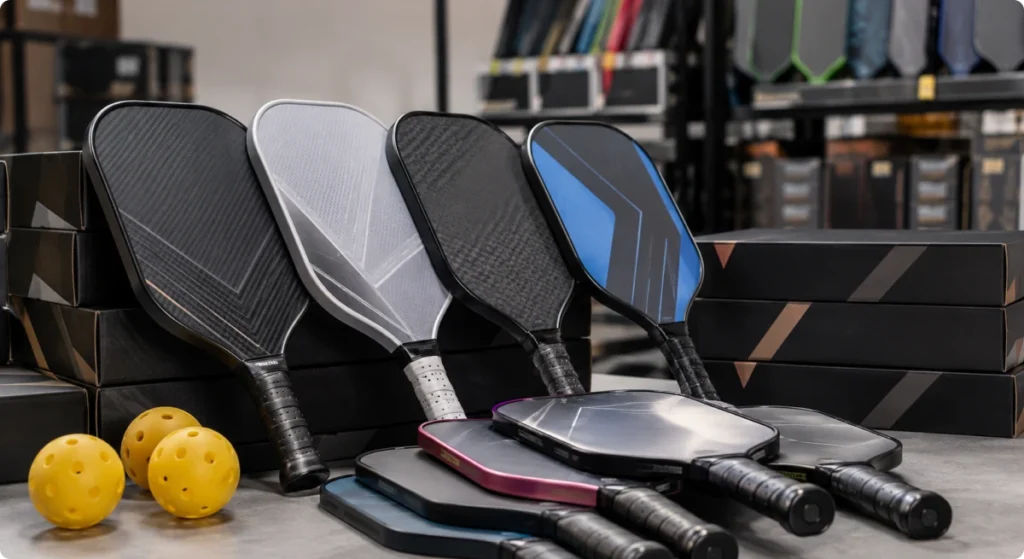
Why Is Pickleball Paddle Wholesale Becoming a Growing Opportunity?
Pickleball’s rise in India has been hard to miss if you’re paying attention to sports facilities in cities like Pune, Bangalore, Mumbai, Delhi, or Hyderabad. Courts that didn’t exist two or three years ago are now booked through weekends. Apartment complexes are converting old badminton or tennis courts. Corporate campuses are adding pickleball as a wellness activity. And with more people picking up a paddle for the first time, retailers are noticing steady, repeat demand rather than a one-time spike.
A few factors are driving this shift for businesses:
- Growth in participation. More recreational players are entering the sport every month, and many of them buy their first paddle from a local store or online seller rather than importing one.
- More clubs and academies. As dedicated pickleball academies and coaching setups open across Indian cities, they need consistent equipment supply – not just for members, but for loaner paddles, tournaments, and merchandising.
- Retailer demand. Sporting goods stores that previously stocked badminton and tennis equipment are adding pickleball sections, and they need a dependable source for stock.
- Online sellers. E-commerce sellers on marketplaces and their own websites are looking for wholesale pickleball equipment they can list without razor-thin margins.
- Institutional and corporate buyers. Schools, resorts, corporate wellness programs, and gated communities are purchasing paddles in bulk for shared use, often preferring a single supplier who can handle repeat orders.
- Repeat purchase behavior. Unlike some sports where a single paddle lasts years, pickleball players – especially competitive ones – tend to upgrade paddles as their skill improves, which creates recurring demand for retailers.
Pickleball India is still an emerging but fast-developing market compared to more mature pickleball markets like the US. That gives retailers and distributors an early-mover advantage, provided they choose their supply partners carefully rather than chasing the lowest possible price. Rather than making broad claims about market size, it’s fair to say the signals – new courts, new academies, growing retail interest – point toward sustained rather than short-term demand.
This is exactly why many retailers prefer wholesale purchasing over piecemeal buying: it locks in better per-unit costs, builds a predictable inventory pipeline, and often opens the door to customization that a small retail order wouldn’t qualify for.
If your business is new to the category, it also helps to understand the game itself before making sourcing decisions – a quick read through What is Pickleball is a useful starting point for anyone unfamiliar with how the sport is played and what equipment it requires.
What Should Retailers Look for When Buying Pickleball Paddles Wholesale?
Not all paddles are built the same way, and the differences matter a lot more once you’re placing a bulk order rather than buying a single unit. Here’s what to evaluate before committing.
Paddle Material
The paddle’s hitting surface has a direct effect on how it plays and how it’s priced. Common surface materials include:
- Carbon fiber – generally offers a tighter, more controlled feel and tends to hold up well over repeated play, which makes it popular with intermediate and advanced players.
- Fiberglass – often provides a slightly softer, more forgiving feel that’s friendlier for beginners, usually at a lower price point.
- Composite construction – blends materials to balance cost and performance, useful for retailers targeting the mid-range segment.
- Graphite and other surface materials – used in some paddle lines for a lighter feel, though less common in Indian retail stock right now.
Material choice affects power, control, durability, and price point simultaneously, so it’s worth stocking more than one material type if your customer base spans beginners through advanced players.
Paddle Core
Underneath the surface, the core material shapes how the paddle feels and sounds on contact. Two of the most common options are:
- Polymer honeycomb cores – widely used because they offer a good balance of power and control, along with a softer feel that reduces arm fatigue.
- Nomex cores – generally firmer and louder on contact, often associated with more power but less forgiveness on off-center hits.
Retailers selecting products for a broad customer base usually lean toward polymer honeycomb options as a safe default, while reserving Nomex-core paddles for customers specifically asking for a more aggressive playing feel.
Paddle Weight
Paddle weight affects maneuverability, power, and how quickly a player’s arm tires during long matches. Lightweight paddles suit players who prioritize quick reactions at the net, midweight paddles work as an all-around option for most recreational and club players, and heavier paddles appeal to players chasing extra power on drives. A wholesale buyer serving a general retail audience typically benefits from stocking mostly midweight paddles, supplemented with lighter and heavier options for specific customer segments.
Grip Size and Handle Design
Grip comfort is often underestimated, but it directly affects how long a player can comfortably use a paddle. Handle length, grip circumference, and cushioning all matter – a grip that’s too large can strain the wrist, while one that’s too small can cause the paddle to slip during fast exchanges. For a retail or academy audience with a wide range of hand sizes, it’s worth checking whether your supplier offers more than one grip size across their product line.
Surface Texture
Surface texture influences how much spin a player can generate. A rougher or grittier surface tends to bite into the ball more, which competitive and intermediate players often look for, while a smoother surface suits players who prioritize control over spin. This is a detail retail staff should be able to explain to customers, since it’s one of the more common questions asked in-store.
Durability and Quality Control
This is where wholesale buying gets riskier than single-unit retail purchasing. A single flawed paddle is a minor inconvenience; a batch of fifty or a hundred with the same inconsistency is a real business problem – returns, unhappy customers, and damaged trust in your store or platform. Before committing to a large order, ask your supplier how they test paddle consistency and how they handle defective units in a batch.
How to Choose the Right Pickleball Paddle Supplier or Manufacturer
Once you understand what makes a good paddle, the next step is evaluating who you’re buying from. This decision matters more than most retailers initially expect, because a wholesale relationship isn’t a one-time transaction – it’s an ongoing supply chain that your business depends on.
Here’s what to look at:
- Manufacturing experience. How long has the supplier been producing paddles, and do they manufacture in-house or through a third party? A pickleball paddle manufacturer with direct control over production tends to offer more consistency than a reseller.
- Product and material quality. Ask what materials go into the core and surface, and whether they can provide samples before you commit to a large order.
- Quality-control processes. As mentioned above, this is critical for wholesale orders specifically, where inconsistency across units is far more damaging than with single purchases.
- Customization capabilities. If you want branded or private-label paddles, confirm what the supplier can actually do – logo placement, color options, packaging design, and so on.
- MOQ requirements. Minimum order quantities vary widely between suppliers. Understand this upfront so it fits your budget and storage capacity.
- Pricing transparency. A trustworthy pickleball paddle supplier will give clear, itemized pricing rather than vague bulk discounts that are hard to verify.
- Packaging. For retail resale, packaging affects shelf appeal and shipping costs. Ask whether the supplier offers retail-ready packaging or only bulk cartons.
- Production capacity and lead times. Can the supplier deliver your order size within a timeline that matches your business needs, especially around seasonal demand spikes?
- Communication. Responsive, clear communication during the ordering process is often a strong indicator of how the relationship will go post-sale.
- Samples and product testing. A reputable supplier should be willing to send samples before a bulk commitment.
- After-sales support. Ask how the supplier handles defective units, delayed shipments, or reorder requests.
- Consistency across bulk orders. This is the real test of a manufacturer – whether paddle number 500 in a batch performs the same as paddle number 1.
Working directly with a pickleball paddle manufacturer rather than a middleman generally gives businesses more control over product specifications, customization, and pricing, since there are fewer parties involved in the supply chain. Gliderz Pickleball, based in Pune, is one of the companies operating in this space in India, manufacturing paddles domestically and working with retailers, academies, and distributors on bulk and custom orders. You can review the current paddle lineup on the GLIDERZ pickleball paddles page to get a sense of the material and construction options available.
Custom Pickleball Paddles in India: A Growing Business Opportunity
Beyond standard wholesale stock, custom pickleball paddle India demand is picking up as more businesses look to put their own branding on equipment rather than reselling generic paddles.
Custom paddles can be valuable across several types of buyers:
- Pickleball clubs and academies wanting branded paddles for members, coaching programs, or loaner equipment.
- Sports retailers looking to build a private-label line that differentiates them from competitors selling the same generic brands.
- Corporate buyers organizing wellness events, employee tournaments, or client gifting programs.
- Schools and institutions introducing pickleball as part of their sports curriculum.
- Tournament organizers who want branded paddles as part of the event experience or as prizes.
- Sports brands entering the pickleball category without building manufacturing capability of their own.
- E-commerce and private-label businesses wanting a distinct product line rather than reselling existing brands.
Customization options generally available through a manufacturer include:
- Logo placement and branding on the paddle face
- Custom graphics and color schemes
- Surface design choices
- Grip color and material options
- Paddle specifications like weight and thickness
- Custom packaging
- Private-label branding for businesses building their own equipment line
Pickleball paddle manufacturing for custom orders typically starts with a design and specification discussion, followed by sample approval before a full production run. This process protects the buyer from receiving a large batch that doesn’t match expectations. Businesses interested in exploring this should look closely at what a manufacturer’s customization process actually involves – turnaround time, minimum quantities for custom runs, and whether design revisions are included before production begins. You can see how this works through GLIDERZ’s own customize pickleball paddle program, which outlines material choices, thickness options, and delivery timelines for bulk and branded orders.
How Much Can Retailers Save by Buying Pickleball Paddles Wholesale?
It’s tempting to reduce wholesale purchasing to a single number – “how much cheaper is it?” – but the real economics are more nuanced, and it’s worth being cautious about any supplier who promises specific savings percentages without knowing your order size or product mix.
What’s generally true is this: buying in bulk lowers the per-unit cost compared to purchasing single paddles at retail price, because manufacturers can spread production, packaging, and shipping costs across a larger order. But several other factors affect the actual savings:
- Order size. Larger orders typically unlock better per-unit pricing, but only if your business can actually sell through that inventory in a reasonable timeframe.
- Shipping and logistics. Bulk shipping costs less per unit but adds more to your upfront investment, so factor this into your cash flow planning.
- Packaging costs. Retail-ready packaging (individual boxes, branded sleeves) costs more than bulk cartons, so decide what level of packaging your sales channel actually requires.
- MOQ considerations. A low minimum order quantity might come with a higher per-unit price, while a very high MOQ might strain your storage or cash flow even at a lower unit price.
- Inventory planning. Overordering ties up capital in unsold stock; underordering means missed sales during demand spikes.
The bigger point retailers should keep in mind: the cheapest paddle in a wholesale catalog is not automatically the best business decision. A low-cost paddle with inconsistent quality can generate returns, refunds, and reputational damage that erode any savings from the lower purchase price. The smarter approach is balancing quality, wholesale price, durability, customer demand, and profit margin together, rather than optimizing for the lowest number on an invoice.
How to Build a Pickleball Paddle Product Range for Your Business
A single paddle model rarely serves an entire customer base. Most successful retailers and distributors in this category build a tiered product range instead.
Entry-Level Paddles
Aimed at beginners and recreational players trying the sport for the first time. These paddles are usually fiberglass-surfaced, moderately priced, and forgiving on off-center hits – ideal for customers who aren’t ready to invest heavily before they know if they’ll stick with the sport.
Mid-Range Paddles
For players who’ve moved past the beginner stage and want better control, spin, or feel. This segment often blends composite or carbon-fiber surfaces with a price point that’s accessible but reflects the improved performance.
Premium Paddles
Designed for advanced and competitive players who prioritize performance characteristics like spin control, power, and precise weight balancing. These paddles usually carry higher margins but also require more customer education to sell effectively, since buyers in this segment are more discerning.
Custom and Branded Paddles
For clubs, academies, businesses, and organizations wanting equipment tied to their own identity – whether that’s a club logo, a corporate brand, or a retailer’s private label.
Having multiple price points lets a retailer serve a wider range of customers without forcing everyone into a single product. It also protects margins – customers who want performance are willing to pay more, while beginners aren’t priced out of trying the sport.
When customers ask what the Best Pickleball Paddle India has to offer, the honest answer is that “best” depends entirely on the individual – their skill level, playing style, preferred paddle weight, grip size, budget, and performance priorities. A retailer who can guide that conversation instead of pushing a single “best” product tends to build more trust, which matters in a category where customers are still learning what they need. You can browse GLIDERZ’s current paddle range through their best pickleball paddle in India collection to see how different series are positioned for different skill levels.
For competitive play specifically, it’s worth understanding official equipment requirements before stocking paddles intended for tournament use. Standards for approved paddles – covering surface material, size, and construction – are published by USA Pickleball, which remains a widely referenced authority on paddle specifications internationally, even for markets outside the US.
Ready to Source Wholesale or Custom Pickleball Paddles?
If you’re a retailer, distributor, pickleball club, academy, or business exploring wholesale or custom pickleball paddles in India, it’s worth having a direct conversation with a manufacturer about your specific requirements – order size, customization needs, timelines, and budget. Contact GLIDERZ to discuss your business’s paddle sourcing needs and get a clearer picture of what a wholesale or custom order would look like for your operation.
Frequently Asked Questions
1. What is pickleball paddle wholesale? Pickleball paddle wholesale refers to purchasing paddles in bulk quantities, typically directly from a manufacturer or authorized distributor, at a lower per-unit price than standard retail purchasing. It’s commonly used by retailers, clubs, academies, and businesses that need multiple paddles rather than a single unit.
2. Why should retailers buy pickleball paddles wholesale? Buying wholesale generally reduces per-unit costs, allows better inventory planning, and – depending on the supplier – can open access to customization options that aren’t available on single-unit purchases. It also creates a more predictable supply relationship for businesses that need to restock regularly.
3. How do I choose a reliable pickleball paddle manufacturer? Look at their manufacturing experience, quality-control processes, willingness to provide samples, pricing transparency, production capacity, and communication responsiveness. Asking for references or reviewing their existing product range is also a reasonable step before committing to a large order.
4. What should I consider before placing a bulk pickleball paddle order? Consider paddle material and construction, minimum order quantities, pricing structure, packaging requirements, delivery timelines, and how the order fits your storage and cash flow. It also helps to request a sample before committing to the full order size.
5. Can I order custom pickleball paddles in India? Yes. Several manufacturers, including GLIDERZ, offer custom paddle programs covering branding, color choices, surface design, and packaging. The process usually involves a design discussion, sample approval, and then production, so it’s worth budgeting extra time for this compared to ordering standard stock.
6. What is the minimum order quantity for wholesale pickleball paddles? Minimum order quantities vary by manufacturer and depend on whether you’re ordering standard stock or custom-branded paddles. It’s best to confirm current MOQ requirements directly with your chosen supplier, since these can change based on production capacity and season.
7. How can retailers choose the best pickleball paddle for their customers? Rather than picking one “best” paddle, retailers do better by stocking a range across price points and skill levels – entry-level, mid-range, and premium – and training staff to guide customers based on their playing style, budget, and experience level.
8. Can GLIDERZ manufacture custom-branded pickleball paddles? Yes. GLIDERZ offers custom pickleball paddle manufacturing for clubs, academies, corporate buyers, and retail businesses, covering branding, surface material choices, and packaging. Reach out through their contact page to discuss specifications, quantities, and timelines.
Final Thoughts
Wholesale pickleball paddle sourcing in India is still a relatively young space, which means retailers and distributors who get their supplier relationships right early have a real opportunity to build lasting customer trust. The businesses that do well tend to be the ones that treat paddle selection seriously – evaluating materials, working with manufacturers who maintain consistency across batches, and building a product range that actually matches what their customers need.