
The Ultimate Guide to Pickleball Paddle Materials exists for one simple reason: pickleball is growing faster in India than almost any other sport, and as more players step onto the court, one question keeps coming up – what should my paddle actually be made of? It sounds like a small detail, but the material of your paddle face and core quietly shapes almost everything about how you play. It decides how much pop you get on a drive, how softly you can drop a third-shot into the kitchen, how much spin you can generate on a serve, and how long the paddle will last before it starts to feel “dead.”
If you’re new to the sport, you might assume all paddles feel roughly the same once you get the swing of things. They don’t. A raw carbon fiber face behaves completely differently from a fiberglass one, and a polypropylene honeycomb core reacts nothing like an aluminum core. These differences aren’t marketing fluff – they’re rooted in physics, material science, and years of paddle engineering that has evolved rapidly, especially with the rise of T700 carbon fiber technology.
This guide breaks down everything you need to know about pickleball paddle materials, in plain language, whether you’re a beginner picking your first paddle, a club or academy buying in bulk, a retailer stocking shelves, or a competitive player chasing every last bit of edge. By the end of this Ultimate Guide to Pickleball Paddle Materials, you’ll understand exactly which material fits your game – and why brands like GLIDERZ are built around these very principles.
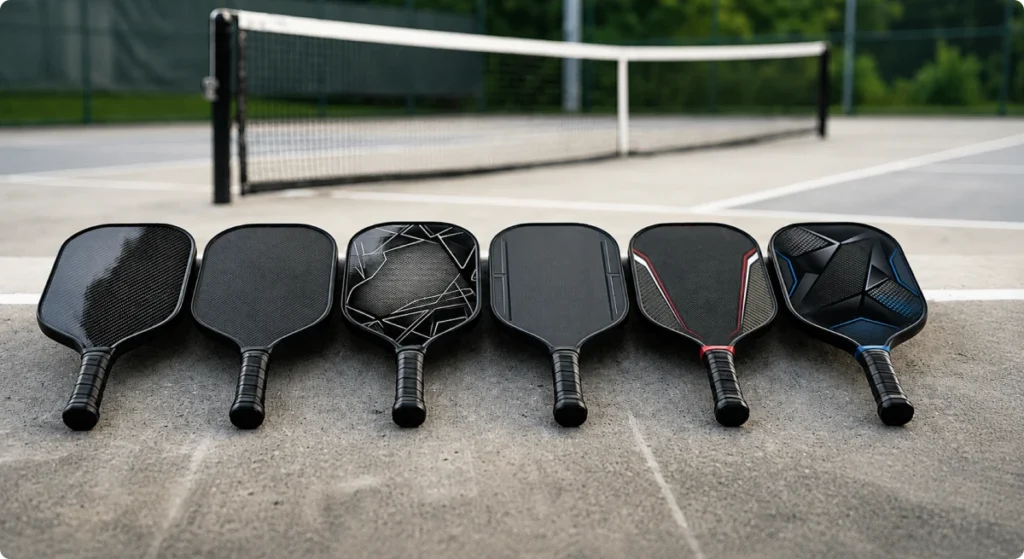
Why Pickleball Paddle Materials Matter: The Starting Point of The Ultimate Guide to Pickleball Paddle Materials
Every paddle is essentially a sandwich: a face material on the outside, a core in the middle, and edge/frame construction holding it together. The materials chosen for each layer directly influence six things that every player cares about.
- Power: Stiffer, denser materials like carbon fiber transfer more energy from your swing into the ball, giving you harder, faster shots.
- Control: Softer-flexing faces and certain core densities let you “feel” the ball better, which matters enormously for dinks and resets at the net.
- Spin: Textured surfaces – especially raw, unpainted carbon fiber – grip the ball longer at contact, letting you generate more topspin and slice.
- Comfort: Core material affects vibration dampening. A harsh core can lead to tennis-elbow-like discomfort over long sessions.
- Durability: Some materials resist cracking and delamination far better than others, which matters if you’re playing daily or running a rental fleet at a club.
- Weight: Material density affects swing weight, which changes how quickly you can react at the net versus how much power you generate from the baseline.
Understanding this trade-off is the real key to picking the right paddle. There’s no single “best” material for everyone – there’s only the best material for your specific game, and that’s exactly what we’ll unpack next.
Carbon Fiber Pickleball Paddles: Features, Benefits & Best Use Cases
Carbon fiber has become the gold standard for serious pickleball players, and for good reason. It offers an unusually good balance of stiffness, lightness, and surface texture that most other materials struggle to match.
Raw Carbon vs. Painted Carbon
Raw carbon fiber faces (unpainted, matte black finish) have become especially popular because the exposed carbon weave creates natural texture. This texture increases the paddle’s grip on the ball at contact, translating into noticeably more spin – a huge advantage for players who like to curve their serves or add topspin to drives.
T700 Carbon Fiber: The Professional-Grade Standard
Among carbon variants, T700 carbon fiber has emerged as a favorite in professional-grade paddles. Originally developed for aerospace and high-performance industrial applications, T700 carbon offers an excellent strength-to-weight ratio. In paddle construction, this means:
- A stiffer face that resists flexing under hard swings, which improves consistency on power shots
- Reduced micro-cracking over time compared to lower-grade carbon weaves
- A lighter overall paddle without sacrificing structural integrity
For players and academies searching for a T700 paddle in India, this is the material to look for on the spec sheet – it’s a strong signal that the manufacturer is using performance-grade construction rather than a budget carbon blend.
Why Players Choose Carbon Fiber
- Spin generation: Textured raw carbon faces grip the ball longer, ideal for players who rely on serve variety and topspin drives.
- Professional performance: Most paddles used on professional tours today feature some form of carbon fiber face, which tells you a lot about its performance ceiling.
- Lightweight construction: Carbon fiber achieves strength without adding bulk, which helps at the net where quick hands matter.
- Durability: High-grade carbon resists denting and cracking better than fiberglass under repeated hard contact.
Advantages
- Excellent spin potential due to surface texture
- Strong power-to-control balance
- Long-lasting under regular, competitive play
- Preferred by professional and advanced players
Disadvantages
- Generally more expensive than fiberglass paddles
- Can feel “harder” or less forgiving for absolute beginners
- Slightly less power off the face compared to some fiberglass options, since carbon prioritizes control
If you’re a player in India shopping for a carbon paddle, it’s worth checking whether the listing specifies the carbon grade – plain “carbon fiber” paddles vary widely in quality, while a labeled T700 construction usually signals a more consistent, tested product.
Fiberglass, Graphite & Composite Pickleball Paddles Compared
Carbon fiber isn’t the only face material worth knowing about. Fiberglass, graphite, and composite blends each bring a different feel to the game, and many excellent paddles – including entry-level and intermediate models – are built around them.
Fiberglass (sometimes marketed as “fiberglass composite”) tends to flex slightly more than carbon fiber at contact. This flex acts like a small trampoline effect, giving the ball extra pop even on a moderate swing. That’s why fiberglass paddles are often associated with more raw power, making them popular with players who want to hit hard without generating a lot of swing speed themselves.
Graphite sits between fiberglass and carbon in terms of stiffness. It’s typically very lightweight and offers a crisp, responsive feel, which is why many control-oriented and touch players gravitate toward graphite faces.
Composite paddles blend fiberglass with other materials (often resin-based) to hit a specific price point or performance profile. These are common in beginner and mid-range paddles because they’re generally more affordable to manufacture.
Comparison Table: Carbon Fiber vs. Fiberglass vs. Graphite vs. Composite
| Material | Weight | Power | Control | Spin | Durability | Price Range |
|---|---|---|---|---|---|---|
| Carbon Fiber (incl. T700) | Light | Moderate-High | High | Excellent | Excellent | Mid–High |
| Fiberglass | Medium | High | Moderate | Good | Moderate | Low–Mid |
| Graphite | Very Light | Moderate | High | Good | Moderate | Mid |
| Composite | Medium–Heavy | Moderate | Moderate | Moderate | Moderate | Low |
Quick Buying Tips
- Want more raw power with a bigger sweet spot? Lean toward fiberglass.
- Want precision, touch, and control at the net? Lean toward graphite or a control-tuned carbon fiber paddle.
- Want the best all-around performance for competitive play? A carbon fiber, especially T700-grade, is usually worth the investment.
- On a tighter budget or buying paddles in bulk for a club? Composite paddles offer solid value for casual and recreational play.
Understanding Pickleball Paddle Core Materials
While the face material gets most of the attention, the core is arguably just as important – it’s the layer that determines how the paddle actually feels and sounds on contact.
Polypropylene Honeycomb Core
This is by far the most widely used core in modern paddles, and for good reason. The honeycomb-shaped cells (usually visible if you look at a cross-section) create a structure that’s light yet absorbs shock effectively. A polypropylene honeycomb core typically delivers:
- A softer, more controlled feel ideal for dinking and resets
- Good noise dampening, which matters in noise-sensitive residential areas and gated communities – an increasingly relevant factor as courts pop up across Indian housing societies
- Consistent performance across a wide range of cell sizes (some brands use larger cells for more power, smaller cells for more control)
Nomex Core
Nomex is a paper-based composite material dipped in resin, known for being extremely stiff and hard. It was popular in early pickleball paddle designs because it produces a very “hot” or lively response – shots come off fast and hard. However, Nomex is noisier on contact and tends to wear down faster than polypropylene, which is part of why it has become less common in modern paddles.
Aluminum Core
Aluminum honeycomb cores were popular in earlier paddle generations. They’re known for a firm, consistent feel and good touch, but they’re generally heavier than polypropylene and can dent over time with hard use, which affects long-term consistency.
Core Material Comparison
| Core Type | Control | Power | Noise Level | Durability |
|---|---|---|---|---|
| Polypropylene Honeycomb | High | Moderate | Low (Quiet) | Excellent |
| Nomex | Moderate | High | High (Loud) | Moderate |
| Aluminum | High | Moderate | Moderate | Moderate |
For most players today, a polypropylene honeycomb core paired with a carbon fiber or fiberglass face offers the best overall balance – which is why it dominates the current market, from entry-level to professional-grade paddles.
How to Choose the Best Pickleball Paddle Material for Your Playing Style: Applying the Ultimate Guide to Pickleball Paddle Materials
There’s no universal “best” paddle material – the right choice depends heavily on your skill level, playing style, and the format you play most.
For Beginners: Look for a fiberglass or composite face paired with a polypropylene honeycomb core. These paddles are more forgiving, offer a larger effective sweet spot, and won’t punish small technical errors the way a stiffer, control-oriented carbon paddle might.
For Intermediate Players: This is where carbon fiber starts to shine. As your consistency improves, you’ll benefit from the added spin and control that textured carbon faces provide, especially if you’re developing your third-shot drop and dinking game.
For Professional and Competitive Players: T700 carbon fiber faces paired with a fine-cell polypropylene core are the current standard at the top level. The combination offers the control needed for precise net play along with enough pop for competitive drives and putaways.
For Singles Players: Prioritize paddles that offer more power and reach, since singles rewards aggressive baseline play. Fiberglass or a power-tuned carbon paddle tends to work well here.
For Doubles Players: Control matters more than raw power in doubles, since so much of the game happens at the net. A control-oriented carbon fiber paddle with a fine honeycomb core is usually the better fit.
For Power Players: Fiberglass faces or larger-cell honeycomb cores amplify natural power, letting you hit harder without over-swinging.
For Control Players: Carbon fiber faces (especially raw, textured finishes) with fine-cell cores give you the touch and feedback needed for precision dinks, drops, and resets.
Buying Tips for Indian Players and Buyers
- If you’re searching to buy a pickleball paddle in India, always check the face material, core type, and weight specifications before purchasing – don’t rely on price alone.
- Shopping for a pickleball paddle online in India has become far easier over the past two years, but make sure the seller specifies the exact carbon grade (T700 or otherwise) rather than just saying “carbon fiber.”
- For clubs and academies buying in bulk, ask for consistency testing across a batch – paddle-to-paddle variation can be a real issue with lower-quality manufacturing.
- Always check whether the paddle complies with recognised standards; for tournament and club play, it’s worth reviewing the USA Pickleball Equipment Standards to ensure paddle specifications meet accepted competitive guidelines.
Whether you’re just discovering what pickleball is or you’re already deep into competitive play, understanding paddle materials will help you make a far more informed choice than shopping by brand name or color alone.
Why GLIDERZ Pickleball Paddles Stand Out
GLIDERZ was built around the exact principles covered in this guide – using premium materials matched to real playing conditions rather than chasing trends.
- Carbon fiber options, including T700 technology: GLIDERZ paddles use high-grade carbon fiber faces, giving players genuine spin, control, and durability rather than a “carbon-coated” marketing label with little substance underneath.
- Polypropylene honeycomb cores: Every core is engineered for the right balance of control and power, tuned specifically for how Indian players actually play – fast net exchanges, aggressive dinking battles, and long rallies in outdoor heat and humidity.
- Strict quality control: Each batch goes through consistency checks so that the paddle in your hand performs the same as the one your teammate is holding.
- Made in India: GLIDERZ paddles are manufactured with Indian playing conditions in mind – from court surfaces to climate – rather than being a generic import repackaged for the local market.
- Real performance testing: Paddles are tested on actual courts by real players before they reach the shelf, not just validated on a lab bench.
- Built for Indian conditions: From humid coastal cities to dry inland courts, GLIDERZ paddles are designed to hold up across the range of conditions found on pickleball courts in India.
If you want to browse the current range, you can check out the GLIDERZ paddle collection, or if your club, academy, or retail business needs something tailored to specific specs, GLIDERZ also offers custom pickleball paddles for bulk and wholesale orders. This Ultimate Guide to Pickleball Paddle Materials wouldn’t be complete without pointing out that GLIDERZ applies every principle above directly to its own paddle line. For questions about materials, specs, or wholesale pricing, you can always contact GLIDERZ directly.
Frequently Asked Questions
1. Which pickleball paddle material is best? There’s no single “best” material for every player – it depends on your skill level and style. Carbon fiber, especially T700-grade, is generally considered the best all-around option for control and spin, while fiberglass suits players who want more raw power.
2. Is carbon fiber better than fiberglass? Carbon fiber typically offers better control, spin, and durability, while fiberglass offers more power due to its slightly greater flex at contact. “Better” depends on whether you prioritize precision or raw pop in your shots.
3. What is T700 Carbon Fiber? T700 is a high-grade carbon fiber originally developed for aerospace-level applications. In paddles, it offers an excellent strength-to-weight ratio, resulting in a stiff, durable, lightweight face used in many professional-grade paddles.
4. What is a polypropylene honeycomb core? It’s a lightweight core made of honeycomb-shaped polypropylene cells, widely used in modern paddles for its balance of control, shock absorption, and quiet performance on contact.
5. Which paddle is best for beginners? Beginners generally do well with a fiberglass or composite face paired with a polypropylene honeycomb core, since these offer a forgiving sweet spot and a more affordable price point.
6. Where can I buy pickleball paddles in India? You can buy pickleball paddles online through Indian retailers and direct brand websites, including GLIDERZ, which offers paddles designed specifically for Indian playing conditions.
7. Are carbon paddles worth the investment? For intermediate to advanced players, yes – the added spin, control, and durability of carbon fiber, particularly T700-grade construction, typically justifies the higher price over time.
8. How do I choose the right paddle material? Consider your skill level, whether you prioritize power or control, and how often you play. Beginners should favor forgiving fiberglass or composite paddles, while competitive players usually benefit from carbon fiber with a fine-cell honeycomb core.
Conclusion
Choosing the right pickleball paddle material isn’t just a technical detail – it’s one of the most important decisions you’ll make as a player, coach, club owner, or retailer. Carbon fiber, particularly T700-grade construction, delivers the spin, control, and durability that advanced and professional players demand. Fiberglass and composite paddles remain excellent choices for beginners and power-focused players who want a forgiving, punchy feel. And the core material – most commonly polypropylene honeycomb – quietly shapes how every single shot feels off your paddle face.
As pickleball continues its rapid growth across India, understanding these material differences will help you buy smarter, coach better, and play with far more confidence on the court. Whether you’re outfitting an academy, stocking a retail shelf, or simply upgrading your own paddle, the right material match makes all the difference.
👉 Looking to start playing? Explore GLIDERZ Pickleball paddles – Made in India for Indian players.