By Prajakta Shinde
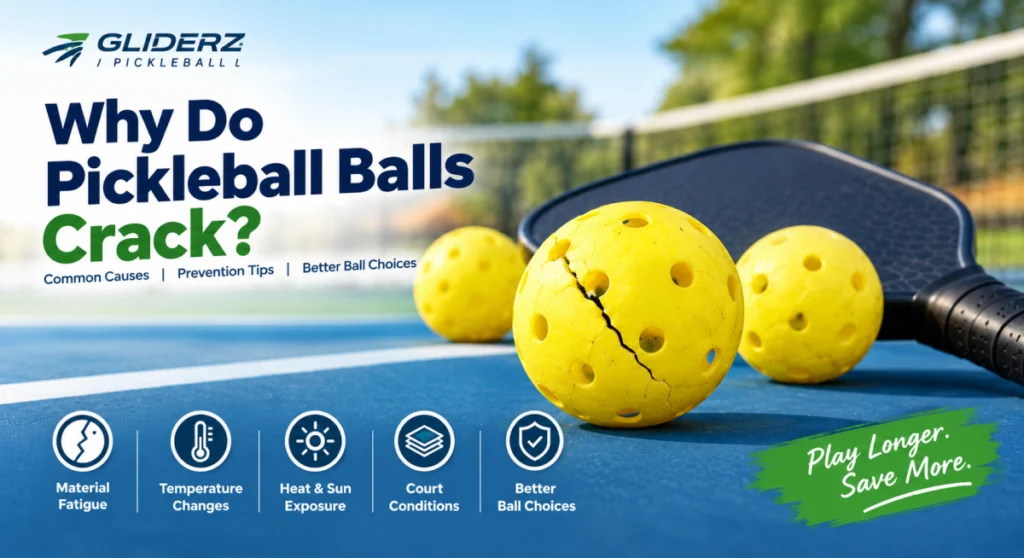
You open a fresh set of balls on Saturday morning, and by the next weekend one of them has a thin split running along the seam. It is annoying, and it raises a fair question: why do pickleball balls crack, and is something you are doing causing it?
The short answer is that a pickleball is a hollow plastic shell with a thin wall, and it takes hundreds of paddle hits and bounces in every session. Cracks usually come from a combination of repeated impact, material fatigue, temperature, court surface, storage conditions and ball quality. It is rarely one single cause. Understanding these factors helps you avoid replacing balls earlier than necessary, and it helps you choose balls that suit the way you actually play.
This matters whether you play with friends in a housing society, coach beginners every morning, run a club or manage an academy that goes through hundreds of balls a month. If you are brand new to the sport, you may want to [learn the basics of pickleball] first, then come back to this guide.
1. Why Do Pickleball Balls Crack So Easily?
A pickleball has to bounce predictably, fly straight and survive hard paddle contact while staying light. To get this balance, manufacturers use a thin plastic wall with a pattern of holes, and that thin wall is also why cracks happen. Here are the main causes.
Repeated impacts during rallies
Every time the ball meets a paddle face or a court surface, the shell flexes slightly and then returns to shape. One impact does nothing. Thousands of them add up.
High-impact shots and hard contact
Hard drives, overheads, smashes and serves put far more force into the ball than soft shots. A ball that gets hit hard over and over, especially off a stiff, textured paddle face or onto a rough court, is under more stress than one used for gentle rallies. Mishits matter too. Catching the ball on the paddle edge, or hitting it into a fence post or net post, can damage the shell in one moment.
Material fatigue and gradual wear
Plastic does not last forever under repeated flexing. Over time, the material can lose some of its flexibility, and small stress marks can grow into visible cracks. This is normal wear. Even a well-made ball will eventually reach the end of its useful life, and that point depends on how often and how hard it is used.
Temperature changes and cold-weather brittleness
Plastics generally become less flexible as temperatures fall, which can make them more likely to crack on hard impact. In India, this is more relevant in northern winters, hill stations and early-morning sessions in cold months. Heat causes a different problem: a ball left in a hot space may soften or lose its shape, and that can affect how it plays.
Manufacturing quality and construction differences
Not all balls are built the same. Differences in the polymer, the wall thickness, how the two halves are joined and how consistent the moulding is can all affect how well a ball resists cracking. Many pickleball balls are made from two moulded halves joined at a seam, and the seam is often where splits show up first.
Incorrect storage and harsh conditions
Where a ball sits between sessions matters more than most players think. A bag left in a parked car, near a window in direct sun, or in a cold storeroom can expose the balls to temperatures they were not designed for. Heavy items stacked on balls can also cause deformation.
Indoor and outdoor balls behave differently
Indoor and outdoor balls are designed for different environments, and that affects how they wear. According to USA Pickleball’s equipment rules, a ball may have between 26 and 40 holes, and the hole pattern is one of the clearest ways to tell ball types apart. Indoor balls typically have fewer, larger holes and a softer feel, which suits smooth gym floors. Outdoor balls typically have more, smaller holes and a harder shell, which suits wind and rougher surfaces. Because the construction and the intended surface differ, an indoor ball used on a rough outdoor court may wear or crack in ways that a purpose-built outdoor ball might not. For official rules and equipment standards, you can refer to USA Pickleball.
2. How Do Temperature, Court Conditions, and Playing Style Affect Pickleball Balls?
Two players can use the same type of ball and see very different results. The reason is usually the conditions and the way the ball is used. It is worth saying clearly: not every cracked ball has the same cause, and durability varies with ball design, materials, usage and environment. The points below are general guidance rather than fixed rules.
Cold weather versus hot weather
In cold conditions, the plastic is generally stiffer, so a hard hit can crack a ball that would have survived in warmer weather. In hot conditions, the ball is usually more flexible, but it can soften, change shape or lose its original bounce. For many Indian players, heat is the bigger everyday factor than cold.
Hard outdoor courts and frequent high-impact play
Outdoor courts in India range from smooth acrylic-coated surfaces to older, rougher concrete. A rougher or more abrasive surface wears the ball’s outer shell faster, and a very hard surface returns more energy into the ball at each bounce. If your regular court is rough, expect balls to show wear sooner than on a well-maintained surface.
Aggressive shots and intensive training
If you practice power drives, serves and overheads in long sessions, your balls are working harder. The same goes for coaching drills where a coach feeds hundreds of balls in an hour. In these cases, balls reach the end of their life faster, and that is a normal cost of intensive training rather than a sign that something is wrong with the ball.
Indoor versus outdoor balls
Playing an outdoor ball indoors, or an indoor ball outdoors, changes both performance and wear. Using each in its intended environment usually gives better consistency. If you play in both, keep separate sets.
Storage and transportation
Balls spend more time in your bag than on the court. A kit bag in a car boot in summer, or a box of balls stored near a window, is a common reason for early deformation. For clubs and academies, bulk stock should be stored in a cool, dry, shaded place, away from direct sunlight, and not crushed under heavy equipment. When balls are shipped, they may spend days in transit, so it helps to check them on arrival and store them properly right away.
3. How Can You Prevent Pickleball Balls from Cracking?
You cannot stop normal wear, but you can avoid a lot of unnecessary damage. These habits help.
Choose the right ball for the environment. Use an outdoor ball outdoors and an indoor ball indoors. Check the product description for the intended use rather than assuming any ball will do.
Follow the manufacturer’s guidance. Look at the temperature and storage advice from the ball’s maker. Different ball designs may have different recommendations, so general tips are a starting point, not a substitute.
Store balls away from heat and direct sunlight. Keep them in a shaded bag or a cupboard, not on a dashboard, a car seat or a sunny windowsill. Avoid leaving them in a hot or very cold vehicle overnight.
Avoid prolonged exposure to extremes. If you are playing in cold weather, let the balls come to a moderate temperature before you start, and avoid hitting them as hard on the first few shots. In hot weather, rest the balls in a shaded spot between games.
Inspect your balls regularly. Before each session, look at the seam, the edges of the holes and the overall shape. Small hairline cracks are easy to miss, so check in good light.
Rotate balls during intensive training. If you are drilling for an hour or more, use several balls in rotation instead of one or two. This spreads the wear and helps you spot the one that is starting to go out of shape.
Buy suitable quantities for clubs and academies. If a group of players shares the same set, balls wear faster. Having enough balls means you can rotate more freely and retire damaged ones without running short. Buying in planned quantities also helps you keep balls of the same type and batch for more consistent play.
Even if you do all of this, balls will eventually wear out. Prevention reduces avoidable damage, but it cannot remove normal wear and tear.
4. When Should You Replace a Cracked Pickleball Ball?
The simple rule is that a ball with a visible crack should be retired. But cracks are not the only warning sign. Here is what to look for.
Visible cracks or splits. Any crack, especially along the seam or between holes, means the shell is compromised. A small split can grow quickly with the next few hits.
Changes in shape or roundness. A ball that has become slightly oval, flattened on one side or dented will not fly or bounce as it should. Roll it on a flat surface and watch for wobbling.
Unpredictable bounce. If a ball bounces low, high or sideways compared with others from the same set, it has probably lost consistency. Drop two balls from the same height and compare.
Damaged or deformed holes. Holes that look stretched, torn or uneven can change how air moves through the ball, which affects flight.
Reduced consistency during rallies. If you keep hitting shots that behave oddly even when your technique is fine, check the ball before blaming yourself.
Playing with a damaged ball is a bad idea for practice and competition. It makes shots harder to read, which can slow your progress because you are no longer training against consistent behavior. In competitive play, it can also lead to disputes and interruptions. In recreational games, if a ball cracks during a rally, the usual approach is to finish the point and then swap it out at the next opportunity. For tournaments, follow the event’s rules and what the referee or tournament director decides. For sanctioned USA Pickleball events, the tournament ball must be on the official approved list, so check the event’s ball requirements ahead of time.
5. How to Choose Durable Pickleball Balls in India
Pickleball India is growing quickly, with new courts appearing in apartment complexes, schools, sports clubs and academies. With that growth comes a lot of choice, and not all of it is clear. If you are searching for the Best Pickleball ball India has to offer, the right answer depends less on a single brand name and more on how well a ball fits your use. Here is what to consider.
Indoor or outdoor
Start with the surface. For smooth indoor floors or wooden courts, you want a ball made for indoor play. For outdoor concrete or acrylic courts, you want an outdoor ball. If you play on both, plan for two sets. Our related guide, Best Pickleball Ball: A Buyer’s Guide for Indian Players, goes deeper on this choice.
How often and how hard you play
A weekend player and a daily coach have very different needs. The more often you play, and the harder you hit, the more you should value durability and consistency. If you are unsure, start with a small pack and scale up.
Consistency and durability
Look for balls that feel uniform from one to the next. Consistent weight, shape and bounce across a set matter as much as the headline durability claim. Ask what the ball is made from, how the halves are joined, and what testing or quality checks the seller does. Be wary of claims like “unbreakable,” because no ball can honestly promise that.
Suitability for different players
Beginners benefit most from balls that bounce predictably and are easy to see. Clubs and coaching academies need balls that stand up to repeated drills. Tournament organisers need uniform sets, and they should also check any ball requirements for the event. For pickleball balls for beginners, a consistent ball that matches the court is usually enough.
Check specifications and intended use
Read the product page carefully. Look for the number of holes, the intended surface (indoor or outdoor), the weight and diameter, and whether the ball is described as tournament-grade. If you need a ball for a sanctioned event, check the event’s official ball list rather than relying on marketing language.
Single packs versus bulk
For individual players, a pack of three or a small set is usually enough. For clubs, academies, schools, coaching centres and events, buying in bulk lowers the cost per ball and keeps your supply consistent. If you plan to Buy bulk pickleball ball stock, think about how many balls you realistically go through per month, how many you need on hand for drills and tournaments, and how long you can store them safely. Bulk pickleball balls for clubs and academies also make it easier to keep the same batch on court, which helps consistency.
What clubs and academies should consider
If you are buying for a group, ask these questions before you order:
- Is the ball intended for your court surface?
- Can the seller share specifications and explain how balls are quality-checked?
- What are the delivery timelines and GST invoicing options for bulk orders?
- Can you order a small trial batch first?
- Will the seller keep supplying the same ball type later, so your sets stay matched?
Where GLIDERZ fits
GLIDERZ is a Pune-based manufacturer of pickleball balls and paddles. According to the GLIDERZ Y40 product page, the Y40 is a 40-hole, two-piece outdoor ball, listed at 26.3 g and 74.5 mm, with a semi-hard build. The ball page also describes the two halves as ultrasonically welded and says each batch is tested for bounce, weight and flight before dispatch. The Y40 is designed for outdoor courts, so if you play indoors you will need to check whether it suits your surface. As with any ball, a stronger seam does not make it immune to wear, and results will depend on your courts and how hard you play.
You can browse pickleball balls from GLIDERZ to see current pack sizes, or look at the 100-ball bulk box if you manage a club or academy. If you are looking at the wider range of GLIDERZ pickleball equipment, including paddles, the shop page is the place to start. For larger quantities, custom quotes or retailer enquiries, you can contact GLIDERZ and enquire about bulk pickleball orders directly.
6. Frequently Asked Questions About Cracked Pickleball Balls
1. Why do pickleball balls crack so easily?
Because they are thin-walled plastic shells that flex with every hit. Repeated impact, hard shots, temperature, rough courts and storage conditions all add stress, and cracks often start at the seam. Cracking “easily” can also point to ball quality or using the wrong ball type for the surface.
2. How long does a pickleball ball usually last?
There is no fixed lifespan. It depends on how often you play, how hard you hit, the court surface, the weather and the ball’s construction. A ball used for gentle casual rallies will usually last longer than one used in intensive coaching drills. Replace a ball when it cracks, loses its shape or bounces unpredictably.
3. Do pickleball balls crack more in cold weather?
They can. Plastics generally become less flexible in the cold, so hard hits may be more likely to cause cracks. Letting balls warm to a moderate temperature before play, and following the manufacturer’s temperature guidance, may help. Not every cold-weather crack has the same cause, though.
4. Are indoor or outdoor pickleball balls more durable?
Neither is universally more durable. Outdoor balls are generally built harder for wind and rough courts, while indoor balls are generally softer and made for smooth floors. Durability is best when you use each type on the surface it was made for.
5. Can you continue playing with a cracked pickleball ball?
It is best not to. A cracked ball can fly and bounce unpredictably, and the crack can grow. In casual play, finish the point and swap the ball at the next stop. In tournaments, follow the event’s rules and the referee’s instructions.
6. How can I make my pickleball balls last longer?
Use the right ball for your surface, store balls out of heat and direct sunlight, rotate several balls during practice, inspect them regularly and avoid hitting them against fences or posts. These habits reduce avoidable damage, though normal wear cannot be removed.
7. Where can I buy pickleball balls in India?
You can buy from sports retailers, online marketplaces and directly from manufacturers. If you want to buy pickleball balls online in India from a manufacturer, you can order on the GLIDERZ shop. Whichever seller you choose, check the intended surface, hole count, and specifications before you order.
8. Can pickleball clubs and academies buy balls in bulk?
Yes. Many manufacturers and suppliers sell in bulk for clubs, academies, schools and events. GLIDERZ lists a 100-ball box and larger bulk quantities on its pickleball balls page, and you can enquire about bulk pickleball orders for custom requirements.
👉 Looking to start playing? Explore GLIDERZ Pickleball paddles – Made in India for Indian players.