
Common mistakes in pickleball are the number one reason players feel stuck at the same level for months, even when they’re practicing regularly. If you’ve been playing pickleball for a few weeks and feel like you’re stuck, you’re not alone. Almost every player – from a first-timer on an apartment court in Pune to someone grinding it out at a club in Mumbai – makes the same handful of mistakes early on. The good news? Once you know what they are, they’re surprisingly easy to fix.
This guide breaks down the top 10 pickleball mistakes players in India make, and exactly how to correct each one. Whether you picked up a paddle last month or you’ve been playing for a year and hit a plateau, there’s something here for you.
If you’re completely new to the sport, it helps to start with the basics – check out our What is Pickleball guide to understand the rules and scoring before diving into strategy.
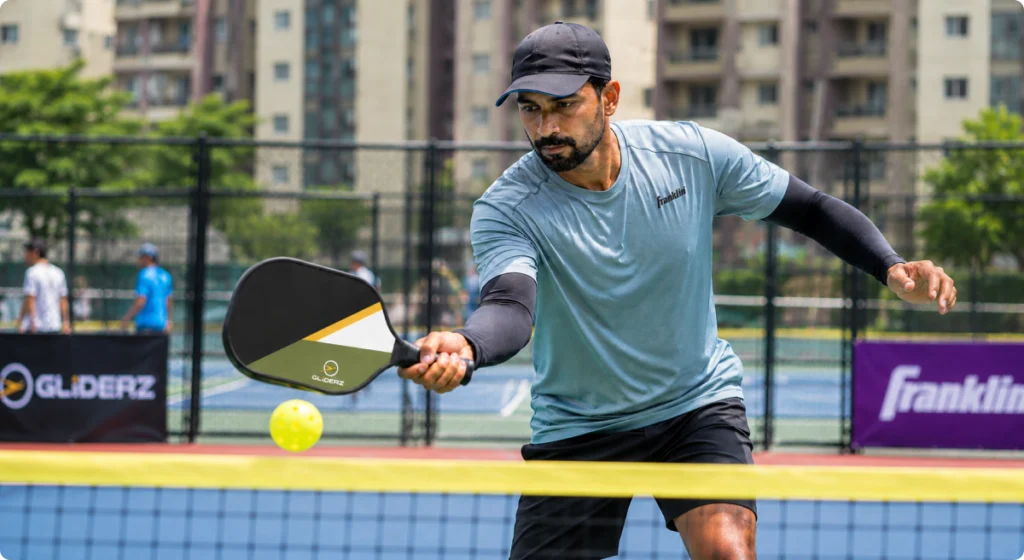
Why Even Good Players Keep Making These Common Mistakes in Pickleball
Pickleball looks deceptively simple. Small court, plastic ball, underhand serve – how hard can it be? Pretty hard, actually. The sport rewards patience and precision over raw power, and that’s exactly where most players trip up.
Coming from tennis or badminton, your instincts tell you to smash, swing hard, and stay near the baseline. Pickleball punishes those instincts. The court is smaller, the ball is lighter, and the “kitchen” (non-volley zone) changes the entire rhythm of the game. Most errors aren’t about fitness or talent – they’re about unlearning habits from other sports and building new ones specific to pickleball.
There’s also a India-specific factor at play. Many players here are learning on repurposed badminton or tennis courts, in apartment complexes, or at newly built community facilities where formal coaching isn’t always available. That means a lot of players are essentially self-taught through YouTube videos and trial-and-error with friends – which is a great way to fall in love with the sport, but it also means small technical habits go uncorrected for months. A mistake that could be fixed in a single coaching session ends up baked into your muscle memory instead.
Here’s the part nobody tells beginners: even players who’ve been on the court for six months still make two or three of the mistakes on this list. Fixing them isn’t about being a natural athlete. It’s about awareness, repetition, and sometimes, using the right equipment. Let’s get into it.
The Top 10 Pickleball Mistakes and How to Fix Them
1. Staying Back Instead of Rushing the Kitchen Line
This is the single biggest mistake among newer players in India. You serve, the return comes back, and instead of moving forward, you plant your feet at the baseline and start rallying from deep court.This is the single biggest mistake among newer players in India, and it’s one of the most common mistakes in pickleball at any level. You serve, the return comes back, and instead of moving forward, you plant your feet at the baseline and start rallying from deep court.
Why it hurts your game: Pickleball is won and lost at the non-volley zone line, not the baseline. Staying back means you’re constantly hitting up on the ball, giving your opponents easy putaway shots.
The fix: After your serve (or the return of serve), move forward with purpose. Get to the kitchen line as quickly and safely as possible, ideally in two to three controlled steps rather than one big sprint. Practice the “serve, move, split-step” sequence until it becomes automatic.
A simple way to check yourself: after every point in a casual game, glance down at your feet. If you’re still standing where you started, you’ve just given your opponents a free advantage. Make moving forward a non-negotiable habit, not an afterthought.
2. Skipping the Third Shot Drop
New players often smash the third shot (the shot after the serve and return) as hard as they can, straight at the opponents’ feet or body. This is another of the classic common mistakes in pickleball – it feels satisfying, but it’s usually a losing strategy.
Why it hurts your game: A hard-driven third shot gives your opponents, who are already at the net, an easy chance to pop the ball back for a winner.
The fix: Learn the third shot drop – a soft, arcing shot that lands in the opponents’ kitchen and lets you advance to the net safely. It takes practice to get the touch right, but it’s the shot that separates intermediate players from beginners.
If the drop feels too advanced right now, a solid backup is the “third shot drive with purpose” – a firm, low shot aimed at your opponents’ feet rather than a wild swing at their body. It’s not as reliable as a well-executed drop, but it’s a far better option than blasting the ball straight into a ready paddle at the net.
3. Foot-Faulting in the Kitchen (Non-Volley Zone Violations)
Stepping into the non-volley zone (the “kitchen”) while volleying the ball is one of the most common mistakes in pickleball doubles games – and most players don’t even realise they’re doing it.
Why it hurts your game: It’s an automatic fault. Losing points because your toe touched the kitchen line during a volley is one of the most avoidable errors in the sport.
The fix: Train yourself to volley from just behind the line, not standing directly on it. If your momentum carries you into the kitchen after a volley, that’s fine – just make sure your feet aren’t inside (or touching) the line at contact.
4. Gripping the Paddle Too Tight
Nervous energy, excitement, or just bad habit – a lot of players grip their paddle like they’re trying to strangle it. This is one of the sneakier common mistakes in pickleball because it doesn’t look wrong from the outside, but it quietly ruins your touch. It’s especially common among beginners coming from badminton, where a firmer grip is normal.
Why it hurts your game: A tight grip reduces feel and control, which matters enormously in pickleball’s soft game (dinks, resets, and drops). It also tires your forearm faster and increases the risk of “pickleball elbow.”
The fix: Hold the paddle the way you’d hold a bird – firm enough that it doesn’t fly away, gentle enough that you don’t crush it. Around 40–50% grip pressure is a good target for most shots, tightening only at the moment of contact on a hard drive or smash.
5. Serving Without Consistency or Strategy
Many players treat the serve as just a formality to start the point. They rush it, use inconsistent form, or aim randomly instead of placing the ball with intent.
Why it hurts your game: An inconsistent serve leads to unnecessary faults, and a random serve gives your opponents an easy, predictable return to attack.
The fix: Build a repeatable serving routine – same stance, same toss (if you use one), same follow-through every time. Once your serve is consistent, start placing it deep and toward your opponent’s weaker side (often the backhand) to limit their return options.
6. Smashing Every Ball Instead of Playing the Soft Game
This ties closely to the third shot drop mistake, but it shows up throughout the entire point. Many players – especially those with a tennis or badminton background – try to end every rally with a hard hit, which is consistently ranked among the most common mistakes in pickleball by coaches and experienced players alike.
Why it hurts your game: Pickleball rewards patience. Overhitting leads to unforced errors, and against decent opponents, hard shots without setup usually come right back at you.
The fix: Learn to dink. Practice slow, controlled exchanges at the kitchen line where the goal isn’t to win the point immediately but to wait for your opponent to pop the ball up so you can attack it cleanly. Think chess, not boxing.
7. Poor Footwork and Not Splitting Step
Watch any beginner match and you’ll notice flat-footed players standing upright, reacting late to shots because their weight isn’t ready to move in any direction. Weak footwork is behind several other common mistakes in pickleball, since it makes every other fix on this list harder to execute under pressure.
Why it hurts your game: Without a split step (a small hop that lands just as your opponent makes contact), you’re always a half-second behind the ball. That’s often the difference between reaching a shot and watching it go past you.
The fix: Practice split-stepping every time your opponent is about to hit the ball. Stay on the balls of your feet, knees slightly bent, ready to push off in any direction. It feels awkward at first, but it becomes second nature within a few sessions.
8. Ball-Watching Instead of Reading the Opponent’s Paddle
A lot of players fix their eyes on the ball itself and end up reacting late, especially during fast net exchanges.
Why it hurts your game: By the time you see the ball leave your opponent’s paddle, you’ve already lost valuable reaction time.
The fix: Train your eyes to focus on your opponent’s paddle face and body positioning just before contact. Experienced players “read” the shot before it happens, which gives them a crucial split-second head start.
9. Ignoring Communication With Your Doubles Partner
Since most pickleball in India is played as doubles, poor communication causes more lost points than almost any technical error – and it’s one of the most overlooked common mistakes in pickleball because it feels like a “team” problem rather than an individual one. Both players going for the same ball – or worse, neither going for it – is painfully common.
Why it hurts your game: Confusion at the net leads to collisions, missed shots, and easy points for your opponents.
The fix: Call the ball clearly – “mine” or “yours” – the moment it’s hit. Agree on basic positioning rules with your partner beforehand (who covers the middle, who takes lobs) so you’re not guessing mid-rally.
10. Using the Wrong Paddle for Your Skill Level
This one isn’t about technique – it’s about equipment, and it’s more common than you’d think. Beginners often start with a heavy, power-oriented paddle because it “feels” more serious, when what they actually need is control and forgiveness while they’re learning.
Why it hurts your game: A paddle that doesn’t match your skill level and playing style can actively work against you – causing arm fatigue, mishits, and slower reaction times at the net.
The fix: Choose a paddle suited to where you are right now, not where you want to be in a year. If you’re not sure where to start, our guide on how to choose the best paddle in India breaks down weight, grip size, and material for every skill level.
How the Right Paddle Fixes Half These Mistakes Automatically
How the Right Paddle Fixes Half These Mistakes Automatically
Here’s something most beginners don’t realise: several common mistakes in pickleball – the tight grip, the mistimed volleys, the arm fatigue that ruins your footwork by the third game – get significantly easier to fix once you’re playing with a paddle that actually suits you.
A paddle that’s too heavy makes split-stepping and quick net exchanges exhausting. A paddle with poor grip control makes it harder to soften your hands for a third shot drop. And a paddle that isn’t built for Indian court conditions – dusty outdoor surfaces, heat, humidity – can wear out faster or feel inconsistent exactly when you need reliability.
This is exactly why so many players searching for pickleball India communities end up asking the same question: which paddle should I actually buy? If you’re looking to buy a pickleball paddle in India that’s built specifically for local courts and climate, GLIDERZ paddles are designed and manufactured in India, AIPA approved, and engineered for players at every stage – from someone picking up a paddle for the first time to competitive club players. You can explore the full range on our GLIDERZ pickleball paddle page.
Quick Fixes You Can Practice This Week
You don’t need to overhaul your entire game overnight. Pick two or three of these and work on them in your next few sessions:
- Shadow-practice the third shot drop at home, focusing on a soft, high-arc swing without a ball.
- Play dink-only rallies with a partner for five minutes before every match to build touch and patience.
- Say “mine” or “yours” out loud during every doubles point, even in casual games, until it becomes automatic.
- Record a short video of your serve and check your form – most players are surprised by what they see.
- Practice split-stepping during warm-up drills, even without a ball, just to build the habit into your muscle memory.
Small, consistent practice on even one of these fixes will show up in your game faster than you’d expect.
How to Know If Your Fixes Are Actually Working
It’s easy to practice a drill for a week and have no real sense of whether you’re improving. A few simple ways to track progress:
- Count your unforced errors in a casual game – shots you lose purely from your own mistake, not your opponent’s good play. Note the number, then check it again after two weeks of focused practice.
- Ask a regular playing partner for honest feedback. They’ll usually notice patterns (like consistently staying back or rushing your serve) before you do.
- Film a few points on your phone once a month. Watching your own footwork and positioning from the outside is one of the fastest ways to catch habits you can’t feel while playing.
- Track your kitchen-line faults. If you’re still getting called for foot faults after a few weeks of conscious effort, slow down your volleys and give yourself more margin from the line.
Improvement in pickleball tends to come in plateaus rather than a straight line – you’ll feel stuck for a couple of weeks, then suddenly notice a jump after your body internalises a fix. Stick with it.
Frequently Asked Questions
Q1: What is the most common mistake beginners make in pickleball? The most common mistake is staying back at the baseline instead of moving up to the non-volley zone line after the serve or return. Pickleball is largely won at the kitchen line, and players who stay back give up control of the point.
Q2: How can I stop faulting in the kitchen (non-volley zone)? Focus on volleying from just behind the kitchen line rather than standing directly on it. Awareness is key – many players don’t realise their foot has crossed the line during a volley until it becomes a habit they consciously correct.
Q3: Does my paddle choice really affect how many mistakes I make? Yes, significantly. A paddle that’s too heavy or doesn’t suit your skill level can cause arm fatigue, poor control, and mistimed shots – all of which show up as “technique” errors that are actually equipment issues. Choosing the right pickleball paddle India conditions demand can fix several problems at once.
Q4: How long does it take to fix common pickleball mistakes? With regular practice (2-3 sessions a week) and focused drills, most players notice real improvement in their positioning, serve consistency, and soft game within 4-6 weeks. Footwork and shot selection take a little longer to become automatic.
Q5: Is pickleball harder than tennis or badminton for beginners? Not really – pickleball is generally considered easier to learn than tennis and quicker to pick up than badminton, largely due to its smaller court and simpler scoring. However, unlearning power-hitting habits from other racket sports is often the biggest early hurdle.
Q6: Where can I learn the official rules of pickleball? For official rules, paddle specifications, and tournament standards, USA Pickleball is the sport’s governing body and a reliable reference for players everywhere, including India.
Final Thoughts
Every player on the court today – from weekend warriors to state-level competitors – has made nearly every one of these common mistakes in pickleball at some point. What separates players who improve from players who plateau isn’t talent; it’s the willingness to notice these habits and correct them, one rally at a time.
Start with one or two fixes this week. Get your paddle checked, work on your split-step, and above all, be patient with the soft game. Pickleball rewards those who stay calm at the net far more than those who swing the hardest.
If you have questions about technique, gear, or getting started, our team is happy to help – reach out through our contact page anytime.
👉 Looking to start playing? Explore GLIDERZ Pickleball paddles – Made in India for Indian players.