By Suresh Shinde
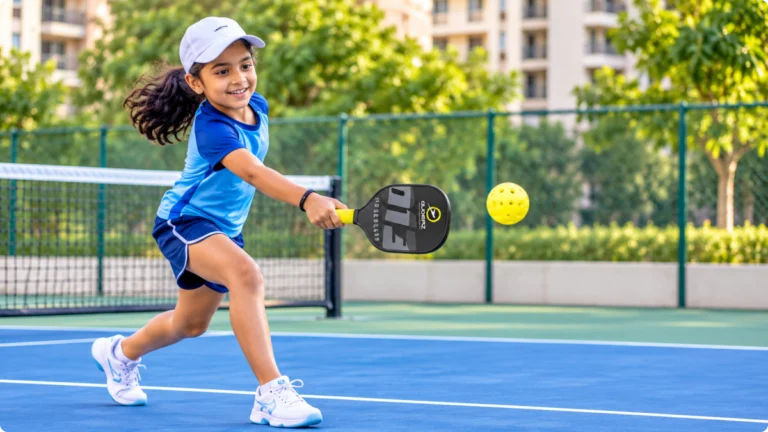
If you’ve ever watched a club-level player glide effortlessly from the baseline to the kitchen while you’re still scrambling to get your paddle up, the difference usually isn’t their paddle skills. It’s their pickleball footwork. Most beginners spend hours working on their dinks, drives, and serves, but the thing that actually separates a player who looks comfortable on court from one who looks rushed is how well they move their feet.
Good footwork does more than help you get to the ball. It helps you reach shots earlier, stay balanced when you make contact, recover quickly after every shot, and position yourself for whatever comes next. It’s the quiet skill that makes every other part of your game look easier. As Pickleball India continues to grow across clubs, academies, and community courts, more coaches are pointing to footwork – not paddle technique – as the fastest way for a recreational player to level up.
This guide breaks down exactly how to move on a pickleball court: the ready position, the core footwork patterns, court positioning in singles and doubles, shot-specific adjustments, and drills you can start practicing this week.
Why Footwork Matters in Pickleball
Pickleball footwork simply means the way you move your feet and body to get into position for a shot – and just as importantly, how you recover afterward. It’s easy to assume this just means “running toward the ball,” but that’s actually where a lot of players go wrong. Chasing the ball in a straight line, at full speed, usually means you arrive off-balance, out of position, and unable to generate a controlled shot. Proper footwork is about controlled, efficient movement that gets your whole body – not just your paddle arm – ready to hit.
Balance is the biggest reason this matters. A shot hit while you’re still moving, leaning, or reaching almost never has the same control as one hit from a stable base. Think about the difference between a dink hit while your feet are set versus one hit while you’re stretching sideways with your weight falling away from the ball. The first version stays low and soft. The second one usually pops up, and at the kitchen line, a popped-up ball is an invitation for your opponent to attack.
Positioning also saves energy. Players who understand where the next shot is likely to go can take smaller, earlier steps instead of sprinting to cover ground they should never have given up in the first place. This matters even more in longer matches or tournament play, where wasted movement adds up over several games.
For beginners specifically, footwork is often the fastest way to improve. A newer player with modest paddle skills but solid movement will consistently outperform a player with a nice-looking swing but poor positioning, because so many unforced errors come from being late, off-balance, or reaching. Footwork and paddle control are connected – you can’t execute a clean shot with your paddle if your feet haven’t already gotten your body into position to hit it.
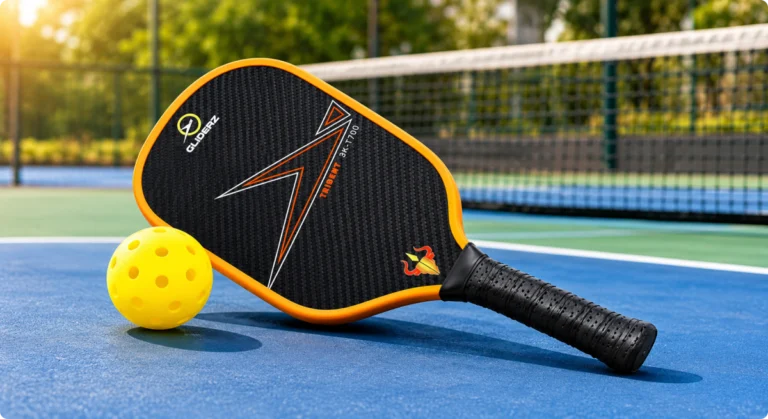
The right pickleball paddles can complement this movement by giving players a comfortable grip, balanced feel, and enough control to make shots without overcompensating with their arms.
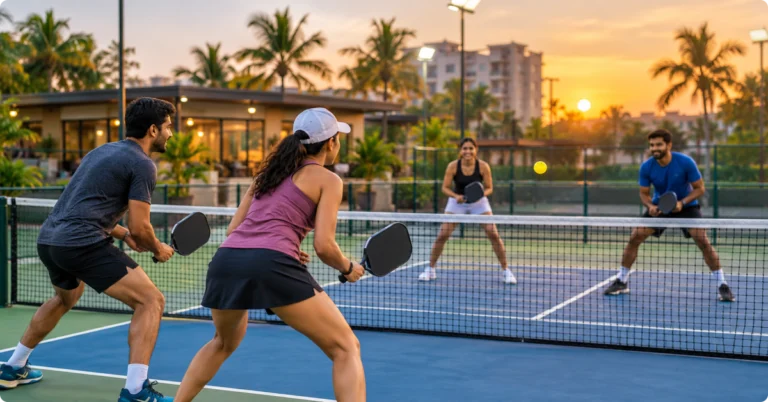
In singles, this shows up as needing to cover the entire width of the court alone, which means recovering to a central position after every shot rather than standing still and admiring your last one. In doubles, it shows up as two players needing to move as a unit – if one partner shifts toward the middle to cover a shot, the other needs to shift too, or a gap opens down the line. In both formats, the underlying principle is the same: move into position before the ball arrives, don’t wait until it’s already there and try to reach.
The Basic Pickleball Ready Position
Every strong footwork pattern starts from the same base: the ready position. This is the stance you return to between shots, and it’s what allows you to react quickly in any direction rather than being caught flat-footed.
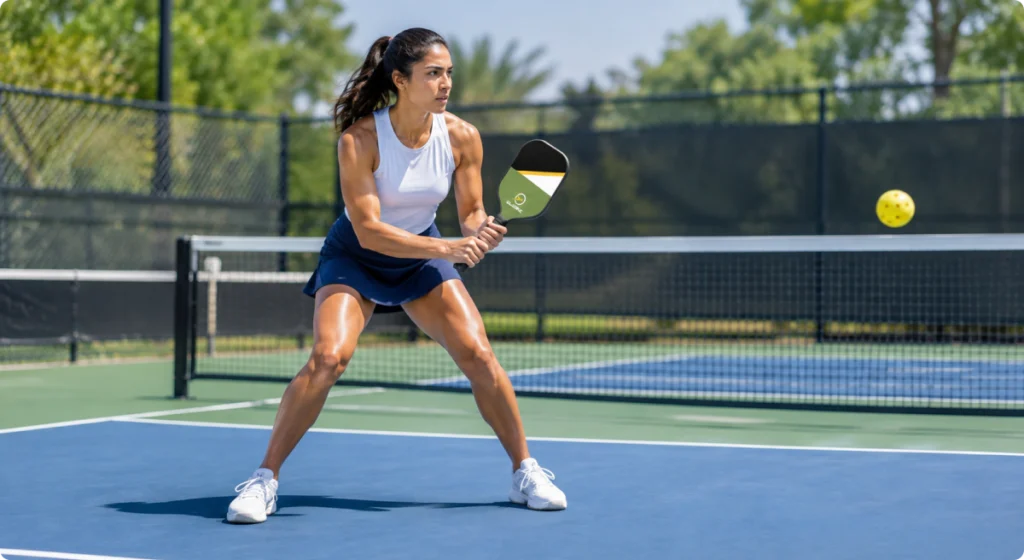
A solid pickleball ready position includes:
- Feet approximately shoulder-width apart, giving you a stable base without restricting movement
- Knees slightly bent, keeping your center of gravity low and ready to push off
- Weight balanced on the balls of your feet, not your heels – heels make it nearly impossible to move quickly
- Paddle held up and out in front of you, roughly chest height, in a neutral position that can block, volley, or dink without a big backswing
- Upper body relaxed, not tense or hunched, so your arms and legs can react freely
- Eyes focused on the ball and the opponent’s paddle face, which gives you the earliest possible read on where the next shot is going
Standing flat-footed is one of the most common habits that holds beginners back. When your weight sits back on your heels, you lose a split second reacting to anything – and in fast exchanges near the kitchen, that split second is often the difference between a clean volley and a ball that sails past you.
This ready stance is what lets you react to whatever comes next: a hard drive that requires a quick block, a soft dink that needs a delicate touch, a volley that has to be redirected instantly, a lob that sends you scrambling backward, or a cross-court shot that requires a fast lateral shuffle. Without a proper ready position, you’re starting every one of these reactions a beat too late.
Beginner exercise: Stand at the non-volley line in your ready position and have a partner or coach randomly toss or feed balls to your forehand, backhand, and body. Focus only on resetting to the ready position after each shot before the next one arrives. Do this for 3–5 minutes at a time – the goal isn’t power, it’s building the habit of returning to a balanced base every single time.
Essential Pickleball Footwork Techniques for Better Movement
Choosing the right pickleball equipment can also support better movement on court. For players searching for Pickleball Equipment India, it is important to consider equipment that feels comfortable, balanced, and suitable for regular play. A well-balanced paddle, comfortable court shoes, and quality pickleballs can help players move confidently while focusing on footwork, positioning, and shot execution.
Split Step
A split step is a small, quick hop that lands with your feet shoulder-width apart just as your opponent makes contact with the ball. It’s not a big jump – just enough to load your legs and interrupt any flat-footed standing. The timing matters more than the height: split as your opponent swings, not after. This tiny movement is what allows you to explode in any direction immediately, whether that’s forward to cover a drop shot or sideways to intercept a dink. Players who skip the split step are almost always a step behind on fast exchanges.
Side Shuffle
The side shuffle is a lateral movement where your feet stay roughly parallel and never cross each other. It’s the go-to technique for moving a few feet in either direction – chasing a dink toward your sideline, covering a gap with your partner, or adjusting position during a rally. Because your feet stay under you the whole time, you keep your balance and stay ready to change direction instantly, which matters a lot at the kitchen line where rallies change direction constantly.
Crossover Step
When you need to cover more ground quickly – like tracking down a wide shot or transitioning from the baseline toward the kitchen at an angle – a crossover step is more efficient than shuffling. One foot crosses over the other in the direction you’re moving, similar to a defensive slide in basketball. It covers distance faster than a shuffle but takes a moment longer to recover balance, so it’s best used for bigger movements rather than the small in-between adjustments near the net.
Forward and Backward Movement
Moving toward the ball should happen on the balls of your feet with short, controlled steps rather than one big lunge. This keeps your body under control and your paddle in position to actually hit a clean shot instead of just poking at the ball. Moving backward – for a lob or a ball hit deep to your feet – is where a lot of players get into trouble by backpedaling quickly and losing balance. It’s almost always safer to turn your hips slightly and take a diagonal step back and to the side, keeping your eyes on the ball the whole time, rather than running straight backward.
Recovery Steps
After every shot, your feet should already be working to bring you back to a strong court position – ideally before your opponent has even hit their return. This is the piece of footwork beginners skip most often. They hit a shot and stand still to watch it, which means they’re static and unbalanced when the next ball arrives. A quick recovery step or two back toward the center of your coverage area, paired with resetting into the ready position, keeps you a step ahead instead of constantly playing catch-up.
Pickleball Court Positioning and Movement
Footwork only matters if it’s taking you to the right place. Good pickleball positioning means understanding the different zones of the court and knowing where you need to be based on the situation, rather than simply reacting to wherever the ball happens to go.
Baseline positioning typically comes into play at the start of a point – during the serve and return. Here, you have more time, so bigger, more powerful groundstroke footwork is appropriate.
The transition zone – the space between the baseline and the kitchen line – is the riskiest area of the court. Balls arrive at your feet here, and standing still in this zone leaves you vulnerable to being hit at your shoelaces. The goal is to move through this area with purpose, usually right after hitting a third shot drop, rather than lingering in it.
The non-volley zone line, often called the kitchen, is where most points are decided. Positioning here is about small, controlled adjustment steps rather than big movements, since the ball travels quickly at close range.
A few practical situations make this concrete:
Example 1: Your opponent hits a cross-court shot from their forehand side. Rather than only watching the ball, you should already be shifting your weight and taking a shuffle step toward that side, anticipating the angle based on their paddle position before contact.
Example 2: You’ve just hit a deep return of serve. That shot buys you time, so you should be moving forward toward the kitchen line immediately, closing the distance while your opponent is still recovering – not standing at the baseline admiring the shot.
Example 3: Your opponent hits a soft dink toward your sideline. This calls for a small, controlled side shuffle rather than a big crossover step, keeping your paddle low and your base stable so you can dink it back with touch instead of popping it up.
Example 4: Your doubles partner drifts toward the middle to cover a shot. You need to shift toward your sideline at the same time to close the gap they’ve left behind – moving together as a unit is one of the most underrated parts of pickleball doubles positioning. Two players standing in their “assigned” spots while a gap opens down the middle is one of the most common ways recreational doubles teams lose points.
The broader mindset shift here is thinking about where you need to be next, not just reacting to where the ball currently is. Strong players are already moving into position while the ball is still in the air.
Pickleball Footwork Tips for Better Dinks, Volleys and Drives
Footwork isn’t one-size-fits-all – the way you move changes depending on the shot you’re setting up.
Dinking Footwork
Dinks are won and lost by small margins, so this is where tiny adjustment steps matter most. Avoid reaching across your body for a dink; instead, take a short shuffle step to get your feet and shoulders square to the ball. Staying low, with knees bent, keeps your paddle face soft and controlled rather than forcing an awkward, reaching swing.
Volley Footwork
At the kitchen line, volleys happen fast, so staying light on your feet – almost bouncing slightly in your ready position – lets you make micro-adjustments as the ball approaches. Big steps aren’t usually needed here; it’s more about tiny weight shifts and a stable base than large movement.
Groundstroke Footwork
For shots from the baseline or transition zone, footwork starts before the ball even arrives – turning your shoulders and hips to prepare, stepping into the shot with your non-paddle-side foot, and transferring your weight forward through contact. This weight transfer is what gives a groundstroke both control and pace, rather than relying on arm strength alone. Recovery back to the ready position immediately follows.
Overhead Footwork
When an opponent lobs the ball, the instinct is often to backpedal in a panic. It’s safer and more effective to turn your body sideways, take a few controlled crossover or shuffle steps backward while tracking the ball, and get fully set before swinging. Backing up dangerously fast, without watching your footing, is how players lose balance or trip during overheads.
Return-of-Serve Footwork
The return of serve is a chance to gain court position, not just get the ball back in play. After returning deep, your feet should immediately start moving forward toward the kitchen line, using the time it takes the ball to travel to close the gap. Players who return the serve and then stand still at the baseline give up the positional advantage they just created.
Pickleball Footwork Drills You Can Practice
These pickleball drills can be practiced at a club, an academy, a public court, or even in a small backyard space with some imagination. Consistency matters more than duration – even 10–15 minutes of focused footwork work, a few times a week, adds up quickly.
- Ready Position Reaction Drill How to do it: Stand at the kitchen line in your ready position. Have a partner feed random shots to your forehand, backhand, and body without warning. What it improves: Reaction speed and the habit of resetting into ready position after every shot. Reps: 3 sets of 15-20 feeds. Common mistake: Watching the feeder’s hand instead of staying in a relaxed, athletic stance.
- Side Shuffle Drill How to do it: Place two cones or markers about 8-10 feet apart along the kitchen line. Shuffle side to side between them without crossing your feet. What it improves: Lateral quickness and balance for kitchen-line exchanges. Reps: 30 seconds on, 30 seconds rest, for 5 rounds. Common mistake: Crossing the feet during the shuffle, which slows recovery.
- Split-Step Reaction Drill How to do it: Have a partner stand across the net and call out “left,” “right,” or “up” at the moment they mimic a swing. Split step on their swing, then move in the called direction. What it improves: Timing the split step to your opponent’s contact point. Reps: 10–15 reps per session. Common mistake: Splitting too early or too late instead of timing it to contact.
- Kitchen Line Movement Drill How to do it: Standing at the kitchen line, practice small adjustment steps – half a step left, half a step right, half a step forward – without ever fully squaring up flat-footed. What it improves: Micro-positioning for dinks and volleys. Reps: 2–3 minutes continuous movement. Common mistake: Taking steps that are too big for the small distances involved.
- Baseline-to-Kitchen Movement Drill How to do it: Starting at the baseline, practice moving forward in controlled steps (not a sprint) to the kitchen line, as if following a third shot drop. What it improves: Safe, balanced transition zone movement. Reps: 8-10 repetitions. Common mistake: Sprinting forward and arriving off-balance and upright instead of low and ready.
- Cone or Court-Line Footwork Drill How to do it: Set up 4-5 cones in a zig-zag pattern around the non-volley zone and practice shuffling and crossover stepping between them in sequence. What it improves: Combining shuffle and crossover steps smoothly. Reps: 5 full sequences. Common mistake: Rushing through the pattern and skipping proper footwork form.
- Partner Reaction Drill How to do it: Rally with a partner at the kitchen line while they occasionally speed up or redirect shots unpredictably, forcing you to react and reposition. What it improves: Real-match footwork under pressure. Reps: 5-minute rally sessions. Common mistake: Reverting to flat-footed standing once the rally slows down.
- Optional Shadow Footwork Drill How to do it: Without a ball, shadow the movement patterns of a typical point – split step, shuffle, dink adjustment, recovery – based on a coach or video calling out shot types. What it improves: Muscle memory for movement patterns without the pressure of tracking a ball. Reps: 5 minutes. Common mistake: Moving too slowly or without real intent, reducing the drill’s value.
Common Pickleball Footwork Mistakes to Avoid
Even experienced recreational players fall into these patterns. Recognizing them is the first step to correcting them.
- Standing flat-footed – Correction: stay on the balls of your feet with knees slightly bent, ready to push off in any direction.
- Watching the ball instead of anticipating movement – Correction: read your opponent’s paddle face and body position to start moving before contact.
- Taking unnecessarily large steps – Correction: use small, controlled adjustment steps for short distances, saving bigger steps for covering real ground.
- Crossing feet when a shuffle would work better – Correction: default to a side shuffle for lateral movement under 6-8 feet.
- Reaching for the ball instead of moving toward it – Correction: take the extra step to get your body behind the ball rather than stretching your arm.
- Moving backward incorrectly – Correction: turn sideways and take diagonal steps rather than backpedaling in a straight line.
- Forgetting to recover after a shot – Correction: build a habit of taking a recovery step and resetting your stance immediately after every shot.
- Moving too early or too late – Correction: practice split-step timing so your movement matches your opponent’s contact point.
- Both doubles partners moving toward the same ball – Correction: communicate verbally (“mine” or “yours”) and practice moving as a connected pair.
- Staying too far behind the kitchen line – Correction: close the distance after a deep return or drop shot instead of camping at the baseline.
- Poor balance during shots – Correction: keep your knees bent and weight centered rather than leaning or lunging into the ball.
- Focusing only on paddle technique while ignoring footwork – Correction: dedicate part of every practice session purely to movement drills, separate from hitting.
Frequently Asked Questions
1. What is footwork in pickleball? Pickleball footwork refers to how a player moves their feet and body to get into position for a shot and recover afterward. It includes the ready position, split steps, shuffles, and recovery movement that keep a player balanced and prepared throughout a point.
2. Why is footwork important in pickleball? Footwork determines whether a player reaches the ball early and in balance, or late and off-balance. Good footwork improves shot control, reduces unforced errors, saves energy, and helps players maintain strong court positioning throughout a match.
3. How can beginners improve pickleball footwork? Beginners should start with the ready position, practice the split step until it becomes automatic, and work on shuffle steps for lateral movement. Simple drills done a few times a week build the muscle memory needed for smoother, faster movement.
4. What is the ready position in pickleball? The ready position is a balanced stance with feet shoulder-width apart, knees slightly bent, weight on the balls of the feet, and the paddle held up in front of the body. It allows a player to react quickly to drives, dinks, volleys, or lobs.
5. What is a split step in pickleball? A split step is a small hop timed to an opponent’s contact with the ball, landing with feet shoulder-width apart. It loads the legs and allows a player to explode in any direction immediately, rather than reacting from a flat-footed stance.
6. How should you move around the pickleball kitchen? Movement around the kitchen should rely on small, controlled adjustment steps and side shuffles rather than large strides. Staying low and balanced near the non-volley zone line helps players react to fast dinks and volleys without overreaching.
7. How can I improve my pickleball positioning? Improving positioning means thinking ahead about where the next shot is likely to go, rather than only reacting once the ball arrives. Practicing recovery steps, communicating with a doubles partner, and closing the gap to the kitchen after a deep shot all help.
8. What are the best pickleball footwork drills? Effective drills include the ready position reaction drill, side shuffle drill, split-step reaction drill, and baseline-to-kitchen movement drill. Practicing these regularly builds the reflexes and balance needed for real match situations.
9. Is footwork important in pickleball doubles? Yes – in doubles, footwork also involves moving in coordination with a partner to avoid leaving gaps in coverage. Both players shifting together toward the ball, while communicating clearly, is essential for solid doubles positioning.
10. Can better footwork improve pickleball performance? Yes. Since footwork affects balance, shot timing, and court coverage, improving it often leads to faster gains than working on paddle technique alone. Many coaches consider footwork the foundation that everything else in pickleball is built on.
Conclusion
Strong pickleball footwork isn’t about being the fastest player on the court – it’s about balance, anticipation, and small, controlled adjustment steps that keep you ready for whatever comes next. From the basic ready position to split steps, shuffles, and recovery movement, every piece works together to help you get to the ball early, hit with control, and reset before your opponent’s next shot. Pair consistent footwork drills with time on court, and the improvement shows up faster than most players expect – in fewer unforced errors, better positioning, and a game that simply feels less rushed.
As Pickleball India continues to expand with more clubs, academies, and recreational players, developing strong movement fundamentals can give new players a better foundation for long-term improvement.
If you’re new to the sport, it helps to start with the fundamentals covered in our What is Pickleball guide before layering on movement and strategy. And once your footwork starts to click, having the right equipment makes a real difference – from choosing the right pickleball paddles that match your playing style to pickleball balls built for consistent bounce and flight.
Whether you’re picking your first paddle or looking to upgrade, exploring GLIDERZ Pickleball Paddles is a good place to start, and if you want something built around your grip and playing style, our custom pickleball paddles option lets you do exactly that. For rule-specific questions on positioning or the non-volley zone, USA Pickleball remains the most reliable official source.
Got questions about paddle selection or bulk orders for your club or academy? If you’re looking to Buy Bulk Pickleball Ball for a club, academy, tournament, or training program, Contact GLIDERZ – our team is happy to help you find the right setup for your game.
👉 “Looking to start playing? Explore GLIDERZ Pickleball paddles – Made in India for Indian players.”